
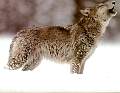
Rabies is a disease that is fatal in nearly all instances once symptoms of the illness are observable. Rabies is acquired through bite or an open wound which is contaminated by the saliva of a rabid animal. The symptoms are exhibited by rabid animals, veterinarians have difficulty in determining the disease. When animals are diagnosed with rabies, the animal may have a jaw and limb paralysis or aggressiveness, and nonspecific findings. The animal may have fever, lethargy, lack of coordination, anorexia, excessive salivation, and hyperactivity.
Domestic animals get rabies from the wildlife. They might get rabies from skunks and raccoons. Skunks and raccons represent the large reservoirs of the diease throughout the country and from bats. Rabies can be transmitted from one domestic animal to another, it can be transmitted to humans. Rabies virus have documented and studied in the gray fox, coyotes, and feral dogs. The vaccine used for doges in NOT GOVERNMENT APPROVED on wolf-hybrids.
The rabies vaccine for wolves and wolf-dogs has been going on for 10 years. The reason that states banned wolves and wolf-hybrids because there is NO rabies vaccine for them. Ther is no action on behalf of a local, state or federal agency to solve this public health problem.
Veterinarians and owners have argued the rabies question of a USDA approval for a vaccine of rabies in wolves and wolf-hybrids. This is a political issue, and this will argue that the already existing dog vaccine for rabies will provide the protective immunity required to the wolf and wolf-hybrid. There are many reason that the USDA requirements must be satisfied. Animals respond differently to different medications. The question is whether wolves and wolf-hybrids need a different level of potency in rabies vaccines than domestic dogs. Another question is what percentage of effectiveness required to obtain USDA approval and licensing of the rabies vaccine for ruse in these animals. The last question is if your family and other animals came in contact with rabies, and they don't require the level of protevtive immunity for wolves and wolf-hybrids.
People who deal with wolf-hybrids promote the content of hybrid pups. They set the prices to their amount of wolf blood in the hybrid litter. This is not base the hybrids biology or genetics. If the hybrid pups parents are a pure breed dog and a pure breed wolf, the pups inherit a set of genes from each parent. The pups are 50% wolf and 50% domestic dog. If the hybrid pups are breed with other animals, there is no way to calculate which genes are passed to the offspring. The offspring may inheir a majority of the genes of a dog. They will inherit the genes of a dog both physically and behaviorally. If the pups would be dominatly wolf, the combination of the genes would be in-between. The wolf-hybrid would look like a dog and has the nature of a wolf.
Wolf-hybrids spans a continuum. SOlf wolf-hybrids act like dogs, and some wolf-hybrids act like wolves. Other wolf-hybrids fall somewhere in between a dog and a wolf. Other wolf-hybrids may have a behavioral and physical traits of both.
To have a high percentage of wolf-cross, you must have two wolves that behave indentically and are pack animals. The wolves have a strong sense of pack identity, and also have a tendency to ahve a wolf social behavior, language and other wild behaviors. The wolves are a ditance of strangers, afraid of strangers, not a positive of new situations, and are not trainable. They are less aggressive and sometimes submit to people or other animals. They feel that they not not concerned or haven't run away from them.
Wolves and content of high wolf-crosses are very opposition to violence and war. The reason is they rather give in or run away from the situation if they are given the opportunity. High content wolf-crosses are loving to other dogs, wolf-hybrids, people or even cats. That is so if they have been raised with these things. IF a high content wolf-crosses are a year old or older, the ability to form a dond decreases. Wolves and high percentages wolf-crosses form bonds differently to species, not to individuals of the same species. If a wolf-hybrid is raised with another dog, it accepts that same dog as its own species.
A high content wolf-hybrid is intelligent. The intelligence is not aimed at you. People will buy a wolf-cross to thin that the dog is macho. They come to find out that the wolf-cross is afraid of the new situation it is in. A high-content animal is different psychological need from a dog. They are used to being in a pack and nees another animal to have as a companion. The person cannot be a companion to a wolf-cross only antoher wolf-cross. The other animal provides security to the first wolf-cross. These animals should be kept in a pen. These animals need a place to call their own. They love to explore, get loose, apt to take an extended holiday and without feeling that people are not going to shoot them. Wolf-hybrids should NEVER be chained or put on a run. The animals can by unhappy, then can be easily escape, and allow anyone to right up the animal.
Mid-percentage and low-percentage crosses is a different animal. These animals look like a wolf. These animals have floppy ears, short legs, curly tails, dog-like markins and so on. These animals maybe protevtive and not afraid of strangers. They bark and show some wolf-like behaviors. Most of there behaviors are similar to those in dogs. A lot of animals fall in this category.
High-percentage animals posses the intelligence and strength of the wolf and posses social inhibitions against agression. Lower content animals have a wolf body, but they have a dog brain. People think that the wolf genes makes an animal upredictable. A dog can be agressive and can be preserved. High-content animals ahve the skil to understand that fighting and aggressive biting in the wolf society. Domestic dog or low- or mid-percentage animals lack this skill. Low-percentage animals can have problems. They are likely to be aggressive and billed as dogs.
It is very difficult to describe the behavior of all wolf-hybrids. Wolves and wolf-hybrids are like people. They(the wolves and hybrids) are very individualistic. They have individual personalities, likes, dislikes, quirks, and changing moods. Two different people might share different common behacioral traits, but there will be a certain amounty of scope between the people. Wolves and wolf-hybrids will react to the same situation as the two different peoople will react to the same situation. In the same animal, behavioral patterns are always adapting to different situations.
If you ahve a wolf-hybrid with low content of a wolf, the wolf-hybrid will exhibit doggy-like characteristics. If you have a wolf-hybrid with high content of a wolf, the animal may exhibit some or all of the behaviors that a person might find in a pure wolf. The wolf has a social skill. It is possible for the wolf or wolf-hybrid to form social bonds with humans or other animals if properly socialized. Behavioral problems that come about do so is that people do not understand that socializing a wolf or a wolf-hybrid is more intense process that with a domestic dog.
A wolf-hybrid mostly will still have its ancestor' wild behaviors in one form or another. Wild necessarily does not mean bad. One must accept that a wolf-hybrid will have a different personality of its own. Most of the wolf-hybrids are independent or at some distance and mostly their personality will resemble a cat or a dog. The wolf-hybrids can be destructive toward a peson's property. Also, the wolf-hybrid will require more attention than a dog. The wolf-hybrids can take longer to mature. They take 2-3 years to mature. The wolf-hybrids may or may not be trained to perform doggy-like duties. The wolf-hybrids eat your favorite stuff, jump around to greet you, play rough, jump on your furniture, and they may howl. If you are willing to pat the price of a wolf-hybrid, it means that the owner will expect to put up with the behavior that would be considered unaccepted for a dog. Certain behaviors can be modified or shaped. You must not change the nature of an animal that is essential. People are wrong to expect a wolf-hybrid to have the same standards of behavior that you have a domestic dog standards.
A dog will retain its puppy-like traits throughout its life. It has been breed to take orders without second guessing the orders. The domestic dog will follow you till you die and no matter how the dog is punished. The wolf or wolf-hybrid is interested in its own welfare. The wolf or wolf-hybrid may take your order but will do your order when it feels like it. The relationship between a wolf or wolf-hybrid and a person is because of mutual respect. The wolf or wolf-hybrid trusts you because you ahve taken the time to understand the elements of the wolf society.
There are two categories that the behavior of a wolf or wolf-hybrid that it falls into. There is a cutoff point that which a low wolf content wolf animals act and look like dogs. This is with a few wolf behaviors and physical characteristics. A higher percentage animals act and look like a wolf. The wolf-hybrid with a lower percentage of a wolf will have a mix of wolf and dog behaviors, they often lean toward the dog spectrum. There are not many animals that look like a wolf that behave like a dog. It doesn't seem to occur. The crossing of a wolf and a dog results may be an opposite effect what it was originally intended. Wolves are very distinctive from a dog. The wolves have a narrow, lanky, have a fluid movements. The biology of a dog and woves are totally different. To understand this is to study pictures of a wolf and pictures of a dog. There are distinctive differences.
Their are body languages in a wolf pack. This establishes relationships between wolves that will benefit the pack. Alpha pair wolves will place their paw or head on the subordinates shoulders or grasp the muzzle of the inferiors in hi saw as an act jof playing. This is a reminder that he is the boss.
Wolf communication can involve positions of the ears, tail, and lips are important. A relaxed, alert wolf(dominant agressive) wolf will carry his ears up. A wolf that is submissive or fearful will pin his ears back against the skull. A wolf that is agressive will carry his tail straight behind. A wolf that is submissive will tuck his tail between his legs. A wolf that is fight ready curls his lips back fully, bares his teeth, stares intently, and raises his hackles. He my growl or not growl.
A wolf that is submissive will avoid eye contace with the dominant members of the pack. This may turn them away from their betters. Ingerior wolves will crawl to their superiors. They will mimic the cubs behavior of soliciting food by licking the muzzle of the dominant animal. The wolves will lie on the ground and expose their bellies to the alpha wolf. This will cause the alpha wolf to urinate to state their acknowledgement that the alpha is truly the top wolf.
The purpose of the social behavior will increase the hunting prowess and will ensure the survival of the pack and the wolf species. Wolves cooperate with each other when they go hunting. Two or three wolves will watch the prey whil the rest of theh pack relaxes and plays. The hunt resumes and some of the wolves will leave the pack and circle around a moose or elk ready to ambush it. Wolves may encircle an animal of prey floundering in deep snow waiting on it to tire and collapse. This behavior will judge the wolf as cruel or gentle and loving type of wolves. Wolves are animals that are equipped to survive in an environment that is harsh.
The Canis lups is an endangered species. When you captgure a wild wolf for any purpose, you are capturing the wolf ILLEGALLY. Before it cam illegal, people were established wolves as a colony and reproducing wolf-hybrids.
The wolf is a shy animal. The wolf is a fierce animal that needs to fit into a pack of hierarchy and depending on the body language and facial expressions and depending on hunting for survival. The state of a wolf is considered a challenge that will brin on attack if the animal cannot flee. The wolf jaws are stronger than a domestic dog, and this will exert dominance.
Never leave the wolf hyubrid alone with small children. Remember that stare ate challenges and the baby will lose every time. The hybrid will consider the child for fair game if the child screams, cries, and make quick movements. These are considered as prey characteristics. Obedience training is a double must.
There is no way to predict a behavior of a hybrid, wolf, or a dog's behavior. If you want to become a hybrid owner, please read as much as you can of wolves and wolf-hybrids. You need to read to recognize and deal with the various stages of their body languages, facial expression and the dominant or submissive behaviors they may encounter. The hybrid maybe spaid or neutered to prevent bredding. To put hybrid puppies in appropriate homes is a great responsibility. This is a great responsibility than dealing with dog pups.
The hybrid is not considered a guard dog. There are more subordinate wolves than alpha wolves. Most wolves don't bark and a hybrid with a wolf behavior is more likley to flee rather than being a guard dog. Female wolf-hybrids are less likely no to get along with female domestic dogs. Male wolf-wolf hybrids are not likely to get along with male domestic dogs. There is a legal notice regarding wolf-hybrids that carries them over to coydogs, the coyote-dog hybrids. These are more common as coyotes that are spread throughout the country. Coyotes are solitary animals that are not attuned to pack living. These problems are encountered with these hybrids that are greater than those of wolf-hybrids.
To own a wolf-hybrid varies from state to state. Please feel free to e-mail to have the regulations of your state on having a hybrid. Wolf-hybrids are classified as wild animals in some states. You have to possess a certain type of permit and caging as for a pure wolf in some states. Wolf-hybrids are considered as dogs and needing only the proper vaccinations and licenses in other states.
I obtained the following information from Ken Riddleberger who deals with this stuff for the state of Georgia. If you don't understand the laws, you can e-mail him at Ken_Riddleberger@mail.dnr.state.ga.us
He told me that there are strict conditions on hold any wild animal in Georgia. They may only be held for exhibition purposes or as part of another wild animal business. The license is $236 annually and includes many other stipulations. These permits are not issued for pets.
He is not sure on how holding wolf HYBRIDS protects the wild wolf population from extinction, but that is besides the point. In the case of wolf hybrids, they are not allowaed in Georgia for two reasons: (1) There is not an approved rabies vaccine for wolf hybrids. In fact, there are several documented cases of where wolve hybrids were vaccinated and later contracted the the disease. (2) Wolf hybrids can be unpredictable and dangerous.
By Georgia law, any hybrid or cross between any combination of wildlife (those wild creatures native to the state) or wild animals (wild animals not native to Georgia), and domestic animals. Therefore, wolf hybrids are considered wild animals and may not by legally held without a permit. Are people holding wolf hybrids without permits? UNDOUBTEDLY Are they in violation of the law? DEFINITELY
I got the background from the following site:
