
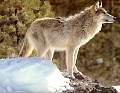
Wolf-dog crosses have been around for years. Wolf-dog crosses are also known as wolf-hybrids or just hybrids. Before Europeans set foot in North America, Native Americans were in close area with the wolves. Native Americans keept wolves and wolf-hybrids as companions. In the Artic, the Intuit used wolf-hybrids as pack animals and sled dogs.
The term wolf-dog has been around since 1736. For at least 260 years, the term wolf-dog has been know to the Europeans. The Native Americns knew this term for years. In the late 1960's and 1970's, the hpublic and scientific interest in the wolf blossomed. Human beings desire got closer to the magnificent animal.
In the 1980's, wolf-dog crosses were very expensive, hard to get, and most of the wolf-dog crosses were owned by people with more than a casual interest in wolves. A few people obtained pure wolves, but the Endangered Species Act provides a penalty for the possession of pure animals. Most states have a difficult permit requirements for wild animals that prove to be impossible to comply with. The wolf-hybrid can be legal and sometimes the behavioral alternative to owning a pure wolf.
In the mid 1980's, there were a lot of animals in the hand of the public for a large breeding stock. The wolf popularity continued to skyrocket, and everyone wanted a wolf-hybrid. There were several Walt Disney movies for inspirtion; and enough animals aroung that everyone wanted one could easily obtain one. Backyard breeding becamie the norm of breeding dogs with wolves. Human beings bred their animal without regarding to their temperament or genetics. Most of the breeders did retain their honesty and keep breeding good tempered animals, but this is the exception rather than the rule. A large number of people realize they make a lot of money by breeding anything that almost looked like a wolf and passing the spring off as a high percent cross. High prices were charged and were paid for animals that were really supposed to be 90% wolf, but the animals were really 10% or 20% wolf content at best. This practice was and still is a FRAUD. People would end up with animals that were low percentage, and be more agressive.
There is a large number of wolf-hybrids being sold. There are bans in many states, therefor there is still a flourishing wolf-dog population. The way the currents laws address the situation, there will be for years to come. Most states don't want to make the trouble of people of owning a wolf-hybrid. The resulted outright bans had little effect witht he exception of removing high-visibility advertising from newspapers and magazines.
The number one reason of these bans is that people buy an animal on whim and realize later that it is illegal, and they end up dumping the animal and having gthe animal euthanized, or taking the animal to a sanctuary. Whim is a sudden fancy or caprice. The animals may end up in local and state officials hands. If people want something bad enough, they will find a way to get it--no ban or ban. Some people don't care if it is illegal or not; they are going to buy a wolf-hybrid anyway.
In this day and age of political and environmental correctness, scientific institutions doesn't want to deal with the hybrid situation because of the controversy. A few organizations have moderatied their stance and tolerate hybrids, and there are several other small refuges scatterd around the country. Most of the refuges are in the west.
Wolf-hybrid consists of the offspring between a wolf and a domestic dog. Some wolves may come in contact with a Siberian Husky, Alaskan Malamute, or a German Shepherd dog. The majority of the wolf-hybrid resulted from the breeding of two animals that are wolf-hybrid themselves, and not an F1 crossing of a pure wolf and a pure dog. The genetic material is almost identical to that of a dog. A wolf-hybrid is completely gertile. Few wolf-dogs are produced from a wolf stock.
Training methods are different from a domestic dog to the various Canis Lupus subspecies. A wolf is defined as a wild animal. The wolf is deeply imbedded in man's cultural and natural history through fairy tails, folklore, and an ill-advised battle against natural predators. The wolf is considered brave, fearless, and admired. Also, the wolf is held up as a model family as efficient and loyal. The wolf is feared by people who misunderstand their needs. The wolves are lobed by ecologist, and disliked by cattleman and sheepmen. Human beings will believe anything about this creature. They will believe that the wolf is related to northern breed of dogs. They will not believe the wolves are not related to their beloved Poodles, Beagles, or Labrador Retrievers.
Through scientific research, dogs are descend from several subspecies of wolves scatterd throughout the world. A long time ago, wolves probably became camp followers, taking advatnage of the scraps of food around the fires and caves of prehistoric man. Man probably brought wolf offspring into the family to raise, and probably taken advantage off the wolf's ability to hunt and guard the campsite. Through a thousand years, the preference for wolves of certain physical characteristics and through genetic mutations, Canis lups became Canis gamiliaris.
Wolves and dogs have much in common. Northern breeds of dogs--the Alaskan Malamute, Akita, Chow, Siberian Husky, and related breeds--are close to the wolf appearance. They have a double-coat of hair with plush undercoats for warth and coarse outer coats for protection against wind, rain, and snow. A lof of these breeds have wild coat coloring. They tend to have broad heads with plenty of brain space. Their brain capacity, muzzle -length, and strength of jaw are less than that of their progenitors. Wolf mature physically at a later age than dogs. Femals have their first estrus at two years old or older. They cycle once a year in later winter. Males mature at age three or later.
Dogs develop from nothern wolves that tend to be substantial canines. There are wll-muscled and well-suited for huntin large game(Akita), herding reindeer(Samoyed), and pulling sleds(Alaskan Malamute and Siberian Husky). Dogs in the southern climes tend to have short coats and be more streamlined than their northern cousins. Sight hounds(Afgahn Hounds, Salukis, Basenjis, and Greyhounds), dingoes and pariah dogs fall into this group.
Mastiff-type dogs are developed a result of gigantism orginating in populations of mountain wolf in northern India or Tibet. Some breeds have developed from the northern, dingo-pariah, and mastiff groups, and some with a mixture of dwarfism genes.
Today, wolves are endangered species wherever they live. They are not endangered in Alaska and Canadian Arctic and subartic where they appear to flourish in the midst of the caribou. Attempts are beding made to reintroduce wolves to their former territory. THis might serve as a natural predators for deer, elk, and other hoofed animals with burgeoning populations.
Wolf-hybrids are usually mixed with Malamuted, Husky, or German Shepherd. Wolf-hybrids can occur naturally in the wild. This happened infrequently due to the territorial nature of the wolf. Hybrids can be the result of deliberate breeding in captivity.
Dogs can take training courses and can be housebroken. Wolves do not train wel and cannot be housebroken. THis is part of their territorial nature, and this will eliminate their territorial marking. Wolf-hybrids can call anywhere between these two extremes.
A wolf-hybrid will make a beeter guard god. Hybrids usually make poor portotection dogs. Aggressive tendencies(if any) may be present in the hybrid maybe fear induced and can be very unpredictable and very hard to control.
Wolf-hybrid may live longer than a dog. The life span of a wolf-hybrid in captivity is 12-14 years. This is the same as a large dog.
Wolf-hybrids are healthier than a dog. The wolf-hybrid is less prone to diease than a dog. Wolves and dogs are prone to the same dieases. Wolves and wolf-hybrids CANNOT use the SAME VACCINES of a typical dog.
Siberian Husky and Alaskan Malamute are part wolf. Siberian Husky and Alaskan Malamute are breeds of dogs. These two dogs are no more related to wolves that any other breeds of dog, such as labrador Retriever and Standard Poodle.
Another myth is a long-standing myth. The wolf will regard you as another wolf. This myth is only partly true. The wolf has enough smarts to realize that you are not a wolf. A good amount of wolf social behavior and body language will be directed toward you, and you will be expected to comply with many of the rules of pack behavior. The owners cannot aknowledge this fact that will be unhappy.
