
 a t r i c k
a t r o n
a t r i c k
a t r o n  a i n t
of I r e l a n d
a i n t
of I r e l a n d 
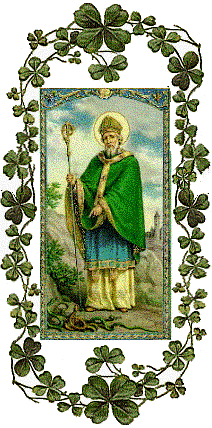
The patron of Ireland, Patrick was a bishop and missionary. He was born in Roman Britain and, at the age of 16, was captured and sold into slavery in Ireland. Ireland at this time was a land of Druids and pagans. He learned the language and practices of the people who held him.
During his captivity, he turned to God in prayer. He wrote "The love of God and his fear grew in me more and more, as did the faith, and my soul arosed, so that, in a single day, I have said as many as a hundred prayers and in the night, nearly the same. I prayed in the woods and on the mountain, even before dawn. I felt no hurt from the snow or ice or rain."
After six years of labor as a shepherd, Patrick escaped back to Britain at the age of 22, determined to convert the Irish to Christianity.
Patrick had a dream in which the people of Ireland were calling out to him "We beg you, holy youth, to come and walk among us once more." He began his studies for the priesthood. He was ordained by St. Germanus, the Bishop of Auxerre, whom he had studied under for years. Later, Patrick was ordained a bishop, and was sent to take the Gospel to Ireland. He arrived in Ireland March 25, 433, at Slane. One legend says that he met a chieftain of one of the tribes, who tried to kill Patrick. Patrick converted Dichu (the chieftain) after he was unable to move his arm until he became friendly to Patrick.
Patrick began preaching the Gospel throughout Ireland, converting many. He and his disciples preached and converted thousands and began building churches all over the country. Kings, their families, and entire kingdoms converted to Christianity when hearing Patrick's message. Patrick by now had many disciples, among them Beningnus, Auxilius, Iserninus, and Fiaac, (all later canonized as well). Patrick preached and converted all of Ireland for 40 years. He worked many miracles and wrote of his love for God in his 'Confessions'. After years of living in poverty, traveling and enduring much suffering he died March 17, 461. He died at Saul, where he had built the first church.
Patrick was a humble, pious, gentle man, whose love and total devotion to and trust in God should be a shining example to each of us. He feared nothing, not even death, so complete was his trust in God, and of the importance of his mission.
Saint Patrick, c.389-c.461

"The Shamrock"
Shamrock is the common name for several unrelated herbaceous plants with trifoliate leaves. White clover, was the original shamrock of Ireland. Saint Patrick used the shamrock leaf to symbolize the Trinity, in his teachings to the Irish people.
This is why the shamrock is worn by the Irish on March 17 to commemorate Saint Patrick's Day.
Back
Next
Home

Celtic Clip Art
Anne's St.Patrick's Day Gifs
