
 Home About
Us Newsletters Calendar SchoolsCrossCountry Photos Information Contacts Links
Home About
Us Newsletters Calendar SchoolsCrossCountry Photos Information Contacts Links 
Welcome to this special edition of Norths News. I hope you enjoy reading all the items sent in as much as I did. We have stories from competitors, officials, volunteers and spectators (both those who went to Sydney and those who sat in front of the tv), and some great photos. I was fascinated to see how different each piece was and how many different aspects of the Games were covered.
My heartfelt thanks to all those who responded to my request for articles and photos.
While most of this newsletter focuses on our Olympic and Paralympic experiences, items covering our current and forthcoming activities are still reported, so make sure you catch up on the current news as well as enjoying those special memories.
Inside this issue
Welcome to new members
We're pleased to welcome quite a few new members who have joined North Canberra at the start of the track and field season. Some of you have progressed up from the ranks of Little Athletics, some of you have come to Canberra from interstate, and others have a re-awakened interest in athletics post-Olympics. We hope you enjoy your time with the club. Please don't hesitate to contact us (either one of the committee, or one of the club captains) if you have any queries or problems. We will do all that we can to assist.
Club captains
Patrick Mossop and Clinton Bebb have been appointed North
Canberra club captains for the summer season. Clinton and Patrick will
be helping to organise relay teams at each interclub competition, so if
you'd like a run please go and see them. Please also let Clinton or Patrick
know if you are experiencing any problems at the track, or would like some
advice - they're a couple of very approachable young men who are only too
willing to help.
Recent results
A swag of pb's
The start of the new season, following straight on from the Olympics and Paralympics, seems to have inspired a number of our athletes. Being Statistician for ACT Athletics has some advantages at the club level - I have access to all last year's rankings and can quickly identify athletes who have improved on their best performances of the 1999-00 season. Congratulations to the following who have all registered pb's in the first weeks of interclub:
Alice Coddington has achieved pb's in three events - 13.60 in the 100m (previously 13.63), 28.05 in the 200m (28.61) and 9.96 in the triple jump (8.79)
Brandan Galic has bettered the 200m time of 24.12 he did in the Pacific Schools Games in May, bringing that down to 23.78.
David Weir has also reduced his 200m pb from 24.96 to 24.80.
James Schofield has added 3m to his discus pb, throwing 31.25m.
Jeffrey Boreham added 5cm to his high jump pb, now at 1.60, and has just snuck past his previous pb in javelin, adding 13cm to bring it to 46.34. Joel Pearson has taken nearly 2 secs off his pb in the 400m, bringing it down from 57.99 to 56.03.
John Jakeman has registered pbs in both sprints - 11.64 in the 100m (down from 11.74) and 23.32 in the 200m (23.44).
Megan Perry shaved 2 hundredths off her pb in the 200m, which now stands at 28.93.
Patrick Cape has added 9cm to his previous best in the long jump - now at 4.88m.
Scott Crowe must have been keeping fit in the off-season. His 100m time has improved from 11.97 to 11.40, his discus from 29.82 to 35.68, and his shot put from 12.33 to 12.54. We don't have any times for new member Dean Folino from last year, but Dean has improved on his performances on each occasion he has hit the track this season - he brought his 200m time down from 27.75 to 26.91, improved his discus by 11cm to 26.21, and his long jump by 30cm to 4.32m. Points galore There have been plenty of points being gained by our junior members in the first weeks of interclub. Jeffrey Boreham is continuing on from where he left off last season, already reaching 222 points and standing second on the ACT list. Eleven other athletes have already amassed more than 100 points - Dean Folino (222), Jan Legg (175), Alice Coddington (172), and Brandan Galic (159), Scott Crowe (154), Jeff Wray (145), Brendan Watt (122), Harry Guinness (109), John Jakeman (103), Pepe King (102), and Thomas Bush (101). The Under 14 boys are having a close tussle with SCT, and if we can field some relay teams in the coming weeks we should be able to pull ahead.
Seven records in eleven days for Crake by John Harding
On the 14th November, Australian mountain running representative Paul Crake achieved his seventh race record in just eleven days when he shattered the Mt Ainslie Run Up record held by national champion Daniel Green. Despite the sloshy condition on many sections of the fire trail up Mt Ainslie, Crake clocked 10 minutes 11 seconds to better Green's record by 3 seconds and is hoping that a faster surface in the future may allow him to break the 10 minute barrier. The previous Friday, the 10th November, Crake became the first runner to crack the 7 minute mark in the AMP Sydney Tower Run Up. This was in spite of having had little time to recover from an arduous campaign in the Victorian Alps which saw him break the overall race record and the individual race record for each of Mounts - Porepunkah, Feathertop, Hotham and Buffalo in the Four Peaks Alpine Classic. The Classic is staged over four days leading up to Melbourne Cup day and Crake's winning time of 3:56:44 was the first time a runner had bettered 4 hours in the 21-year history of the race. It was also a 25 minute improvement on Crake's winning time in 1999.
All Schools Competitors
Five North Canberra juniors will be heading to Adelaide in December to contest the Australian All Schools Championships and we wish them every success. Our under 14 competitors are James Southgate in the 800m, and Brandan Galic in the 100m and 200m. We have three competitors in the Under 18 agegroup - Scott Crowe in the long jump, Connel O'Neill in the hammer, and Katira Davis competing up an agegroup in the 2000m steeplechase.
Travel subsidies
A timely reminder to all athletes (and their parents) that subsidies are available to athletes travelling interstate for national competitions - requests for assistance should be directed to the club treasurer, Barbara Wagstaff, or through any committee member.
World half marathon championships
Shaun Creighton was a late addition to the Australian men's halfmarathon
team which contested the world championships in Veracruz, Mexico on Sunday
12 November. Shaun was third Aussie home in a time of 1:08.12, coming in
43rd from 122 starters. Congratulations, Shaun!
Sponsorship
Many of our newer members may not be aware that North Canberra, along
with many other clubs in the ACT, receives support from The Runners Shop.
Each time you make a purchase, let the staff know you are a North Canberra
member and a percentage of the sale will be donated to the club. The Runners
Shop is open 7 days a week at 76 Dundas Court, Phillip.
Now let the Olympic stories begin....
I think the most appropriate way to both begin and end our Olympic stories
is with two articles written by our Olympics competitors.
Sue Hobson In September 1993 I joined in the all night
party at the AIS to hear the announcement of the host city for the 2000
Olympic Games. It was an exciting time and I too was caught up in the euphoria
of the occasion. Back then I was wondering whether I should become a volunteer,
or just buy tickets for events. After all, I would be 42 years old in the
year 2000, so competing didn't seem an option. I remember at the Closing
Ceremony of the '92 Olympics in Barcelona stickers were being handed out
with "see you in Atlanta" on them. I thought no way, I'd be too old. All
of this happened BC (before children) when my plans were to retire from
competitive running once we started a family.
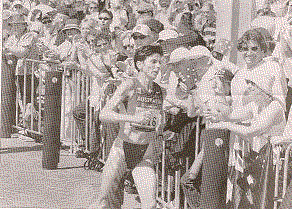
So, here I am in December 2000 reflecting on my experiences as a Sydney Olympics competitor for the Norths newsletter! A lot of hard work, many times in training over the last two years when I wondered if it was all worthwhile, and a body still recovering from running a marathon with a bit of an injury. But there is no doubt whatsoever that it was all worthwhile.
My reason for getting back into racing shape after Cassidy was born in 1998 was to run the marathon in Sydney. It was my dream to run through the streets of Sydney in a home Olympics marathon. I felt competing in an Olympic Games in our own country would be very special, and different to the previous two I had been to. What I didn't realise then was just how different and special the occasion would be.
From the moment we (being the Track and Field team) moved into the Olympic village on 14 September you could feel the excitement about the place and the incredible enthusiasm of the volunteers. A group of us went for a run the next morning around the village and Olympic Park. We were treated like heroes. There were continual calls of "good on you", "good luck" and "go Aussies" as we ran. We were allowed to run straight through security points so we didn't have to stop. It was so uplifting. Imagine if you could have this sort of support every time you trained - it would be a breeze. The volunteers just made us feel very special and couldn't do enough for us. Mind you, there were occasions when we used this to our advantage and got away with just a couple of naughty things.
On the night of the Opening Ceremony we had to walk from the Superdome, where the athletes had been waiting for a couple of hours for our moment, to the stadium. As soon as the Australian team left the Superdome the atmosphere was electric. Volunteers lined the road for that 500m walk and cheered. Andrew Gaze was in his element and was just fantastic, running up and down the length of the team waving the Australian flag. And then we hit the tunnel leading into the stadium - it was lined with performers from the Opening and more volunteers, all yelling their lungs out, in a tunnel! The noise was unbelievable, the atmosphere just amazing.
It's very hard to describe how you feel as you enter the stadium in an Opening Ceremony, let alone in your own country. It's a combination of great pride, excitement and even nervousness. You feel like you might burst. For years I had imagined this moment, and for the preceding couple of days we had talked about it a lot. I was not disappointed, and the moment was everything I had dreamt it would be. To be then standing there in the middle while all the formalities of the Opening Ceremony took place was very special, and the symbolism of it all did sink in. I could have put my arm out and touched Shirley Strickland as she ran by with the torch, carrying the same flame I had carried in Canberra ten days earlier. I just wanted to stand there and absorb it all so I would never forget the moment. It took me a long time to get to sleep that night!
Nine days later I entered the stadium again, this time very very sore and with mixed emotions. So disappointed with my performance and yet so uplifted and emotional because of the near capacity crowd who stood up and cheered me in. The result was not what I had hoped for but the reception was more than I had imagined it would be. Despite the race being my slowest and most painful marathon, it was still an amazing and very positive experience. For two and a half hours I raced through the streets of Sydney with people lining both sides of the course (five and six deep much of the way) for probably 40 of the 42 kilometres. For the entire journey there were screams of "Aussie Aussie Aussie" and "Go Susan", even towards the end when I was in 35th place and obviously struggling. When I reached the motorway at about 38k where the crowds were pretty thin due to the access, it hit me how quiet and peaceful it was. I also realised I had a headache, probably from all the cheering so close to me for the last two hours or so. But I was looking forward to getting into the Olympic Park precinct and the crowds again - I needed all the help I could get to carry me through those last few kilometres.
It also took me a long time
to get to sleep that night, but mainly because I was so bloody sore! But
that soon passed and I am left with vivid memories of the most amazing
fortnight in my lifetime. It was with a feeling of great sadness that I
walked out of Stadium Australia on the first of October after the Closing
Ceremony. I knew this experience could never be repeated. I feel very privileged
to have been able to participate as a competitor, and grateful that my
body hung in there - almost.
Some memorable moments
James Southgate
My most memorable moment in the Olympics was watching the underwater
shots of the waterpolo games. I was amazed at all the antics going on underwater.
Waterpolo looked like such a fun sport that I have taken up playing it
at the AIS Waterpolo school now.
Martin Bye Unfortunately I was working almost all the time it was on, but I did manage to see some of it.
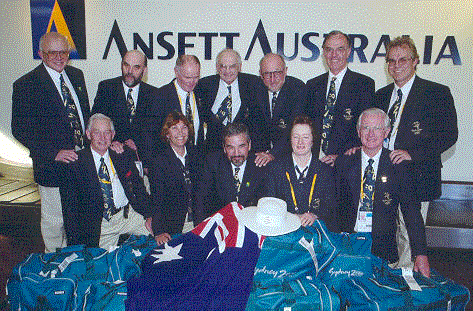
Official view
Hugh McGowan
There
were many memorable moments at the Olympics and Paralympics. The two that
really stand out are:
Dudley Scoullar I attended the Olympics as a spectator and the Paralympics as a track and field official, and wouldn't have missed either event for all the tea in China! A couple of incidents that occurred during my officiating will remain in my memory forever were:
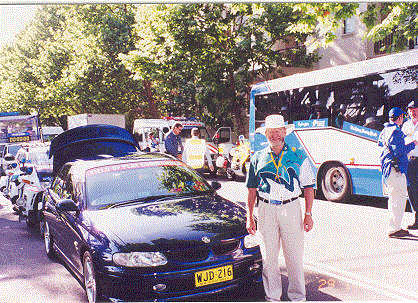
Owen Henness Citius Altius Fortius (Faster Higher Stronger)
I looked at those words every day and watched the athletes as they tried to be just that. As one of the fortunate ones to be selected as a Technical Official for the Sydney Olympic Games it was truly something beyond all my earlier dreams to be able to take part in Sydney 2000. The motto didn't say anything about sportsmanship but occasionally in the lead-up to this magnificent event someone would utter the word possibly with the expectation that all competitors would comply.
What struck me most was
the true sportsmanship of the Australian people who either filled or partly
filled that vast stadium for each session of athletics. Could you imagine
a crowd at the MCG, SCG or at any other cricket ground sighing with heartfelt
disappointment if a catch from an Australian batsman was put down by an
MCC slips fielder? No, it would bring a cheer almost to rival another gold
medal to Australia. Yet I heard this time and time again at the Olympics
and again at the Paralympics.
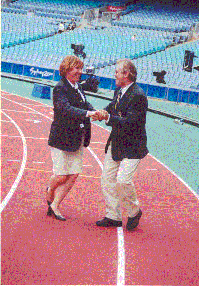
If an athlete from anywhere but Australia was on the runway or in the throwing circle and asked for some rhythmic clapping from the spectators to give them that bit more to do something outstanding, the crowd responded. Likewise if an athlete walked into the throwing circle and on the big screen was seen to put her finger to her mouth suggesting that she would like complete quiet, then the crowd was quiet. Why didn't we all sit on our hands and let the athlete do their best or worst or why not break the silence at an appropriate time? After all these athletes were competing against Australians and were trying to deny them medals, gold medals. But what of the subsequent result. A foul throw or jump, a distance not so good received a sigh almost expressing that the crowd wanted something better. However, when it was an Australian athlete the clapping appeared to be a bit more enthusiastic, the quiet even quieter and the sigh expressing even more disappointment.
This touched me. In spite of how I might come across I have always enjoyed good sportsmanship and this was the ultimate by one-eyed Aussies. They showed the rest of the world that we do have it.
I was on the track when Cathy won the 400m and I can still feel my heart racing. The noise was deafening. I could even feel the shock wave as the noise was generated to a level never to be heard again in that stadium. Luckily I was not umpiring at the time; I was out there for crowd control to ensure that the hundred or so photographers did not take Kathy on her victory lap through the long jump pit where an event was in progress.
For the Olympics, the Technical Officials were accommodated
at the University of Sydney. The location was such that the transport system
was thoroughly tested and it was as good as reported. Buses left the university
every 20 minutes with additional special buses at peak times. My most vivid
memory of the buses was that half the passengers always knew the best and
quickest ways to go. Best and quickest found a new meaning on more than
one occasion: talk about back seat drivers. Security at the University
was quite high. We were required to wear our identification at all times
and on a number of occasions people had to go back to their rooms to get
their identification just to get breakfast. We did our own washing and
ironing but had the rooms serviced and that included getting the bed made.
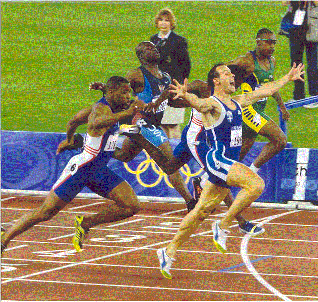
People often talk about the best seat in the house. I had close to that during the 100m, at the side of the track near the 50m mark. There I was only a few metres away watching the fastest men and women in the world doing what they do best, go fast. After her final Marion Jones stood on the walk bridge over the camera rail to acknowledge the crowd just in front of me, I could have put my hand on her shoes. Luckily I didn't because I wouldn't have washed that hand for weeks. Maurice Green's shoe landed nowhere near me so I wasn't in the running for it. Jai Taurima was magnificent, he got it all together when it counted. Some of you might recall his performance at the Canberra Grand Prix in January 2000. I could go on naming names and eventually get to the women's 4x100 relay. What a disappointment that was. And the men faired little better. Oh well on with the show.
During the Paralympics the Technical Officials were accommodated at the Athletes Village with the athletes. That was a buzz just being so close to so many great athletes. Besides all the great food, much of which I never got around to sampling; we were given chocolate magnums as though there was no tomorrow. There was an unknown, to me anyway, number of blind athletes in the village and they were easily identified. There was this train, like a caterpillar, each holding the one in front with the ultimate one in front able to see. The longest I saw was six and the one in front saw that each got a meal. Now that was looking after one's brother and sister.
Access to the village was up a hill and not every bus appeared to go to the front gate to let the passengers off. Thus an athlete in a wheelchair had to push their day chair, not the smartest mode of transport, up the hill. Occasionally you would see a technical official doing the right thing and giving them a bit of a hand. Transport around the village was by bus even though it was only a 500m walk to the dining room. This was a great opportunity to meet and talk to some of the visitors from other countries.
You probably want to hear of the things that I found funny. Unfortunately funny sides generally have a tragic side and that was the case at the Paralympics. Lachlan Jones is a partly blind cerebral palsy athlete who competes in a wheel chair. He was in lane eight for a particular race but in the straight ended up in the outside lane. Just after the finish line Lachlan encountered some starting blocks which turned his event more into a rough ride contest rather than a wheelchair race. It looked quite funny from 100 meters but it could had been tragic as he was heading for the cameraman's trench and was really out of control. The other incident was the athlete from East Timor who competed in the 5000 meters event. He was overwhelmed by the occasion and the rest is history. It is just a pity that humour comes from someone's adversity.
On our last morning at the village I went for a walk and found
Lisa MacIntosh. My wife had told me how wonderful Lisa was so I got a photograph
with her. I also got photographed with a couple of Chinese athletes for
a son now working in China. They were my two personally obtained records
but the memories will last for ever and that is enough for me.
Spectator views
Chris Butler One of the many highlights (or maybe lowlights) of the Olympics for me came from one particular session of the athletics out at Stadium Australia. Surprisingly it was not the one hundred metre finals that I got to see, nor was it seeing Cathy run her 400m semi final. It came from one of the morning athletic sessions.
Four years ago in Atlanta I was lucky enough
to win a trip to see the entire Athletics program sponsored by the IAAF.
I had a great time as you can imagine, with tickets over the finish line
for every session. But the best part was making friends with everyone else
from all the other countries who won tickets also, and the people organising
the trip for us. One such person happened to still work for the IAAF and
came to Sydney. I met up with Rosie again in Sydney and she was kind enough
to give me and my girlfriend some free tickets to a couple of morning sessions.
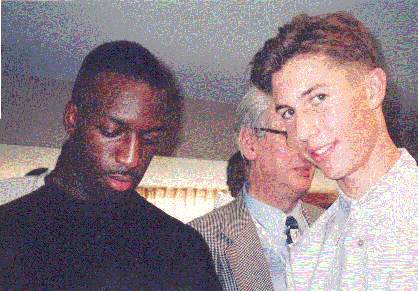
Eagerly we rocked up to the first of the morning sessions to see some great athletics without knowing which events were on. To our slight disappointment we realised there really was nothing overly exciting going on. Just a few decathlon events, some throws qualifying events, and a women's 20km walk - nothing special at all. We sat down and watched the women's 20km walk happening on the big screen. The couple in front of us were loudly discussing how boring and stupid the event was. But as the race went on it became clear that Jane Saville who was in the lead group was a good chance of a medal. Then with not to far to go the crowd began to realise that she was actually in the lead and looking likely to win the event. Suddenly this very boring session looked like it could return a gold medal for Australia. We couldn't believe how lucky we were to be there.
Funnily enough, the couple who had been bagging the event previously all of a sudden became experts on the event and were getting right into it!! In fact the whole crowd had come alive. The place was absolutely buzzing as we watched on the screen as Jane drew closer. Then as she was about to enter the stadium this smallish crowd was making an unbelievable amount of noise. They were going crazy over a walking race. And I thought to myself how ironic it was that the potentially most boring session of the week was about to produce a gold medal. Then she was disqualified!!
The crowd went deadly silent. It was a gut wrenching feeling seeing her about to enter the stadium an have that happen. So we all went home with a hole left in our stomach and feeling very sorry for Jane. But that was the highlight for me - getting excited along with 80,000 others over a walking race - how strange.
Clinton Bebb
Olympic Focus
I'm sure most of you saw the
same things I did at the games, if not in person then on the box at home.
So I won't tell you about what it was like seeing the 200m finals, the
men's long jump or the relay finals in person, being part of the crowd,
trying to lift Jai or Cathy (or anyone else with Australian Flags tattooed
on their arms) to achieve things that the form guide said they should not
be capable of doing. Instead I'd like to try and relate to everyone what
I felt being at such an event, as a spectator.
My first memories of the Olympics go back to Moscow 1980, I was 6, it is my first memory of television and of sport are of the East Germans in their Blue singlets dominating the world. I couldn't tell you who won what or what appealed to me the most but it stuck in my head, I don't remember my baby sister being born that year but I remember the blue uniforms. Four years later I was hooked, the year before I had finally managed to run 100m without tripping over my own legs, shed the nickname of "tangles" and made it to the NSW Primary Schools Championships, the poster of the Olympic Stadium in LA that my Aunt brought back for me adorned my wall from that day until it faded beyond recognition. The memories of Carl Lewis's 4 gold left me in awe and Gary Honey's silver, a skinny young Aussie like me, made it seem real and possible.
This is how it started, and as life went on I never lost the dream that it could one day be me, I still dream. I met a lot of people in athletics over the years, I beat some of them and got beaten by others, and some of them were there doing it for real in Sydney, and I was in the stands. Not down with the athletes but in the cheap seats with Joe Average who could have no real appreciation for what they were seeing, that's what I thought. I would hear comments from those who had probably never been to a championship event before and I'd scoff. But they did appreciate it, they weren't ignorant of what it meant to have gotten this far, they didn't know the technical side or the training required but they did appreciate it, they knew it was the pinnacle of achievement.
But I sat there staring out, quiet and uncomfortable. I felt like I was in the wrong seat and it took until I went back two nights later to work out what it meant. When I was 13 I could jump like Jai, at 16 I could hurdle like Matty Beckenham, but they were there. They were Olympic Athletes and now I was something else. The difference was focus, in the 16 years since the LA games I had stopped believing it could be me and these other guys didn't. I did other things and lost focus, these guys didn't. That's why the crowd was so deafening and the accolades flowed for the month of September. I felt strange because I realised I had failed and that the opportunity had now passed me by.
Without focus a dream will only ever be that. Congratulations to all those
who made it, for those who are still dreaming remember that the difference
is focus, don't get distracted if it's what you really want.
More memorable moments
Karen Boreham
I
loved all the Track and Field and soccer. Chris and I went up to Sydney
to watch one session at the stadium. It was the heats of the 100m relays,
the 50k walk (men's) and the heats of the women's javelin. It was a very
hot day. Luckily we were under cover but the people in the open seats must
have been boiling hot. Both Joanna Stone and Louise McPaul (sorry I've
forgotten her married name) were there. Joanna threw a terrific throw as
a warmup (a qualifying throw) but didn't do so well in the competition.
You could see Louise was in pain and I really admired her doing her best
with her serious knee injury. How those men could walk so far in 34 degree
temperatures I don't know. I thought I would perish just watching it all.
The stadium is wonderful and so many people, food stands etc. Everything
was very well organised and we were 'herded' to our seats with time to
spare.
Danny O'Dea One of my lasting memories is standing on the platform and seeing the look of horror on my 'slow to get off the train' mother's face as the door closed and she headed off to the city i.e opposite direction to the Olympic stadium.
Anne Southgate
My favourite moment was watching Cathy
Freeman win the 400 meters. She was awesome!
The volunteers have their say...
Michael
Thomson
(Michael was manager of the athletics warm-up facility
at SIAC)
Just quickly, some interesting moments
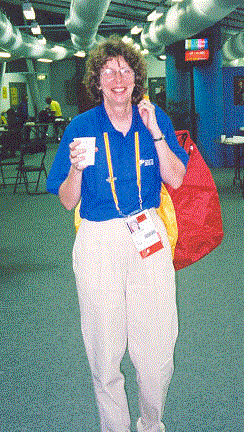
Linda Butler (Media slave) I was part of the Olympic News Service team at the Olympic Stadium (known as the Unquotables), which was mainly made up of a group of young, energetic and enthusiastic people magnificently led by Dave Tarbotton from Athletics NSW. Most of the team were "flash quoters" - they would watch their designated events, interview the athletes and quickly file their quotes onto the stadium's computers, which would then be distributed to the thousand-odd media for use in fleshing out their stories.
The team also included Englishman Peter Matthews, an ace statistician and commentator (you may have listened to him during the SBS-televised IAAF Grand Prix events), who was brought in to provide invaluable assistance. Peter would spend up to an hour each morning and afternoon briefing the Unquotables on what to expect from the coming session's events - who to watch out for, who were the favourites, what was their background, any juicy bits of gossip, etc. For the Paralympics, Peter's role was taken over by Karen McBrien, Louise Sauvage's manager who had a wealth of knowledge and a fund of stories about the Paralympians.
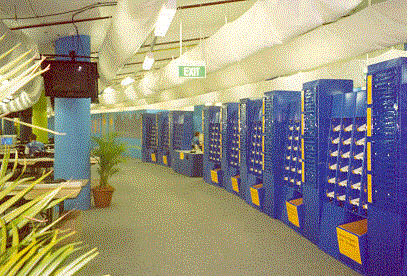
My tasks were much more mundane - ensuring these flash quotes, and all results, were distributed to the media via a set of pigeon-holes. Hundreds of the things - all constructed from recycled cardboard. I was very sceptical that they'd survive the Olympics and Paralympics, but they did.
The highlights for me were:
More memorable moments
Patrick Mossop
The
most memorable moment for me was seeing the finish of the women's marathon.
Naoko Takahashi of Japan ran in waving her hands and smiling as though
it was only a jog. It was the only final on the morning session I went
to and the crowd was just awesome. 100 000 people stood and cheered runners
from every nation as though they were all Aussies. The marathon is such
a hard event, were the athlete faces battles from fatigue of both physical
and mental strength (let's hope I never have to do one, 400m is too far!)
I guess that's the reason why the loudest roar from the crowd went to Aguida
Amaral from East Timor. I have never experienced such a noise and everyone
seemed to get more and more pumped as she ran around waving and blowing
kisses to the crowd. She dropped to one knee and prayed above in thanks,
only to have the track official tap her on the shoulder to let her know
she had another lap to run before she finished. I hear athletes (me included)
whingeing about injuries and training and it made me think of how blessed
I am. The horrific times she must have experienced and realise how lucky
I actually am to not only have good training conditions with top rate facilities
but the security of a stable country to live in. The hardships that she
must have experienced in the build up to the games and to put that aside
and still to finish 43rd in the Olympic marathon is inspirational.
Kathy Southgate
I spent the Olympic period glued to the
front of my Tele. I have never watched so much TV at one time before in
my life. After attending the Olympic qualifying trials in Sydney, I decided
the best seats in town were right in front of my TV I took the entire two
weeks off work and went to the coast to watch the Olympics on TV I only
moved long enough to get in some training and exercise myself ( running,
swimming, cycling and surfing). I was very pleased at the sportsmanship
and hospitality the Aussies showed the rest of the world. We had a great
family holiday.
Overseas perspective
David Osmond
I
was lucky/unlucky enough to be in Europe during September when the Olympics
were on. Although I saw a few events on TV, I missed a lot, so I would
often be scanning the newspapers for results. Understandably, most countries
focused on results or events in which they had enjoyed success, and so
it was often difficult to find out how the Aussies had fared. But towards
the end of the Olympic program, there was no shortage of stories with an
Aussie slant. Suddenly, everywhere you looked, there were stories of how
friendly Australians are, how beautiful Sydney is, and what a great country
Australia is. After the closing ceremony, every newspaper was in full agreement
with Mr Samaranch when he declared these the best games ever. Indeed, some
even claimed Australia had solely saved the Olympic movement. In England,
one person, upon hearing that I was an Australian, congratulated me on
the great job we had done as hosts of the Olympics. I wasn't sure if I
should say "thanks", or tell him that I personally hadn't done anything.
But despite my confusion, and sadness to have missed it all, it sure felt
great to be an Aussie.
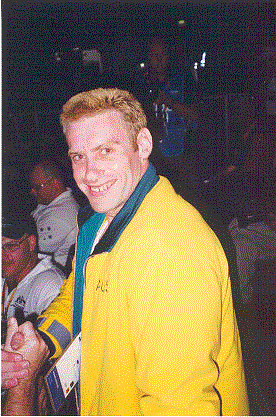
Powerlifting report by Leo Stinson (Leo is a work colleague of Richard Nicholson's, and we thank him for his permission to reproduce an item he wrote for the ABS newsletter)
Richard Nicholson an ABS staffer of 10 years had outstanding success at the recent Paralympic Games 2000. Richard competed in the 60kg class in powerlifting. The event had all the ingredients of an emotional rollercoaster. Richard had just recently moved into the 60kg division after competing in Atlanta at the 56kg level.
Just before competition, Richard was moved down into the 'B' division in his class after a more highly credited lifter swapped in from the 56kg class. Richard duly lifted all three lifts, the last (175kg) being a Personal Best and new Australian record, overpowering all the lifters in the 'B' division. This was exceptional in itself but looked to be the end of his highlights for the Games when the 6 'A' division lifters posted their preferred first attempts at 165kg, 175kg, 175kg, 185kg, 185kg and 193.5 kg respectively.
Over the next 45 minutes, however, lifter after
lifter failed to boost the weights in the required time or using the correct
technique. The exception being the Egyptian who blew away the Paralympic
record in his first lift of 193.5 kg. Spectators (the majority of whom
were unashamedly "Oi Oi Oi" but impartial in their applause) quickly rearranged
plans to move on to other venues as the word buzzed around that our man
Richard was still in with a chance of a medal. Two more 'A' division lifters
equalled Richard's best and speculation was rife about what this meant
in terms of medals (or not) for the ABS's best.
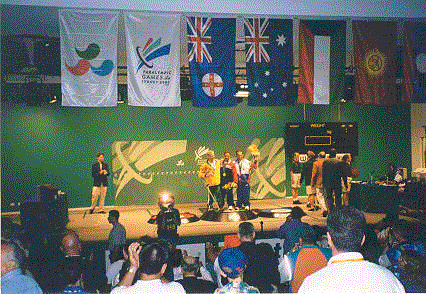
The final lifter raised 185kg and a stifled groan was heard. Then the results board showed three red bars. While spectators were left wondering what this meant, Richard himself smashed two fists into the air, and soon afterwards the announcer confirmed that the boy from Oz had jumped up to brand his name on the silver medal.
It is very rare for an athlete to win a medal from the 'B' division and even harder on the athlete who has to watch the whole process and not have the chance to come back with a bigger lift. Many friends from the ABS had made the trip and considered themselves more than well rewarded by the spectacle and the hype. Well done Richard.
Torch Relay
Bob McFadden
What a momentous
day was 6 September 2000 for us residents of McKellar when the Olympic
Torch Relay passed through our suburb.
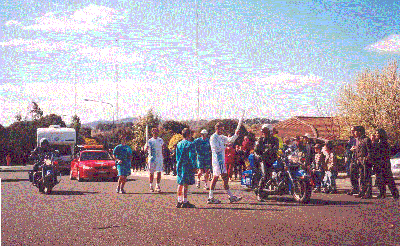
It was not just the torch bearers
but the convoy: two buses, an ambulance, official relay car, police motor
cycle escorts including two bulue Harley Davidsons, several police cars,
a police minibus, and vast numbers of police officers. Was this enormous
caravan there to ensure we did not miss the runners? Or was it to emphasise
the national historical significance of the event?
But enough of such cynicism. This event brought more McKellans from their humble cottages and into the main street than a suburb-wide fire drill. (I always suspected there were other people living here but I could never find them.) It might even put us on the map!
The point is that it made us feel part of the magic that is the Olympic spirit and part of history in the making. This is the real significance, especially for people who would never get to Olympic events.
Yes, this was the most excitement we have seen or are likely to see here - unless they decide to re-route the Gunghalin Parkway through the middle of us! A 'North Canberra' Olympic Journey
Shaun Creighton
Starting out
As a young athlete competing in Little Athletics I ran for fun. As a now dual Olympian, I still run for fun, but that 'fun' is different to what it was 25 years ago, but the basics are the same. 'Fun' 25 years ago was to join my friends once a week and enjoy the thrill of running all distances as fast as I could, and seeing if I could beat my friends in races. I still enjoy attempting to run all distances as fast as I can. I also still enjoy trying to beat my friends in races. The difference is that the races of 25 years ago took place on the sporting fields of Northern NSW, and the races of the past 13 years of international competition have taken me to running tracks in every continent. The average running ability of my friends has improved a lot in the past 25 years too !
Rob de Castella was always my "hero" when growing up. I read his books and followed his race results. The books and the results always inspired me. I remember that Rob would sometimes quote 'The Man of La Mancha' in encouraging people to "dream the impossible dream". I also recall Rob saying that most of the training you do is very hard work, with the 'rewards' with good races only a small percentage of the time you spend running. Over the years I've found both Rob's comments to be true. Competing in the Olympic Games was once nothing more than an "impossible dream" to me. I have been one of the fortunate few who has been able to realise what was once only a dream. Realising the dream of competing in the Olympic Games was a result of many things. Some of it was to have the talent to be able to reach that level, some of it was being fortunate to have an excellent coach who understood me both as an athlete and a person and prescribed appropriate training, and some of it was good old fashioned hard work, done consistently over many years. If I didn't have the talent, good coaching, or willingness to train hard over many years, the dream of competing in the Olympic Games may have eluded me.
Becoming an Olympian
I consider my 'Olympic experience' started in earnest 10 years ago. Prior to making the 1990 Commonwealth Games team in the 3000m Steeplechase, I didn't believe I would ever be good enough to make an Olympic team. By 1991 I had won the Steeplechase at the World Student Games and almost took it for granted that I would be in the 1992 Olympic Team. Despite qualifying, winning nationals, and not losing a race to an Australian I ultimately wasn't selected.
By the end of 1992 I had broken the Australian Steeplechase record and taken the bronze medal at the IAAF World Cup, but this still didn't make me 'an Olympian'. In 1993 I ranked in the top 10 in the world for the Steeplechase as a result of a 9th placing at the World Championships, a 7th at the IAAF Grand Prix Final, and a time of 8.16. I wasn't thinking whether I'd be in the Olympic team in 1996, but where I would potentially place in the final, especially allowing for another 3 years of improvement. All plans were revised in 1994 when recurrent hip and lower back problems forced me to abandon the Steeplechase and aim for the 5,000m and 10,000m. A successful transition to these distances saw me running times of 13.17 and 27.46 in 1995 to qualify for my first Olympic team in 1996. Unhappy with my results in Atlanta, I was determined to return to the Olympic arena in 2000 and do everything I could to make the top 10.
The road to Sydney
The "Road to Sydney" was a long and at times, bumpy one. It started very well with an Australian 10,000m record at the end of 1996. My time of 27.31 ranked 11th on the world list, and reinforced the "dream" of placing in the top 10 in Sydney in September 2000.
My coach Pat Clohessy and I decided that although 27.31 for 10,000m might place me in the top 10 at the Olympic Games, it was unlikely to place much higher. Conversely, that sort of speed at 10,000m when translated to the marathon MAY prove to be what it takes to get a medal in the marathon with 4 years of specific training. Despite running 2.10 in 1997, and a 2nd and 4th placing at the Houston Marathon, by the end of 1999 we decided to abandon the "Marathon 2000" plan and re-focus on the 10,000m for the Olympic Games. A silver medal in the 5000m at the IAAF World Cup in 1998 showed us that track aspirations on the world stage were still realistic.
After running two marathons (and starting a 3rd) in 1999, the transition back to the track at the start of 2000 wasn't as smooth and initially successful as we had anticipated. The 1999/2000 Australian track season was the first time in 10 years I'd really "struggled" on the track against domestic competition, and Olympic selection suddenly didn't seem so certain. By March I'd completed the Australian season without an Olympic qualifying standard, and time beginning to run out. Fortunately I could feel improvement with each race and each week of training.
In April I headed to the USA for 3 months with an ambitious schedule - to get married in June (to 1992 USA Olympic representative Shelly Steely), and prior to then to hopefully have Olympic qualifying times at both 5,000m and 10,000m. The Olympic qualifying times were 13.29 and 28.10. Prior to our June 10 wedding I had one race over 10,000m and one race over 5000m. Fortunately, the wedding was everything we'd hoped it would be, and my race results were 13.21 and 27.49 - well within the Olympic qualifying times - and I was back close to my best ever form.
The Sydney 2000 Olympic experience

Entering the Olympic Trials with the fastest Australian times over 3000m, 5000m and 10,000m for the year, I was confident of comfortably making the Olympic Team at both 5000m and 10,000m - with an emphasis on the 10,000m. Five days out from the 10,000m trial I came down with a head cold. Although almost back to 100% for the 10,000m trial, I decided to run a conservative race. I ended up further back in the field, and feeling worse than I'd anticipated, and had to be content with 3rd place. Backing up for another 3rd placing in the 5000m - 48 hours after the 10,000m - saw me selected in both the 5000m and 10,000m for the Olympic Games. The program at the Olympic Games allowed for men to attempt the 5000m and 10,000m "double", although with only one rest day between the 10,000m final and 5000m heats, it was a very difficult "double". Running in the 10,000m final would make it extremely difficult to run well in the 5000m heats. This was one consideration in giving my 5000m Olympic position to 20 year old Craig Mottram. As it turned out, only one athlete (from Japan) attempted the "double", and Craig Mottram did himself proud with a fine run in the 5000m - narrowly missing the final.
There was a "bug" going around the Australian team camp in Brisbane 3 weeks before the Olympic Games. I'd managed to avoid it, but then 2 days after one of my best ever track sessions, I came down with the "chest" variety of the "bug". At the time I thought "well, better now than in 2 weeks time". Unfortunately I didn't fully recover until one week AFTER my 10,000m heat - with neither rest or antibiotics able to allow me to recover in time.
My first thought during the Olympic Games was flying into Sydney the day the Team went into the Olympic Village. Normally my thoughts on such an occasion would turn to how I was hoping to perform, and mentally 'rehearsing' the race. This time however my thoughts were "I feel so bad I think I definitely need to go onto antibiotics today". While everyone else went to the Olympic Village, I got my antibiotics and went on a self-imposed "sickness exile" to my father's house - about 15 minutes from the Olympic Village.
One of the few times I have ever disagreed with my coach was whether to march in the opening ceremony. He preferred I stay at my father's and rest. I hoped that marching may spark my body into action and make it realise that now isn't the time to be sick ! I marched, but still didn't feel better. My general lethargy prevented me from really enjoying the experience - but there was no denying that the roar from the crowd when the Australian Team entered the Olympic Stadium was an unforgettable moment.
Four days out from my 10,000m heat I did 6 x 400m repetitions on the track. With the flu still in my system I felt terrible. Two days out I did 6 x 200m and felt so much better than 2 days previously that I got hopeful that I'd be OK to run well enough to make the final - given my rapid improvement curve the previous 48 hours.
The night before my 10,000m heat I stayed in the Olympic Village, and must have kept my room-mate, fellow 10,000m runner Sisay Bezabeh awake with constant coughing. I spent a lot of race day with Shelly (my wife), not trying to think about the race - all that had been already done, and there's no point wasting nervous energy on race day ! My thoughts heading back out to the stadium, and communicated to those close to me were that "I have no concerns about my fitness, but I'm worried about the amount I'm still coughing etc when racing against the best in the world... and I'm sure that I won't really find out until almost half way how much the flu is still in my system".
At the warm up track I had both cause for optimism and pessimism. My final words to my coach were that I felt great and my legs felt great, but that after each warm up "stride" I was still coughing phlegm off my chest. Entering the stadium I suspected my cold still had a grip in me, as I didn't feel the 'sense of occasion' I would have felt if 100%.
My pre-race plan had been to relax through 5-6km in the middle of the main pack, and then 'cover' any moves made up to 8km. If still feeling good, I'd planned to go to the front with 3-4 laps remaining and attempt to break up the pack with a long sustained effort - similar to what I'd done successfully when racing in the USA from May to July. With the cold still in my system, by 4km I was struggling just to hang onto the back of the main pack, and by 5km I knew it was only going to take one more 'surge' in the pack for me to drop off.
It was a lonely and painful last 4km in the Olympic Stadium. The physical pain didn't hurt as much as the disappointment of knowing how fit I was, yet not being able to run to my true potential in the Olympic Games (and in front of a home crowd). Although my family and close friends knew how ill I was, to have prepared so well and not be able to reap the rewards, I likened it to the feelings a farmer must have when tending to a field all season and a storm ruining the crop at the last minute.
When leaving the track and going to the media zone, I was asked by one journalist (who knew I'd been ill) "just how disappointing is it"? My response was that "competing well in the Olympic Games is what every international athlete aspires to do, and even more so when it is a 'home' Olympic Games, so from that point of view it couldn't be more disappointing. Against that, getting ill was totally outside my control, I prepared very well for the Games which gives me satisfaction that the 'process' was right even if the outcome wasn't, and that I wasn't going to judge my athletic career on one race.' I added that although running has been the major focus in my life for the past 10 years, it is not the only thing in my life, and that generally life is very good - so I won't be unnecessarily dwelling on what 'might have been'.
Athletics Australia's Head Coach for the 1996 Olympic Games, Phil King, told prospective 1996 Olympians that athletes don't make "sacrifices" in other areas of their life (eg careers, education, family) to become Olympians - you make choices. Even though my Olympic experience was disappointing, I would not make any other 'choice' if allowed to have my time again.
One of my favourite sayings
is "the journey is more important than the destination". The wonderful
experiences I've had in my "Olympic journey" far outweigh any disappointments
I've suffered ... and I'm still optimistic that in 4 years time the "destination"
of placing top 10 in the Olympic Games is possible. In the meantime, I'll
be enjoying the journey. I've taken a small break from full training the
past few weeks, but as of this week, the journey towards Athens 2004 has
begun.
John's torch leg
NC life member John Harding
carried the Olympic torch along Yamba Drive. He said it was going to be
the slowest ever 400m he ever did, but even though John's leg was all downhill,
I couln't keep up with him. I think there was a bit too much adrenalin
pumping through those legs! Quite a few North Canberra members turned out
to cheer on John. The above photo was taken of John with Erwin McRae, after
he had completed his leg.
For coaches
The following message was posted on oztrack recently, and may be of interest to coaches: The International Society of Biomechanics in Sports (ISBS) has developed the Coaches Information Service as part of its charter to disseminate Sports Science information in a coach friendly manner. A section of this site is devoted to field athletics. Currently there are a few articles in which you are more than welcome to access for your information. An important feature of the site is that it is for coaches and control is placed on this site to ensure that the information is coach friendly.
The address for this site is :- www.education.ed.ac.uk/field-ath/ Please take the time to visit the site and read the articles so that this resource can be built further. I would welcome any comments on both current and potential content.
This item was posted by: Angus Burnett, PhD Lecturer - Biomechanics Edith Cowan University Joondalup Campus Joondalup, Western Australia, 6027 E-mail: a.burnett@cowan.edu.au
Home About
Us Newsletters Calendar SchoolsCrossCountry Photos Information Contacts Links
