| |
| |
| Winds |
| Quena |
The
Quena
is an Andean instrument of pre-millenerian
origin. Thanks to its musical flexibility
(being so adaptable and tunable
in so great a variety of ways),
it holds a position of substantial
prominence. It can be made of wood
or bamboo, though its ancestors
were also made of clay, stone and
bone, especially the wing bones
of the condor.
The
quena is a vertical flute, tubular
in shape, open at both ends, with
a U-shaped mouthpiece that is placed
at the tip of the lower lip when
blowing air to produce sound. It
has six finger-holes in front and
one in the back. Quenas are available
in a variety of sizes, according
to purpose and to local customs.
Not surprisingly, different groups
of Andean natives use their own
tuning for this instrument, which
may vary in shape, size and even
in name, from place to place. The
modern standard professional quena
is tuned to G major.
Quenas
vary in size. The Quenacho
is a larger quena. |
| |
| Siku |
Not to be mistaken for the European panflute, the siku
(in Quechua and Aymara) or zampoña
(in Spanish), is a cane panpipe
native to the highlands surrounding
lake Titicaca, between Perú and
Bolivia.
The
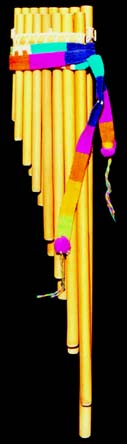
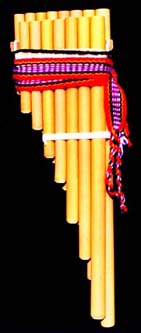
siku has two separate rows of
pipes open at one end and closed
at the other, with each row containing
every other note of the musical
scale. Usually, there is a row
of six pipes, called the ira,
and one of seven, known as the
arca. The pipes
are held in place by two or more
straps, also made of cane, running
across the width of the instrument,
and by threads or cloth braided
between the pipes and attached
to the straps. Present-day sikus
are made from highland bamboo
and from chuqui,
a cane found in the outskirts
of many Peruvian forests. In Bolivia,
a cane called zongo
is also used. In ancient times,
sikus were also made of clay or
stone.
Depending
on size, sikus are known by different
names, which may vary from place
to place. Intermediate in size,
the most popular siku is the malta(about
11.5 inches long). The Chuli,
or chili, is
an octave higher and about 5.5
inches in length. The sanka
or Basto (about
23 inches) is twice the size of
the malta and an octave lower.
Further down the tonal scale,
we find the toyo
(about 46.5 inches), twice the
size of the sanka and an octave
lower still.
A
sikuri is a siku
player (un tañedor de
siku in everyday Spanish).
Traditionally, sikuris
are ensembles (known to have reached
some 100 persons in number) of
siku players who collectively
interpret a melody while dancing
to it, almost always accompanied
by one or more bombos to keep
time. The execution is carried
out in the form of musical dialogues,
each performed by a pair of which
each member plays one of the two
rows of the same siku.
From
times immemorial, Andean man has
used the siku to express his character,
feelings, sentiments and emotions.
His happiness, grief, pride and
feats as a warrior have found
their deepest expression thus.
Since long before the Inkas, the
siku has been an instrument both
ritual and magical through which
the many Andean cultures have
expressed their deepest spiritual
tradition.
|
| |
| Antara |
The pre-Inka Nazca culture developed its musical language and
spiritual expression through the
Antara. Although present-day antaras
are made of bamboo, in times past
they were made of several types
of clay-like muds, fired to achieve
hardness, with some instruments
taking on a terra-cotta appearance.
The
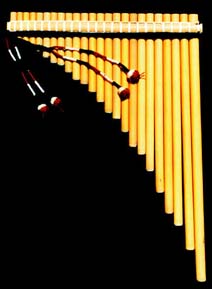
antara is made from a single row
of cylindrical pipes arranged
by size to give the instrument
an essentially triangular shape.
In the National Museum of Anthropological
Archaeology in Lima, there are
dozens of Nazca antaras retrieved
from burial and other archaeological
sites dating to the Nazca period.
The number of pipes in each of
these instruments varies from
three to fourteen.
Antaras
found in Inka burial sites are
mainly pentatonic and are made
of cane fastened by multicolored
threads of cotton or wool. These
instruments vary substantially
from their Nazca counterparts,
not only in the method of construction,
but also in their musical quality.
In
truth, the original Nazca antara
is a musical enigma: Thanks to
it diatonic and chromatic scales,
it offers major musical possibilities
than those of the Inka instruments
that appeared subsequently.
|
| |
| Rondador |
The rondador,
the national musical instrument
of Ecuador, is similar in construction
to the cane antara and siku.
This instrument has a single
row of pipes arranged pentatonically,
interlaced from major to minor:
Each note is followed by its
lower third, making it possible
to play a melody in parallel
thirds. To this end, the player
must blow air in two adjacent
pipes simultaneously. Many musicians
are accustomed to playing the
rondador and the bombo at the
same time, while the ensemble
of musicians, usually five or
more in number, dances to the
music.
This
instrument is the most typical
and representative of the Andean
people of Ecuador and parts
of Northen Perú. San Juanito
is the most well known rhythm
associated with this instrument.
Today,
the rondador is available in
a variety of tunings. For its
construction, the thinnest bamboo
canes are selected to produce
instruments with a soft sound.
At the time of the Inkas, feathers
from the wing of the condor
were also used to give such
instruments a magical aura and
a ritualistic character.
|
| |
| Ocarina |
The Ocarina is
yet another Andean wind instrument
of pre-millenerian origin.
Its sound is melancholic,
wailful and might even be
described as painful. Since
times lost to human memory,
ocarinas have been made of
a number of materials: a variety
of fired clay-like muds, stone,
wood and large seeds. In addition
to being used for musical
tuning, ocarinas were made
to imitate animal sounds,
especially bird voices.
The
ocarina is a globular flute,
with or without a mouthpiece
(to channel air inflow), such
that sound is extremely easy
to produce. In the Andean
world, this instrument can
be found in many varieties
and with a multitude of decorations.
Some have eight finger-holes
in the upper part (four for
the fingers of each hand)
and two in the lower part
(one for each thumb).
The
European ocarina (known as
the sweet potato)
was developed in the nineteenth
century in Italy and Austria.
It became quite popular in
many countries, including
the United States. Its invention
is attributed to Giuseppe
Donati, around 1860.
Probably,
one of the ocarina ancestors
is the pututu (quipa
in Ecuador), a traditional
instrument among Peruvian
Natives, particularly those
near Cusco (Cuzco). The pututu
is a large seashell, about
eight inches in length, with
a hole of around four tenths
of an inch drilled at the
pointed end. The pututero
(pututu player) places his
lips there and by blowing
air, with some strength, produces
a highly vibrating and penetrating
sound. The pututu, also made
of fired clay-like mud, is
used to convene cabildos
(town meetings), to announce
reminders of important days,
and to signal situations of
emergency.
|
| |
|
|
|
| Percussion |
| palo
de lluvia |
The
palo de lluvia (rainstick),
or palo de agua (waterstick),
is a musical and ceremonial
instrument used in many communities
from ancestral times to the
present. Its name is descriptive
of the sound of falling rain
the instrument produces. Rainsticks
are made only from dead cacti,
found predominantly in the desert
zones of Northern Chile. The
thorns of the cactus branch
are pressed into the hollow
shaft to form a spiral pattern.
Filled with desert pebbles,
the rainstick produces its characteristic
sound when it is tilted to allow
the pebbles to run through its
interior.
The
origin of the rainstick is a
mystery. According to legend,
its sound has the spiritual
power to serenade the rain gods.
Indeed, some maintain that the
Diaguita People of the Elqui
Valley in Northen Chile use
the rainstick to this day in
ceremonies to invoke the rain
spirits. In modern society,
the rainstick, in addition to
being widely used as a musical
instrument, is also used by
persons of all ages as a toy
or as a tool for relaxation.
|
| |
| Wankara |
The wankara is
a large, round drum with goat
skin stretched across both ends.
It has a deep, bass sound. It
most commonly played in sikureadas,
a musical performance where a
large group plays sikus and drums.
|
| |
| Bombo |
The bombo is
made from a hollowed tree trunk,
with animal skin stretched across
both ends. Bombos are made in
many sizes.
|
| |
| Tinya |
The tinya is
like a small bombo, about 4 to
6 inches in height and 12 to 20
inches in diameter (there is no
standard size), made of tree bark
and goat skin tied with goatskin
straps or rope. It is played with
small drumsticks, the business
end of which can be padded.
|
| |
| Caja |
The caja,
made from a hollowed tree trunk,
with animal skin stretched across
both ends, is much smaller than
a small bombo. Across one of its
sides is stretched a string to
which there are attached small
slivers of wood. The purpose is
to create a sound similar to that
of a snare drum.
|
| |
| Chajchas |
The chajchas (chullus
in Bolivia) is a vowen
ribbon to which there are tied
several goat or pig hooves. When
shaken, the sound produced suggests
that of wind and falling rain.
|
| |
|
|
|
| Strings |
| Charango |
The Charango
is the only stringed instrument
native of the Andes. Fashioned
after the Spanish guitar, the
charango appeared in the 18th
century between Bolivia and Perú.
Made of armadillo shell or wood,
this instrument has ten strings.
It is rather small in size so
that shepherds may carry it easily
while herding their llamas.
|
| |
| Kirkincho |
| Kirkincho
is the name of the armadillo in Quechua
and Aymara. In reference to musical
instruments, a kirkincho is a charango
made of armadillo shell. |
| |
| Walaycho |
The hualaycho
(called walaycho
in Bolivia) is a small charango
with metal strings. Most of the
time, it is played kalampeado:
by strumming, not picking, the
strings. The instruments is also
known as chilleador
(that which produces
a sharp and disagreeable sound)
for its strident and "disturbing"
sound. The hualaycho is also called
the charango diablo (the
devil charango) when it is tuned
in diablo style.
|
| |
| Other |
Although not native to the Andes, the introduction of the guitar,
violin, harp and tiple brought
about the creation of new styles
and rythms to Andean music.
|
| |
|
|
|
|
|
|
|
|