|

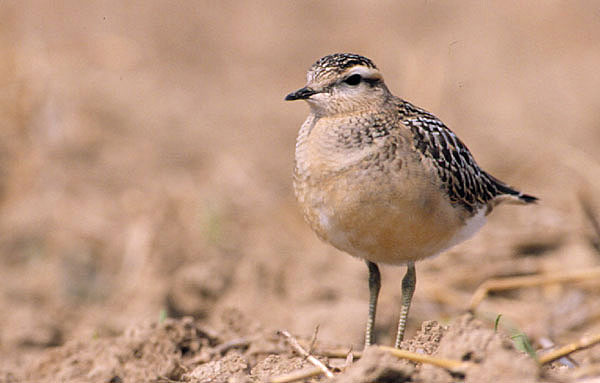
QUIZ 45
?
Bird photographed by ?

QUIZ 44
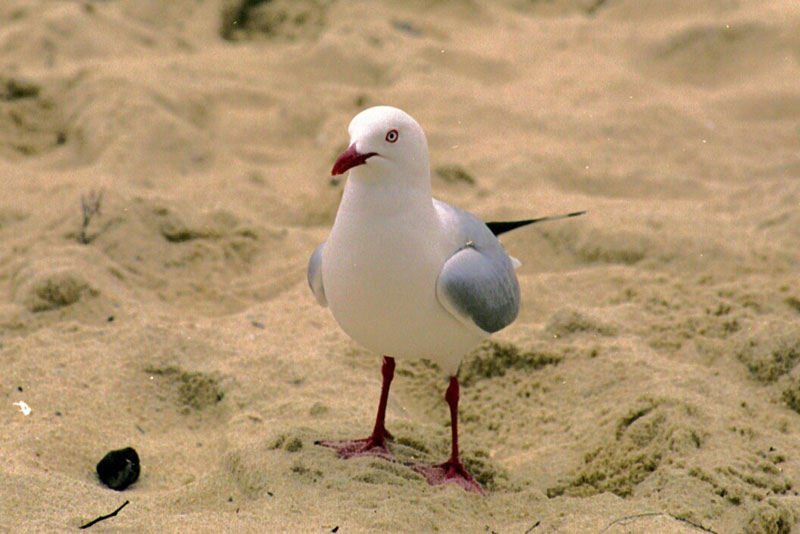
Red-billed Gull Larus novaehollandiae
This species, breeding mainly on east coasts of New Zealand and surrounding islands, forms a superspecies with the Silver Gull (Larus novaehollandiae) and Hartlaub's Gull (Larus hartlaubii), and all three are sometimes treated as a single species, reason why both answers will be considered as correct in the context of this competition.
The Red-billed Gull has a white head, body and tail. Its mantle and wing-coverts are pale grey, with black outer primaries showing white tips, and with large white mirrors. Bill and feet are scarlet, and the iris are yellowish white, with a narrow red orbital ring. The (sub)species differs from the Silver Gull by its smaller size, slightly darker upperparts and a relatively deeper bill. Non-breeding adults are similar to breeding birds, but with bill and feet duller red. The Silver is an abundant species, counterpart of the Red-billed in Australia and Tasmania.
The Black-billed Gull (Larus bulleri) is a very pale gull, distinguished by its mainly white wingtips with narrow black trailingborder and a long slender black bill. The iris of this species is completely white.
The The Audouin's Gull (Larus audouinii) shows a characteristic profile, with elongated sloping forehead and a deep hooked red bill. Its legs are dark-grey to black, and the iris is dark with a crimson orbital ring.
The The Dolphin Gull (Leucophaeus scoresbii) is another red-billed gull, with short bright red legs, from the southern regions of South America, including Falklands Is. Its plumage consists in a uniform grey suffusion on head and underbody, a dark mantle, and black primaries, the latter with no white windows and a broad white triangular trailing edge to secondaries and inner primaries. The iris is white with a conspicuous red orbital ring.
Bird photographed by Helen Baines, in Bark Bay in the Abel Tasman National Park, South Is., New Zealand.
QUIZ 43
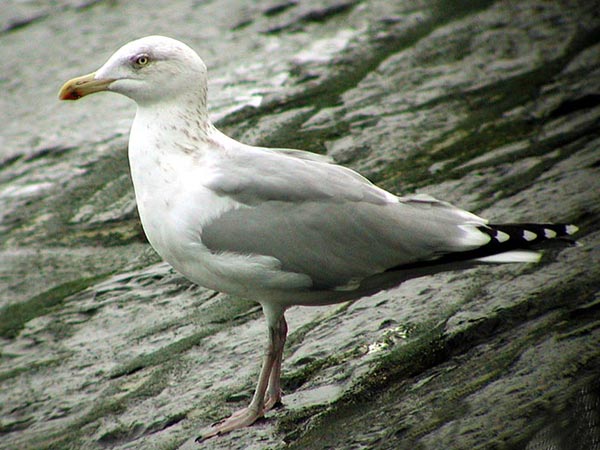
Herring Gull Larus argentatus
One of the commonest gulls of the european coasts, bigger than Common (Mew) Gull (Larus canus). Adult have a grey mantle, white a white head streaked with brown in winter. The race argentatus from Scandinavia, is slighlty darker than the western european argenteus. Underparts are white, with primaries black toward the tips. The bill is yellow with a red spot, like many other species. The iris is yellow, legs and feet are pink. The bird shown here is in winter plumage.
The Common (Mew) Gull (Larus canus) is smaller, with a more rouded head profile, black eyes, and a more slender greenish yellow bill, providing a more 'friendly' expression.
Adult California Gull (Larus californicus) has a grey mantle, slightly darker than Herring Gull, with a rouded head and grey-green or greenish-yellow legs. The Western Gull (Larus occidentalis) have a white head, a dark grey back, pink legs, and a very large bill. In winter, the head is moderately streaked with brown in northern birds, and more clear in southern birds.
The Slender-billed Gull (Larus genei) resembles a Black-headed Gull (Larus ridibundus), without hood, but is bigger, has a more attenuated body shape, and in flight longer and broader wings, beaten more slowly, much more like the large gulls. Eye region and ear-coverts show only faint dusky markings, which make eyes look quite small This species also appears strikingly 'long-nosed'.
Bird photographed by Stéphane Moniotte.
QUIZ 42
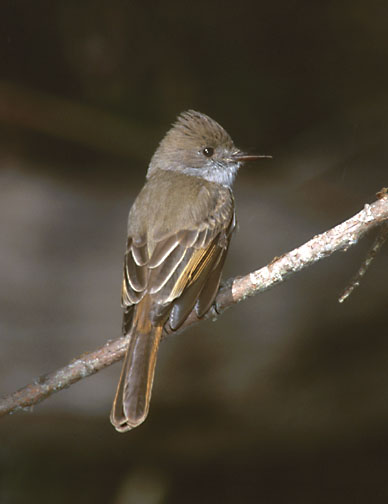
Dusky-capped Flycatcher Myiarchus tuberculifer
Formerly called Olivaceus Flycatcher, this bird is a typical member of the Myiarchus complex, fairly common in sycamores and oaks of mountain canyons of southeastern Arizona and southwestern New Mexico. Brownish-olive above, with a darker bushy crest, the species shows gray breast and throat, darker on sides of breast. Belly and undertail coverts are lemon yellow and usually brighter than in the Ash-throated Flycatcher (Myiarchus cinerascens), the closest species (see below).
As shown in the figure below (reproduced from the National Geographic Society Field Guide to the Birds of North America, second edition) its dark tail shows only slight reddish edgings around each feather. The pronounced rufous outer rectrices look here just like a juvenile Dusky-capped, more than any other Myiarchus. Moreover, Secondaries have reddish edges, unlike other Myiarchus Flycatchers.
Its long and fairly tubular bill is entirely black. The presence of rust on primaries, their relatively short length and the white-edged tertials are three other criteria favoring this identification.
Ash-throated Flycatcher is larger and also grayish-brown above, with a bushy crest.
Throat and breast are pale gray, with belly and undertail coverts pale yellow. Seen from below, its dusky tail shows entirely reddish inner webs and brown tips, as in the Great-crested Flycatcher (Myiarchus crinitus). In the latter, the lower mandibule is horn-colored, at least at the base, as in the Ash-thraoted Flycatcher.
The Brown-crested Flycatcher (Myiarchus tyrannulus) is very similar to Ash-throated Flycatcher, virtually identical in general appearance and habits to the more widespread Great-crested Flycatcher. La Sagra's Flycatcher (Myiarchus sagrae) is an accidental species in North America; similar to immature Ash-throated Flycatcher or those with worn plumage, but with more olive on upperparts. Underparts are very pale, often white, including on belly.
Members of the Contopus family, like the Eastern wood-pewee (Contopus virens) do not have such reddish tone in tail feathers and secondaries.
As usually, where all species may be encountered, the voice is the best mark helping identification. OK, this one might generate some discussion ...
Bird photographed by Don DesJardin.
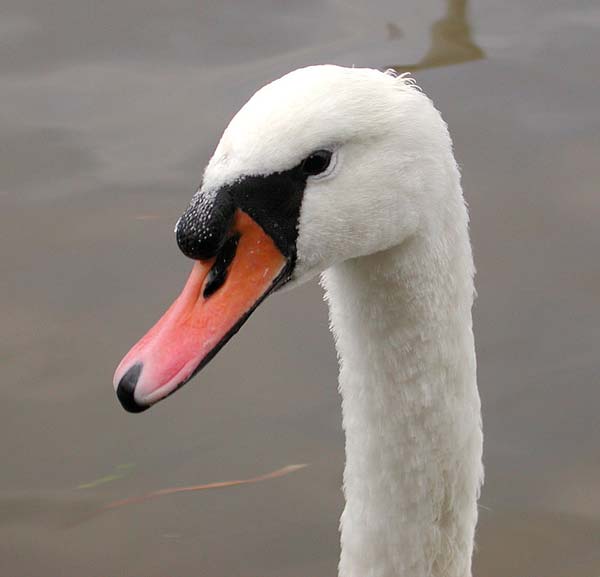
QUIZ 41
Mute Swan Cygnus Olor
The commonest of the Swans and a familiar breeding bird on many lakes and rivers. The species is recognized at distance by its more curved neck, and in certain situations by higher rear end and longer tail. At closer range, its red bill, with a black knob, is characteristic.
Whooper Swan (Cygnus cygnus) and Bewick's Swan (Cygnus columbianus) have yellow on bill when adult. Their imatures may also be distinguished from Mute Swans : Whoopers are more uniformly grey-toned and have a paler bill base which contrasts with a darker face. Bewick's are appreciably smaller, with shorter necks and a less elongated head shape.
Bird photographed by Stéphane Moniotte.
Gallery overview
Quiz Statistics
Quiz results
Rules
Hall of Fame
More links !

|

