Mayan Urban & Rural Living
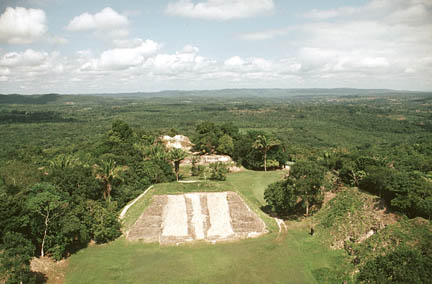 The city-states were ceremonial places where Mayans met for political, religious and social events, and in times of emergency it would be used as a place where Mayans would receive instructions from there leaders.
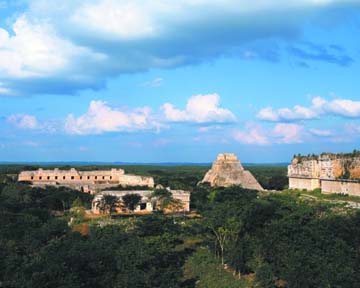
At the heart of each Mayan City State was a central plaza. It was fronted by one or more temple-pyramids for worship and the places that served as the residence for the Halach Uinic, High Priests and other leading nobles. All the other buildings were made in block back from the central plaza.
The homes of the upper-class citizens were divided into two by an interior partition. The partition was often decorated with paintings and it separated the public and private parts of the house. The front of the house was used for an entrance hall, living room, and a reception hall for guests. The back of the house was only for family use. Their furniture was benches, low tables, mats, and wooden beds covered with rush mats.
Slaves maintained their house and made their meals. The upper class ate well. But their diet was similar to the lower classes. The difference was the variety and quality of the food was much better. The upper class could afford more meat and a wider variety of vegetables for their diet.
The pheasants lived in village homes that were a little more than huts. They were built to last to one generation. In the lowlands, huts were made of wood over a stone foundation. The roofs were made of thatched palm, in the high lands, there was some variation lands, and there was some variation since stone was plentiful. In the high lands walls were made of rubble and stucco was applied to the surface. Instead of palm for the roof they used grasses instead.
 The huts offered very little privacy because the front door was only a blanket draped across the entrance. The inside was small and divided into two sections by a screen or a wall. One of the sections served as a bedroom and the section served as the kitchen. In the center of the kitchen floor was a hearth. In the huts were a few wooden tables to hold pots, cooking utensils and tools. There were also a few wooden stools used for seating.
The women in the village rose well before sunrise to prepare the morning meal consisted of a bit of posol, a drink made from crushed corn boiled in water and leftover tortillas. When the men finished eating the morning meal they would set out for the milpas, or depending on the season.
The women spent their morning preparing corn for making tortillas. They would dry the corn then shell them then place them in a cooking pot with enough water and lime to soften their kernels. After it was boiled, it was set aside to stand overnight. The next morning the women would wash it free of hulls and ground it by hand. Once it was grounded, it was ready for use. It is now a daily supply of tortillas kept hot in a heated gound.
There were three meals a day, but only the late afternoon meals were substantial. It included a stew of meat or fish with added herbs and vegetables. The tortillas were used as spoons during the meal but eaten at the end. A third light meal was served later in the evening before the family went to bed.