Location and name of the bridge
Name of the bridge: "Szabadság" bridge
Distance: 1645+300 km
Country: Hungary
City/town: Budapest
Year of building - completion: 1894 - 1896.
Year of reconstruction: 1945 - 1946.
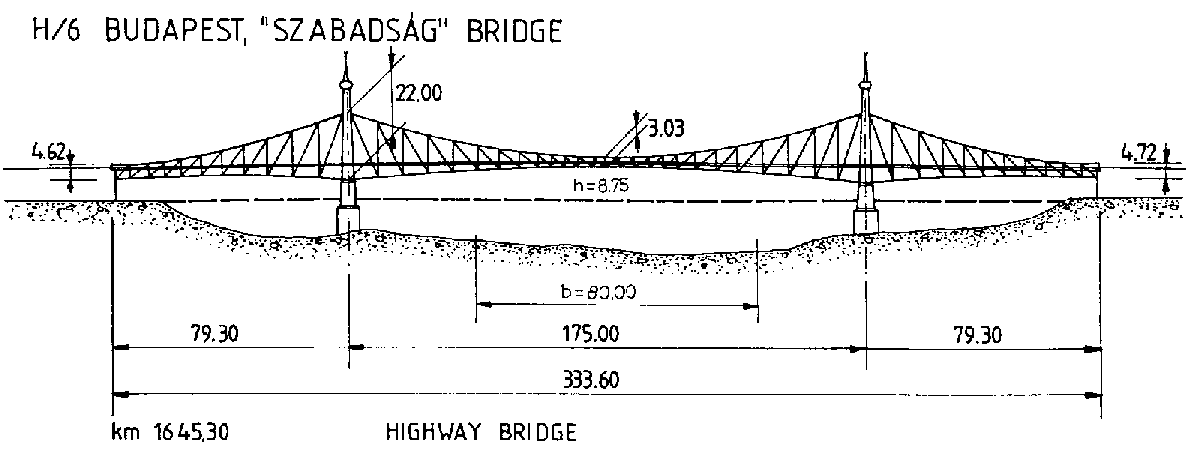
Span lengths: 79.3 + 175.0 + 79.3 m
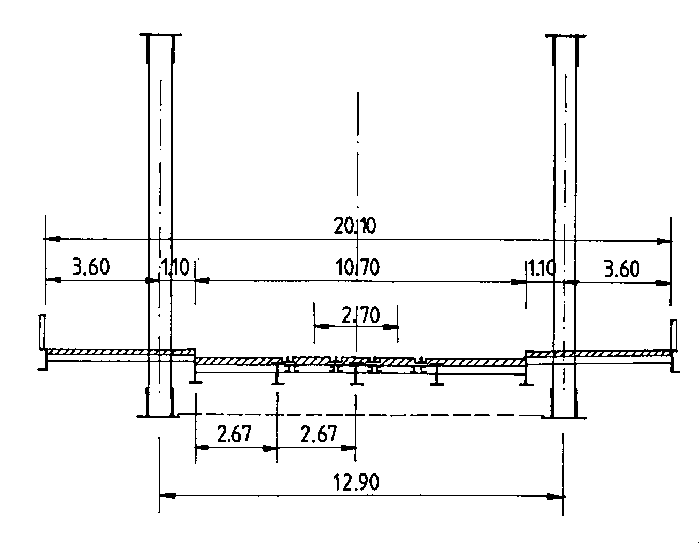
Roadway widths: 2.9 + 1.4 + 11.5 + 1.4 + 2.9 m
Designer: MÁVAG, on the basis of original plans
Main contractor: MÁVAG, Gusztáv Fáber
Construction cost: 6.164 million HUF
Traffic function of the bridge
Highway bridge (2 lanes) carrying tramway line (2 tracks)
Antecedents; the history of the bridge
The construction of the Elisabeth and Liberty bridges was ordered by law No. XIV. in 1893 on
the occasion of the forthcoming millennium of Hungary in 1896, and a common tender was
held with great success. All together 74 designs were presented, among them 53 for the
Elisabeth bridge, and 21 for the Liberty bridge. The members of the international jury were
bridge engineers of the highest reputation of that time. The reporter of the jury was Antal
Kherndl, the well-known professor of Technical University. 41 designs were solved with a
single-span structure; 15 designs were Hungarian, 16 ones were American, several ones were
Italian, Austrian, German and French.
The first prize was given to the cable-bridge of Julius Köbler from Germany for the later
Elisabeth bridge; while the second prize winner plan of János Feketeházy and the third prize
winner plan of Róbert Totth were prepared for the Liberty bridge.
The second prize winner plan of János Feketeházy was realized with small modifications. The
details of the plan were worked out by István Gállik and József Beke, the portals, having an
architectural importance, were designed by Virgil Nagy, professor of the Technical University,
who was the architect specialist of the design team.
The construction started in 1894. The foundations are iron caissons, made by Gartner and
Zsigmondy Company. The erection of the steel superstructure was carried out between July
1895 and August 1896.
The opening of the bridge took place on October 4th, 1896, during the millennium ceremony in
the presence of Ferenc József, Hungarian King and Austrian Emperor. The bridge was called
Ferenc József bridge for it for decades.
The simple supported midspan and the cantilevers were blown up in January 1945. During
construction of a provisory bridge, the Buda side span fell down, as the ballast weights at the
side support were not removed.
A provisory bridge was built in the midspan on five barges and on the wrecks of the Buda
span, but it was drifted by an ice-flow in January 1946.
As this bridge was the relatively less damaged one in Budapest, its reconstruction was the most
realistic. For this material of the other destroyed bridges also was used. The midspan had to
completely rebuilt, its material was produced in the iron-works of Diósgyőr and Ózd.
Further reconstructions were made in 1980, when the roadway structure was changed to a
composite one, and in 1985-86, when the pavements and their supporting structures were
renewed. During this process, because of very heavy corrosion damages of some members of
the main girder, a local collapse developed in a column of the main truss. After it the corroded
parts of the main trusses were strengthened.
The technical data of the bridge
Structural system, span lengths, widths
The statical system of the main girder is a so called Gerber truss, having an appr. 50 m long
simple supported part in the symmetry axis. Because of balancing the tension reaction forces
from self weight, ballast weights of 609 t each were necessary at both bank supports.
Deck
The deck was reconstructed in the original form and changed later into a composite
construction.
Method of construction/erection; joints
First the raising operations of the Buda span took place. Lifting of the structure was done with
16 hydraulic jack of 100 t capacity each resting on piled pedestals to a height of 9 m. It was
accomplished in five days.
After reconstruction of the two cantilevers the lift-in operation of the midspan structure was
realised with the floating crane of "József Attila" and "Ady Endre" having a lifting capacity of
100 t each. The total weight of the 46.9 m long piece of main was 240 t, so this operation
needed a special care.
Test loading(s); periodical assessment of serviceability
After 33 years of service the complete floor system and the suspension system of the
counterweights had to be reconstructed in 1979. The next step of rehabilitation became
necessary in 1985, when the replacement of the side walks and the repair of main elements was
decided.
Vertical and diagonal members of the main trusses are led through the slab of the side walks,
practically without any gap, which is the "result" of a previous repair. Dust and salted sand,
thrown in winter time, caused very heavy corrosion. Cross section reduction of the diagonals
was around 10 %, while that of verticals exceeded 40 % in some cases.
During the rehabilitation process, the one of the mostly damaged columns in its complete cross
section broke and moved 15 mm downward and 35 mm sideways. The traffic was closed
immediately, provisional fixing elements were built in by HSFG bolts.
Reconstruction should be started with the determination of the remaining force in the damaged
member. Applying the trepanation method, strain gages were bonded to the elements of the
column. Drilling pairs of hole near the ends of strain gages, the remaining stresses could be
measured and the total force was calculated. The active force in the column was found as 871
kN instead of 1930 kN, calculated from the dead loads.
Special devices and technology were designed to achieve the necessary position of the column
ends, to replace the damaged part of them and to induce the required force into the column.
The complete process was continuously controlled and measured.
To examine the behaviour of the repaired part of the main trusses local loading tests were
carried out. The live load intensity in the column achieved the maximum design value. The
difference between the actual and calculated behaviour was realistic.
At the end of the reconstruction work the complete bridge was tested again using 30 trucks of
20 t each.
Literature
Haviár, Gy.: Reconstruction of the blown Szabadság-Bridge, Műegyetemi Közlemények,
1947. No. 2.
Széchy, K.: A Ferencz József-hid és a Szabadság-hid épitésének összehasonlitása, Általános
Mérnök, 1947. No. 2.
Link to the next page: