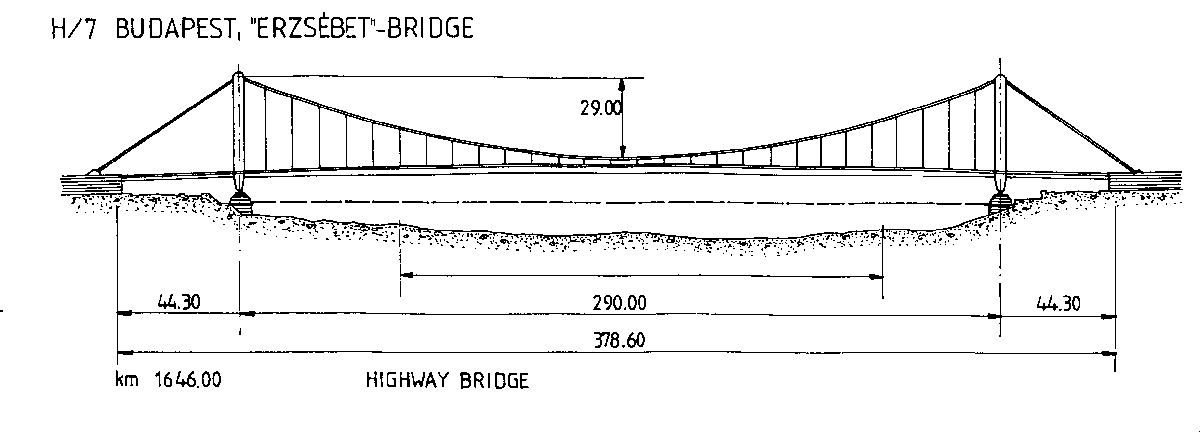
Location and name of the bridge
Name of the bridge: "Erzsébet" bridge
Distance: 1646+000 km
Country: Hungary
City/town: Budapest
Year of building - completion: 1898 - 1903.
Year of rebuilding: 1959 - 1964.
Span lengths: 44.3 + 290.0 + 44.3 m
Roadway widths: 4.45 + 18.2 + 4.45 m
Designer: UVATERV, Pál Sávoly, Tibor Sigray, FÖMTERV, János
Juhász
Main contractor: Ganz-MÁVAG, Károly Massányi, János Fekete, Károly
Vogt, Bridge Construction Company
Construction cost: 381 million HUF
Traffic function of the bridge
Highway bridge, number of lanes: 6
Antecedents; the history of the bridge
Before the construction of the "Erzsébet" and "Szabadság" bridges international tenders were
invited for both bridges together. The first price winner plan was for the "Erzsébet" bridge,
while the second price winner was the design for the "Szabadság" bridge.
The first prize winner plan of the common tender finally has not been realized. Its main reason
was, that it was a cable bridge, and at that time in Hungary cables of the required quality had
not been produced. Therefore a chain bridge was built. Although during construction this
change of the solution caused controversy, the realized structure later became famous and
found approval.
The plans of the realized construction were made by the Bridge Department of the Ministry of
Trade Affairs, headed by Aurél Czekelius, and they applied the statical calculation method of
Antal Kherndl, professor of the Technical University, who was a very important personality of
the Hungarian bridge engineering.
A new design was carried out by Aurél Czekelius in the form of a chain bridge solution and it
was realised.
Near to the end of World War II, in January 1945 the Buda side anchorage chamber was
blown up, the pylon and the chain together with the stiffening girder of the bridge falled into
the river, only the pylon of the Pest side remained in the original position.
As the original structure, by the opinion of a lot of people was one of the nicest chain bridge in
the world, reconstruction was first planed in the style and form of the destroyed bridge. But
the width of the roadway (11 m) was not enough the fulfil the requirements of the increasing
traffic. For this and other reasons a completely new structure was designed in form of a cable
suspension bridge.
Special model tests have been carried out in the laboratory of the Department of Steel
Structures, TUB, to help the design of the erection of the new construction.
The model was of a scale of 1:50. Forces in the suspension cable, as well as, the characteristic
deformations of the structure in different erection phases have be measured.
The technical data of the bridge
Structural system, span lengths, widths
The two bundle of cables contains 61 elementary cables. It is formed in the shape of a regular
hexagon resting on its vertex. An elementary cable contains 115 pieces of wires and its
diameter is 54.5 mm.
Deck
The stiffening girder and the floor structure of the bridge is an orthotropic steel construction.
To prevent the slip of the asphalt layers on the deck plate, zig-zag shaped ribs were welded on
the top of the deck plate.
Foundation, substructure
The abutments needed a thorough rebuilding due to the different layout of the new bridge.
After demolishing of the original ones the reinforced concrete blocks of anchorage chambers
were built. The embankment piers also required a complete repair.
Quantities of applied materials
Weight of steel structure: 6300 t
Method of construction/erection; joints
The portal frames of the pylons were built first, each of them containing two columns, made
from six elements and a transverse beam. For transferring the cables from one bank to the
other, an assembly "carpet" of 420 m long was built on both sides. The two carpets were
stiffened to each other in five sections by tubular trussed constructions. The cables were drawn
through form Buda to Pest side, they were clamped into the disc shoe and were fixed into the
anchorage chambers.
The stiffening girder and the floor system containing 195 assembly units, was manufactured at
the yard of Ganz-MÁVAG at Lágymányos and they were shipped by barges to the building
site. The units were lifted with the help of a floating crane of 100 t capacity. First the middle
element was positioned and the further ones were lifted in a symmetrical order. The units were
connected to each other with temporary hinges, the final connections by riveting were done,
when the total structure was build and it was preloaded with 2400 t of sandy gravel ballast to
achieve the final shape.
Corrosion protection
Re-dusting of the steel deck plate was performed by sand blasting, and after cleaning it was
furnished with a zinc-coating. Other parts of the steel construction were furnished with a
double prime coating of red lead and a semi-synthetic painting in two layers.
Traffic situation
After reconstruction the bridge carried a two track tramway line, which was removed in 1973.
This way the number of road lanes could be increased from four to six.
Test loading(s); periodical assessment of serviceability
The loading test, after finishing the construction, involved measurements of deformations and
those of stresses around the intermediate supports of the main girders. Results of these later
ones clearly showed that in case of such a great number of flange plates in a riveted
construction the stress distribution is not linear along the flange thickness and its maximum
develops around the centroid of the complete chord.
Literature
Sávoly, P.: Az új Erzsébet-hid, mint műszaki alkotás, Közlekedéstudományi Szemle, 1964.
No.2.
Sávoly, P.: Az új Erzsébet-hid erőtani vizsgálatairól, Mélyépitéstudományi Szemle, 1964.
No.1.
Az új Erzsébet-hid, Mélyépitéstudományi Szemle, 1965. No.4-5. Special Issue
Köröndi, L. - Szittner, A.: Az Erzsébet-hidon végzett dinamikus próbaterhelés eredményei,
Mélyépitéstudományi Szemle, 1968. No.2.
Link to the next page: