Traffic function of the bridge
highway bridge (4 lanes) with tramway (2 tracks)
Antecedents; the history of the bridge
The building of this new bridge and to name it after the Hungarian governor, Miklós Horthy,
was ordered by law No. XI. in 1930. Ten designer teams prepared 17 plans, and all of the prize
winner ones were made by Hungarians. The first prize winner plan was a chain bridge of János
Kossalka and Gyula Wilder, the second one was the arch bridge of Győző Mihailich and Iván
Kotsis, while the third one was an other arch solution of Jenő Kiss and Pál Sávoly. Győző
Mihailich presented an other plan containing a single span cable bridge version.
It can be seen, that those designs, which were preferred by the jury, and all of the other ones,
too, gave such solutions, in which the top of the main girders was much over the floor system.
Its main reason can be found among the design conditions, as taking into account the
prescribed height alignment of the floor system, an alternate variation could not be solved.
Later the design conditions in this sense were changed and a new design was carried out by the
Bridge Department of the Ministry, and finally that version was accepted and realized. The
design process was directed by Pál Álgyai-Hubert.
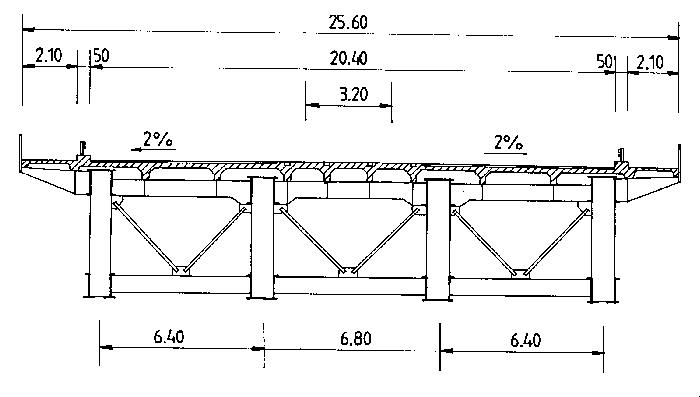
The bridge had four main girders with strong cross bracings and both upper and lower wind
bracings.
The bridge was blown up in January 1945. The main part of the original structure could be
used during rebuilding.
In 1978-79 the floor structure had to be replaced and at that time the five-span old steel
structure on Pest side was demolished and a new, three span reinforced concrete structure
made from prefabricated beams was built.
The technical data of the bridge
Structural system, span lengths, widths
The main girder of the bridge over the river is a three span continuous deck-type truss of
changing height.
Deck
The complete deck was replaced in two phases, one half of the bridge width could be used all
time. The old reinforced concrete slab had no water protection and it was seriously damaged.
The formwork of the new reinforced concrete slab was made from steel corrugated sheets of 3
mm thick and it was connected by welding to the other structural elements. The thickness of
the concrete slab is 15 cm.
Foundation, substructure
Original foundations of the abutments were reinforced concrete caissons, while those of the
river piers were steel caissons. They had a concrete core covered with limestone blocks.
Quantities of applied materials
Weight of steel construction: 7500 t
Method of construction/erection; joints
During the rebuilding the side spans were divided by intermediate temporary supports, while
the middle span was erected as free cantilevers from both sides.
Test loading(s), periodical assessment of serviceability
After the reconstruction of the bridge in 1980 it was detected that the expansion joints on the
pier on the Buda side got stuck in under all the four main girders and operated as fixed
supports. Therefore it was decided to modify them in a way that the rollers should be replaced
by sliding-tilting bearing with complete teflon coating manufactured by the Maurer firm. For
accurate position of the sliding surfaces the bridge had to be raised and after the removal of the
rollers the new bearings had to be inserted.
It was also noted that two intermediate piers of the bridge are moving in the axial direction. To
get information about the behaviour of the bridge a computer simulation check was carried out
to determine the effect of the vehicle loading, the temperature changes, etc. in this respect. The
results showed that the present state is not dangerous, but the complete repair of bearings is
necessary as soon as possible.
Literature
Haraszti, G.: A Boráros-téri Petőfi Duna-hid ujjáépitése, MÉLYÉPTERV Műszaki
Közlemények, 1953. No. 9.
Bácskai, E. - Kozma, K.: A Petőfi-hid felujitása, Mélyépitéstudományi Szemle 1980. No.3.
Link to the next page: