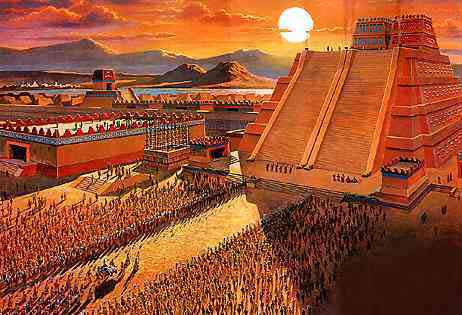
 For those of us who are Mexican..
we are of MAYAN descent..
For those of us who are Mexican..
we are of MAYAN descent..
"Originating in the Yucatan around 2600 B.C., they rose to prominence around A.D. 250 in present-day southern Mexico, Guatemala, northern Belize and western Honduras.
Deep within the jungles of Mexico and Guatemala and extending into the limestone shelf of the Yucatan peninsula lie the mysterious temples and pyramids of the Maya.While Europe was still in the midst of the Dark Ages, these amazing people had mapped the heavens, evolved the only true writing system native to the Americas and were masters of mathematics. They invented the calendars we use today.
 Without metal tools, beasts of burden or even the wheel they were able to construct vast cities across a huge jungle landscape with an amazing degree of architectural perfection and variety. Their legacy in stone, which has survived in a spectacular fashion at places such as Palenque, Tikal, Tulum, Chichen Itza, Copan and Uxmal, lives on as do the seven million descendants of the classic Maya civilization.The Maya are probably the best-known of the classical civilizations of Mesoamerica."
INFORM YOURSELF!! SOME RELATED LINKS:
http://mexico.udg.mx/historia/precolombinas/ingles/maya/
http://www.mayaruins.com/
http://www.michielb.nl/maya/astro.html
http://www.historylink101.com/1/mayan/ancient_mayan.htm
|
 Those of us of PUERTO RICAN DESCENT,
Juan Ponce de León and Christopher Columbus arrived on the island of Puerto Rico in 1493 and named it San Juan, for St. John the Baptist. It was inhabited at the time by a branch of Arawak Indians known as Tainos. Ponce de León became the first governor and established a colony at Caparra, south of San Juan Bay, in 1508. In 1520, when attempts to find gold there failed, he moved the settlement to a new location, which he named Puerto Rico--"rich port." The island and city names were later exchanged.
The settlers constructed numerous forts and homes on Puerto Rico, along with a cathedral and a convent.
Puerto Rico's importance lay more in its location relative to Spain's New World empire.
Puerto Rico's economy relied on its sugarcane plantations and the slave labor used to work them. The island colony never flourished under Spanish rule, however: Spain maintained very restrictive trading policies, especially for its colonies.
After centuries of struggle under the Spanish flag, in 1897, Puerto Rico gained independence from Spain. But just one year later, the Spanish-American War brought American troops to the island and in 1899 the Treaty of Paris handed Puerto Rico over to the United States. Only in 1917 did the U.S. Congress extend American citizenship to Puerto Ricans. Then in 1952, Puerto Rico became the United States' only commonwealth, complete with its own constitution and government.
Although there had been a push for statehood, in 1993 Puerto Ricans voted to remain a U.S. commonwealth. As a commonwealth, the island enjoys one major difference with the states: Residents pay no federal income tax on revenue earned in Puerto Rico; they do, however, pay a local income tax.
INFORM YOURSELF!! SOME RELATED LINKS:
http://welcome.topuertorico.org/
http://www.loc.gov/rr/hispanic/1898/puertorico.html
http://www.nyboricua.com/vieques.htm
http://www.thenation.com/doc.mhtml?i=20010709&s=falcon
|