| Old
Gold
|
Old Gold,
great players who have worn the Old Gold and Black
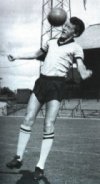
 Peter Knowles
 Born:
Frickley, Yorkshire, September 1945 Born:
Frickley, Yorkshire, September 1945
Peter Knowles joined Wolves
nursery side Wath Wanderers in 1961 and turned professional in October
1962. Twelve months later he made his league debut in a 1-0 win at
Leicester City and the following season established himself as a first
team regular. Sadly the club were relegated that season, but in 1965/66
Knowles was in fine form and scored 21 goals in 34 games including
hat-tricks against Carlisle Utd (home 3-0) and Derby County (home 4-0).
Wolves won promotion back to the 1st Division in 1966/67, Knowles was
hampered by injuries but still managed to contribute 8 goals in 21 games
that season. Knowles was capped 4 times by England at Under 23 level and
looked likely to win full international honours. Then in 1970, after
scoring 64 goals in 91 games he turned his back on football and became a
Jehovah's Witness. Knowles was only 24 and his sudden departure from the
game was a great shock to everyone.
James Mullen
Born : Newcastle-on-Tyne,
6th January 1923; Died: Wolverhampton, October 1987
Jimmy Mullen is the youngest
player ever to appear for Wolves in a first team match. He was just 16
years and 43days old when he played in the 4-1 win over Leeds Utd on the
18th 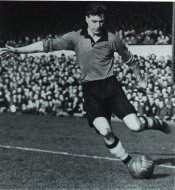 February 1939 in front of 32,000 fans. During the Second World War he helped Wolves win the
Wartime League (North) Cup in 1942, and as well as "guesting"
for Leicester City (with Billy wright), scored 27 goals in 87 games for Wolves. When League
football resumed in 1946/47, the fast raiding left-winger appeared for
Wolves for 13 seasons. He won the first of 12 caps for England when he
played against Scotland in April 1947 and his last seven years later, when
he scored against Switzerland in the World Cup. He also had the
distinction of being England's first ever substitute when he replaced the
injured Stan Mortensen against Belgium in May 1950. He scored in a 4-1
win. With Mullen on the left flank and Johnny Hancocks on the right,
Wolves possessed the best pair of wingers in the Football League at that
time. With Wolves, Mullen won three League Championship medals in 1953/54,
1957/58 and 1958/59 as well as an FA Cup winners medal in 1949. He played
the last of his 486 league and cup games, in which he scored 112 goals, in
March 1959 as Wolves beat Arsenal 6-1. February 1939 in front of 32,000 fans. During the Second World War he helped Wolves win the
Wartime League (North) Cup in 1942, and as well as "guesting"
for Leicester City (with Billy wright), scored 27 goals in 87 games for Wolves. When League
football resumed in 1946/47, the fast raiding left-winger appeared for
Wolves for 13 seasons. He won the first of 12 caps for England when he
played against Scotland in April 1947 and his last seven years later, when
he scored against Switzerland in the World Cup. He also had the
distinction of being England's first ever substitute when he replaced the
injured Stan Mortensen against Belgium in May 1950. He scored in a 4-1
win. With Mullen on the left flank and Johnny Hancocks on the right,
Wolves possessed the best pair of wingers in the Football League at that
time. With Wolves, Mullen won three League Championship medals in 1953/54,
1957/58 and 1958/59 as well as an FA Cup winners medal in 1949. He played
the last of his 486 league and cup games, in which he scored 112 goals, in
March 1959 as Wolves beat Arsenal 6-1.
Steve Daley
An England International,
Steve Daley joined Wolves as an apprentice and signed as a professional in
1971. It took him a number of seasons to establish a regular first-team
place after making his debut as a substitute in a 4-2 win over Nottingham
Forest in September 1971. In fact, when he did win a regular spot, Wolves
were slipping out of the top flight in 1976 but he was an ever-present the
following season and Wolves made a swift return to the First Division. He
scored 13 goals, easily the best of his career. In the summer of 1978,
Daley was selected for the England 'B' tour of Australia and won his first
cap at that level in a 1-1 draw against Malaysia. After another season at
Molineux, Daley, who had scored 43 goals in 244 games, joined Man City for
a British record transfer fee of £1,437,500. Having spent a little over a
year at Maine Road, he crossed the Atlantic to play for Seattle Sounders
in the NASL. He later returned to England to play for Burnley, scoring a
hat-trick for the Clarets in a 3-2 win over Port Vale. After another spell
in America, he ended his league career with Walsall. It took him a number of seasons to establish a regular first-team
place after making his debut as a substitute in a 4-2 win over Nottingham
Forest in September 1971. In fact, when he did win a regular spot, Wolves
were slipping out of the top flight in 1976 but he was an ever-present the
following season and Wolves made a swift return to the First Division. He
scored 13 goals, easily the best of his career. In the summer of 1978,
Daley was selected for the England 'B' tour of Australia and won his first
cap at that level in a 1-1 draw against Malaysia. After another season at
Molineux, Daley, who had scored 43 goals in 244 games, joined Man City for
a British record transfer fee of £1,437,500. Having spent a little over a
year at Maine Road, he crossed the Atlantic to play for Seattle Sounders
in the NASL. He later returned to England to play for Burnley, scoring a
hat-trick for the Clarets in a 3-2 win over Port Vale. After another spell
in America, he ended his league career with Walsall.
Steve 'The Tank'
Kindon
After starring in Burnley's FA
Youth Cup run of 1967-68, Steve Kindon became the first member of the
Clarets victorious Youth Cup side to establish himself in the First
Division. He scored  on his Turf Moor debut in a 3-1 victory over West Ham
Utd, and after winning Youth international honours, he was ever-present in
Burnley's First Division side of 1969-70, top-scoring with 17 goals. After
the Lancashire club were relegated in 1971, Kindon was unable to sustain
the form that his speed and talent warranted. He joined Wolves for a fee
of £100,000 in the summer of 1972 and scored on his debut in a 2-1 defeat
at Newcastle Utd on the opening day of the 1972-73 season. However, it
took him a while to settle down in the Midlands and he only appeared
briefly in the club's successful League Cup run in 1973-74, missing out on
the final when Wolves beat Man City 2-1. Though the club were relegated at
the end of the 1975-76 season, they bounced straight back as Second
Division Champions the following season with Kindon playing his
part. He had scored 31 goals in 167 games for Wolves when he returned to
Burnley in November 1977 for £80,000. He spent two more seasons at Turf
Moor taking his goal tally to 58 in 225 games before joining Huddersfield
Town where a knee injury ended his career. on his Turf Moor debut in a 3-1 victory over West Ham
Utd, and after winning Youth international honours, he was ever-present in
Burnley's First Division side of 1969-70, top-scoring with 17 goals. After
the Lancashire club were relegated in 1971, Kindon was unable to sustain
the form that his speed and talent warranted. He joined Wolves for a fee
of £100,000 in the summer of 1972 and scored on his debut in a 2-1 defeat
at Newcastle Utd on the opening day of the 1972-73 season. However, it
took him a while to settle down in the Midlands and he only appeared
briefly in the club's successful League Cup run in 1973-74, missing out on
the final when Wolves beat Man City 2-1. Though the club were relegated at
the end of the 1975-76 season, they bounced straight back as Second
Division Champions the following season with Kindon playing his
part. He had scored 31 goals in 167 games for Wolves when he returned to
Burnley in November 1977 for £80,000. He spent two more seasons at Turf
Moor taking his goal tally to 58 in 225 games before joining Huddersfield
Town where a knee injury ended his career.
William McIanny Carr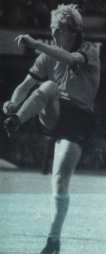
Born:
Glasgow, 6th January 1950
Scottish International
inside-forward Willie Carr began his career with Coventry City where he
scored 33 goals in 252 league games during his eight years at Highfield
Road. He joined Wolves in March 1975 for a fee of £80,000 and scored on
his debut in a 7-1 home win over Chelsea. He went on to suffer relegation
to Division 2 at the end of the 1975-76 season but then helped Wolves win
the 2nd Division Championship at a canter in 1976-77. The period following
promotion was another purple period in the history of Wolverhampton
Wanderers, with the FA Cup semi-final being reached twice and the League
Cup won over a three-year period. He went on to score 26 goals in 289
league and cup games before leaving to join Millwall in the summer of
1982. After only eight league appearances for the Lions, he moved into
non-league football playing for Worcester City, Willenhall Town and
Stourbridge.
It was Willie accompanied by 'Ernie' Hunt (below) who invented
that famous 'Donkey-kick' as seen on TV in the sixties which is nowadays
banned on the professional front.
Roger Ernie Hunt
Born:
Swindon, 17th March 1943
Ernie Hunt was working for
British Rail when Swindon Town manager Bert Head signed him as an amateur
in 1957. With the Wiltshire club, Hunt, whose real first name is Roger,
won three England Under-23 caps and scored 82 goals in 214 league games
before signing for Wolves in September 1965. He should have made 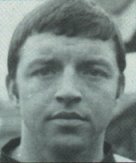 his
debut at Southampton but he decided that he wasn't fully match fit and
watched from the stands as the Saints won 9-3! He did make his debut in
the next match, creating goals for Knowles, Wagstaffe and Wharton in a 3-0
home win over Bury. The following season he helped Wolves win promotionto
the 1st Division, top-scoring with 20 goals in 37 games including a
hat-trick in a 4-0 win at Northampton Town. Hunt, who had an excellent
scoring record for a midfielder, had found the net 35 times in 82 outings
for Wolves before joining Everton for £80,000. Unable to settle at
Goodison Park, he signed for Coventry City where he teamed up with a
Wolves player of the future in Willie Carr (above). The two of them
perfected the infamous 'Donkey-kick' which resulted in a spectacular goal
on Match of the Day. Hunt scored 45 goals in 146 league games for the Sky
Blues before a loan spell with Doncaster Rovers. He ended his career with
Bristol City in 1975 and became Licensee of the 'Full Pitcher' pub in
Ledbury, later switching to being a window cleaner in the same town where
he also helped run a local junior team. his
debut at Southampton but he decided that he wasn't fully match fit and
watched from the stands as the Saints won 9-3! He did make his debut in
the next match, creating goals for Knowles, Wagstaffe and Wharton in a 3-0
home win over Bury. The following season he helped Wolves win promotionto
the 1st Division, top-scoring with 20 goals in 37 games including a
hat-trick in a 4-0 win at Northampton Town. Hunt, who had an excellent
scoring record for a midfielder, had found the net 35 times in 82 outings
for Wolves before joining Everton for £80,000. Unable to settle at
Goodison Park, he signed for Coventry City where he teamed up with a
Wolves player of the future in Willie Carr (above). The two of them
perfected the infamous 'Donkey-kick' which resulted in a spectacular goal
on Match of the Day. Hunt scored 45 goals in 146 league games for the Sky
Blues before a loan spell with Doncaster Rovers. He ended his career with
Bristol City in 1975 and became Licensee of the 'Full Pitcher' pub in
Ledbury, later switching to being a window cleaner in the same town where
he also helped run a local junior team.
Ronald Flowers
Born: Edlington,
near Doncaster, 28th July 1934
Ron Flowers started his
football career at Edlington Grammar School then playing for Doncaster
& Yorkshire boys as a inside-forward, he then moved onto Doncaster
Rovers as a amatuer where both his father and brother played. He then
joined the Wolves nursery side, Wath Wanderers, in the summer of 1950
before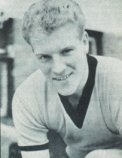 turning professional two years later. He made his debut in September 1952
at home to Blackpool and, though the Seasiders won 5-2, Flowers headed one
of Wolves goals. After helping the Molineux club win the League
Championship in 1953-54, he began to produce performances that led to his
winning the first of 49 caps for England when he played against France in
May 1955. His last game in a England shirt came 11 years later in a 6-1
win over Norway, a year in which he was a member of England's World Cup
winning squad. Flowers won further League Championship medals in 1957-58
and 1958-59 and in 1960 won a FA Cup winners medal when Wolves beat
Blackburn Rovers 3-0. He spent 15 years as a professional at Molineux and
scored 37 goals in 512 games before joining Northampton Town in September
1967. He later became player coach of the Cobblers before becomming
player-manager of non-league Wellington Town. By the time he had guided
them to the FA Trophy final they had been renamed Telford United, but in
1971 he left the club to run his own sports shop in Wolverhampton.
turning professional two years later. He made his debut in September 1952
at home to Blackpool and, though the Seasiders won 5-2, Flowers headed one
of Wolves goals. After helping the Molineux club win the League
Championship in 1953-54, he began to produce performances that led to his
winning the first of 49 caps for England when he played against France in
May 1955. His last game in a England shirt came 11 years later in a 6-1
win over Norway, a year in which he was a member of England's World Cup
winning squad. Flowers won further League Championship medals in 1957-58
and 1958-59 and in 1960 won a FA Cup winners medal when Wolves beat
Blackburn Rovers 3-0. He spent 15 years as a professional at Molineux and
scored 37 goals in 512 games before joining Northampton Town in September
1967. He later became player coach of the Cobblers before becomming
player-manager of non-league Wellington Town. By the time he had guided
them to the FA Trophy final they had been renamed Telford United, but in
1971 he left the club to run his own sports shop in Wolverhampton.
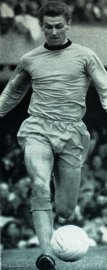 Bobby
Thomson
Bobby
Thomson
Left-back Bobby Thomson was a
polished defender whose performances in schoolboy football led to a number
of Midlands clubs trying to sign him. Wolves won the chase and he made his
debut in a 2-1 FA Cup fourth-round defeat at home to West Brom in front of
46,411 fans at Molineux. He soon established himself as a first-team
regular and developed into a international layer, gaining eight full caps
for England before he was 22. He also appeared for the England Under-23s
and the Football League, and he helped Wolves win promotion to the 1st
Division in 1966-67. But in March 1969 after playing in 300 games for
Wolves, he joined Birmingham City for £40,000. After making 68 league
appearances for the Blues, where he also had a spell on loan with Walsall,
he joined Luton Town before ending his league career with Port Vale. He
then dropped into non-league football as a player-manager of Stafford
Rangers before leaving to run a sports shop in Sedgley.
If you would like a player
added to Old Gold or have any information I have missed on the players
please contact me
|