|
|
 The
Development of Castles The
Development of Castles
The Ringwork Castle
The first castles in western Europe were built in the 10th century but
became much more widespread from 1020. The earliest type of castle consisted
of a simple ringwork. The ringwork comprised a circular earth bank
surrounded by an external ditch, surmounted with a palisade (a tall, sturdy
fence made of wooden stakes). The entrance was a defended gatehouse, and
inside the ringwork were wooden buildings, usually dwelling houses,
storehouses, and a well. In England about 200 of these ringwork castles were
built between 1066 and 1215.
The Motte and Bailey Castle
The motte and bailey castle was a more advanced form than the ringwork
castle. The motte was an artificial mound on which stood a wooden tower. The
base of the motte was surrounded by a ditch; earth and stones that were dug
away to make the ditch were used to build the motte. Just inside the ditch,
at ground level below the motte, was the bailey, a courtyard that was
usually oval or kidney-shaped, and that was enclosed by another ditch and
bank. The bank was fortified with a wooden palisade, or later on, with a
stone wall, known as an enceinte or outer wall.
In time, the crude ditches that acted as the outer defences of earlier motte
and bailey castles were replaced with wide, deep moats that were either dry
or filled with water. Access to the castle was by a drawbridge, which could
be raised and lowered over the moat from within the castle. Some gateways
were protected by a walled outwork known as a barbican. The gateways
themselves were often closed by a portcullis-a thick iron-plated wooden door
that could be pulled up into a cavity in the wall above or quickly lowered
to stop anyone entering the castle.
Today, all that remains of these motte and bailey castles are grassy mounds
that were once mottes (about 700 of them can be seen in Britain today).
However, an idea of what these castles looked like may be gained from the
Bayeux Tapestry; its pictorial narrative shows the 11th-century castle of
Rennes and Dinan, in Brittany, and of Bayeux, in Normandy.
The Keep Castle
The next stage of development was the keep castle. The keep, or donjon, was
a rectangular tower built to withstand siege. It had very thick stone walls
buttressed at the base with a sloping plinth. There were virtually no
windows, and the entrance was by means of a flight of stone steps leading to
first-floor level. On the ground floor were a well sunk into the floor of
the keep, kitchens, and storage rooms. Dwelling quarters were situated on
the floors above and were reached by means of moveable ladders, or by
staircases built into the walls.
The disadvantage of the rectangular keep was that, from within the walls, it
was impossible to see what an enemy was doing round the corner of its
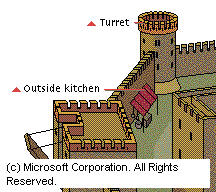
angles. One solution to the problem was to build angle turrets, small towers
built on to the corners of the keep; however, these were vulnerable to
undermining by a skilled enemy. Later keeps were often circular or
polygonal. Circular keeps are thought to have originated in France in the
12th century. One advantage of a circular keep was that it made possible
all-round vision; another was that cannon fired at the walls tended to
glance off the curved walls rather than penetrate them. As time went on,
living and administrative quarters were generally moved from the keep to new
buildings within the bailey. The keep, which then had a purely defensive
purpose, became stronger and smaller.

The Concentric Castle
During the 12th and 13th centuries, castle-building was refined and
improved. A castle's strongest point was no longer the keep; its strength
was now concentrated in the walls. Walls were set with strongly fortified
gatehouses and with towers at regular intervals all round their
circumference. The gatehouses and towers were machicolated, or built in such
a way that large stones, boiling oil, or other missiles could be dropped
through the floor on to the enemy below. The tops of the walls were also
crenellated, or set with regular recesses through which archers could shoot
in relative safety. This change was partly brought about by the use of a new
weapon, the crossbow, which was capable of delivering a far longer-range
shot than earlier bows. It was both to enhance its defensive power and to
fend off enemies armed with crossbows that soldiers were now stationed on
the castle walls, on wall towers, and in gatehouses.
This led to the development of the concentric castle, which was defended by
walls within walls. The origins of the concentric castle lay in the tendency
to wall the outer bailey once the inner bailey had been enclosed by a wall.
The walls of the outer bailey were usually less substantial than those of
the inner bailey: their purpose was to protect the less important
outbuildings, to keep attackers away from the inner defences so long as the
outer ward could be held. Two sets of defensive walls set close together
also allowed archers manning the top of the inner wall to fire down above
the heads of their comrades defending the outer wall and also to shower the
inside of lower ramparts with arrows if attackers managed to penetrate the
outer wall.
In Britain, the finest examples of concentric castles are those built by
Edward I at the end of the 13th century to secure his conquests in Wales; of
these, the finest is Beaumaris, on Anglesey. (Caernarfon, Conwy, and Harlech
castles are other fortresses built by Edward I.)
Crusader Castles
The period of the Crusades, when Christians travelled from western Europe to
reclaim the city of Jerusalem from the Muslims, was an important time for
castle-building. This was also the age of the great military orders: the
Knights Templar, and Knights Hospitallers of St John (see Knights of St John
and Jerusalem), and the Knights of the Teutonic Order. They built or
remodelled many of the most magnificent castles in the Holy Land (see
Palestine).
One of the most notable examples of medieval military architecture is the
great fortress of Krak des Chevaliers, at Qal'at a-Hsin, in Syria. It was
built by the Knights of St John, who held it from 1142 until 1271. Typically
of Crusader castles, it consisted of two concentric walls, set with towers
and separated by a wide moat. It was large enough to accommodate a garrison
of 2,000 men. This style of building was copied, on a smaller scale,
throughout Europe and, in England in particular, was associated with Edward
I.
However, the Crusades' major influence on castle-building in western Europe
was not as great in terms of military architecture as it was in terms of
giving kings and noblemen an appetite for powerful castles and armies. As a
result of their encounters with Muslim soldiers, they also came into contact
with the crossbow, a weapon that, as already mentioned, proved crucially
important in the development of castles.
The Castle and the Countryside
Castles were built in locations that enhanced their defensive capabilities.
Almost any high point made a castle easier to defend and more difficult to
attack. An ideal location was on the edge of high cliffs overlooking a bend
in a river, commanding an extensive view of the surrounding countryside.
Château Gailliard, built by Richard I at Les Andelys, in Normandy, and
Peveril Castle, in Derbyshire, are notable examples of strategically located
castles. In areas where there were no hills or cliffs, castles tended to be
moated. The Tower of London, a moated castle, was built by William the
Conqueror to defend a crossing-place on the Thames.
Built to defend a king's or nobleman's territory, a castle dominated the
area in which it was set. Over time, however, it became a source of security
for the inhabitants of the surrounding countryside. As part of their feudal
obligations, the local inhabitants served in the castle garrison for a fixed
period, or provided food or other goods and services. Local commerce was
also controlled from the castle; royal castles often controlled local market
towns, the king or lord gaining revenue from the collection of market tolls.
The castle also functioned as an administrative centre of the king's or
lord's local estates, and served as a courthouse for local tenants and as
prison for those awaiting trial.
|