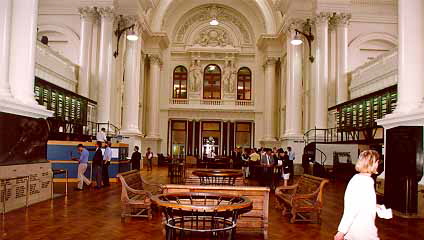
|
Important Dates:
2 July 1801
Incorporation of the "Bourse de Fonds public et de change de Bruxelles" by Napoleon.
1835
Listing of the first industrial securities.
30 December 1867
"Liberal law " regulating the Stock Exchange activity.
27 December 1873
Opening ceremony of the present Stock Exchange building.
27 July 1914
Closing of the Stock Exchange - World War I.
5 February 1919
Re-opening of the Stock Exchange after World War.
30 January 1935
Royal decree nr. 84 on the new Stock Exchange regulations.
10 May 1940
Closing of the Stock Exchange - World War II.
6 September 1940
Re-opening of the Stock Exchange under German regime.
September 1944
Closing of the Stock Exchange by German regime.
27 March 1950
Re-opening of the Brussels Forward Market.
24 January 1989
First computer assisted listing (CATS) on the Forward Market.
30 November 1990
Fire in the Stock Exchange building.
4 December 1990
Law concerning the financial operations and the financial markets (Big Bang I) "brokers" must convert them into "broker companies" - indirect access for domestic banks - reinforced control of the Banking and Finance Commission.
1 January 1991
Incorporation of Euronext Brussels (BSE).
15 March 1993
European Directive on the capital adequacy of investment firms and credit institutions (CAD) containing dispositions regarding the capital adequacy of the above mentioned firms and institutions and the introduction of solvency ratios.
10 May 1993
European Directive on investment services in the securities field (ISD) which introduces the European passport for investment firms.
6 April 1995
Law on secondary markets, the status and supervision of investment firms, and intermediaries and investment advisers, Big Bang II or the transposition of the above mentioned European Directives into Belgian legislation, the main accents of which are the opening to foreign intermediaries and a reinforced control on the transactions in securities (introduction of a double line control).
February 1996
The new management - the management committee - becomes operative:daily management and first line control on transactions in securities.
February 1996
NTS - the New Trading System appears into the Spot Market : fully computerised stock exchange activity.
19 April 1996
The last "criée" on the Spot Market.
June 1996
NTS - the New Trading System - replaces CATS - the Computer Assisted Trading System on the Forward
Market.
3 July 1996
RD on the obligations concerning occasional information of issuers whose financial instruments are admitted to listing on the First Market of a Stock Exchange.
25 January 1997
Publication of the Market Regulations of Euro.NM Belgium in the Moniteur Belge.
11 April 1997
First listing on the Euro.NM Belgium market.
31 December 1998
Conversion into euro of all stock prices of the Brussels Stock Exchange.
4 January 1999 :
From this day forward, all securities listed at Euronext Brussels can only be traded in euro.
A brief history of London Stock Exchange
The London’s Stock Exchange (LSE) is considered to be the world’s third largest share market by capitalisation behind New York and Tokyo, and is the bigger centre in the world for trading of foreign shares.
1760
150 brokers kicked out of the Royal Exchange for rowdiness form a club at Jonathan's Coffee House to buy and sell shares.
1773
Members vote to change name to Stock Exchange.
1801
We become a regulated Exchange.
1914
The Great War meant the Exchange market closed at the end of July until the new year. The Stock Exchange Battalion of Royal Fusiliers was formed - 1,600 volunteered, 400 never returned.
1972
Her Majesty the Queen opened the Exchange's new 26-storey office block with its 23,000 sq ft trading floor.
1973
First female members admitted to the market.
1986
Big bang:
Ownership of member firms by an outside corporation is allowed. All firms become broker/dealers able to operate in a dual capacity. Minimum scales of commission are abolished. Individual members cease to have voting rights.
Trading moves from being conducted face-to-face on a market floor to being performed via computer and telephone from separate dealing rooms. This is enabled by SEAQ and SEAQ International - 2 computer systems displaying share price information in brokers' offices around the UK. We become a private limited company under the Companies Act 1985.
1991
We replace the governing Council of the Exchange with a Board of directors drawn from the Exchange's executive, customer and user base.
1995
We launch AIM - a market for growing companies.
1997
SETS (Stock Exchange Electronic Trading Service) is launched to bring greater speed and efficiency to the market.
The settlement service transferring stock from seller to buyer and arranging the movement of money is no longer provided by the Exchange, moving to CRESTCo.
2000
We transfer our role as UK Listing Authority with HM Treasury to the Financial Services Authority (FSA).
Shareholders vote for us to become a public limited company and we become London Stock Exchange plc. Dealing in our shares is conducted via an off-market trading facility operated by Cazenove and Co.
2001
We list in July. We celebrate our 200th anniversary.
|