|
North Atlantic Treaty Organisation |
 |
|
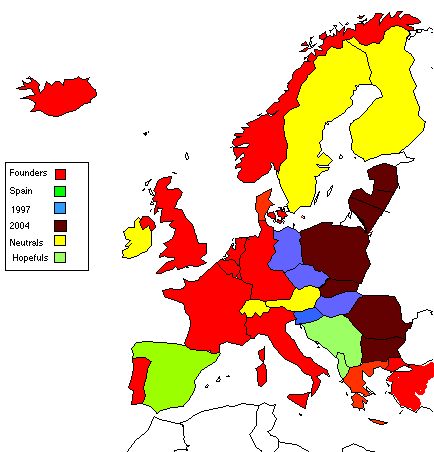
The North Atlantic Treaty Organization was formed in 1949 to provide a united defense against the military power of the Soviet Union. Towards the end of the second world war the Allied powers, Britain, the United States and the Soviet Union, had agreed at the Yalta conference that the Soviet Union would exercise power in eastern Europe whereas Britain and the United States would predominate in western Europe. Did the western leaders therefore agree to Stalin's installation of one-party dictatorships in his area of influence? Historians are still arguing about this. At the time the Soviet Union and the western powers were allies, though not uncritical of Stalin. Winston Churchill warned Roosevelt about trusting him. By 1945 in the course of defeating Nazi Germany the Soviet Union had occupied all the countries between Russia and Germany, and controlled a part of Germany. The fear was that the large Soviet army could be used to take over the countries in western Europe as well. In 1948 Stalin ordered that all the governments in the countries he controlled be formed from the Communist Party. Specifically, he organized a coup d'etat in Czechoslovakia in which the Communists took power from a coalition government in which the Communists already had the Ministries of the Interior and Defense. Similar governments were formed in Poland, Hungary, Romania and Bulgaria, contrary to an agreement with the western powers that all these countries should hold elections with a choice of parties. At the same time in 1948 to 49 he tried to get the western powers out of Berlin by organizing a blockade of West Berlin. This was broken by an airlift. NATO was the response to these actions. He also rejected the Marshall Plan aid for reconstruction which was offered to the Soviet Union and eastern Europe as well as to western Europe. NATO was formed by the United States, Canada and all the western European states except Ireland, Sweden and Switzerland. (Austria was still occupied by the four powers.) West Germany joined soon after the Federal Republic was formed in 1949. Portugal joined, though it was a dictatorship. Spain only joined after the death of Franco and the restoration of democracy (though the US had a bilateral defense agreement from 1959 - Franco's fascism was acceptable as long as he opposed the Soviet Union). France withdrew from the military command structure after De Gaulle came to power in 1958. No American troops were permitted in France. Kremlin records now available show that in 1945 Stalin did have a plan to occupy the whole of Germany and other parts of western Europe but had to abandon hopes of quick victory after the Marshall Plan. Soviet military power was exerted on its eastern European client states and overseas countries. To Britain and America the large Communist vote in France and Italy also appeared to be a threat. The Cold War in Europe settled down to a stalemate with no military activity other than spying and the shooting of attempted escapees. Perhaps war was deterred by the threat of nuclear weapons. The invasion of Afghanistan in 1979 provided a new boost to western fears of Soviet expansionism, though presumably Soviet leaders, such as Brezhnev, being ignorant of history, thought Afghanistan would be an easy target. Following the agreement of 19 November 1990 between NATO and the Soviet Union, formally ending the Cold War, the future necessity of NATO is uncertain. There has been talk of replacing it by the Organization on Security and Co-operation in Europe (OSCE). Its opponent the Warsaw Pact ceased to be a military power and disbanded its military aspects in June 1991. The territory of East Germany is now considered part of the NATO area but there is an agreement not to station non-German forces there. Russian troops left in 1994 after Germany provided the money to pay for new accommodation in Russia. Soviet troops have now left Czechoslovakia and Hungary. The desire of the governments of the members to reduce military expenditure is leading to reduction in forces and the closure of some of the United States bases in Europe. The disappearance of the Soviet threat to the United States has increased American politicians' calls to bring US forces home, and perhaps reduce American Influence in Europe. In December 1991 occurred the first meeting of the NATO Co-operation Council which included the former members of the Warsaw Pact. The Russian president announced that he wished Russia to become a member of NATO, though there are doubts about whether this is practicable (no-one thinks it is). Central European countries: Poland, Hungary, Czech Republic, Slovakia, Romania, Bulgaria said they wished to join NATO. However in October 1993 the NATO Council of the existing members refused to consider it, possibly to avoid new responsibilities, or perhaps to avoid provoking the military in Russia, who were the main power in the Yeltsin government after the events of September 1993. Instead they were offered an associate membership, which may have no real security value. Western European Union consists of Britain, France, Germany, Italy, the Netherlands, Belgium, Luxembourg, Spain and Portugal but excludes Turkey, Greece, Denmark, Norway and Iceland. It may develop into the defense arm of the European Union. Recent discussions in Europe suggest that WEU may take over from NATO with a diminished presence of US forces. Difficulties about WEU are that Ireland is neutral and so are the new members of the EU, Sweden and Austria. The November 1991 meeting of the NATO foreign ministers agreed to form a committee for relations with eastern European countries, formerly part of the Warsaw Pact. It is possible that they may eventually join NATO. If sovereignty is the ability to conduct foreign and military policy, the European Union is inching towards it but has not yet reached it. Nevertheless, none of its components can now be said to be fully sovereign in this sense. The abolition of the Soviet Union creates an area of instability in the east. The successor states are creating their own armies. At first they will be weak. If Russia recovers it may again become a military power. Until then NATO's main problems will be in the Balkans - Yugoslavia, Albania, Bulgaria and Romania. Greece and Turkey are another problem as they are traditional enemies with potential disputes over maritime frontiers in the Aegean Sea and over Cyprus. Proposals to form a WEU force to enforce peace in Yugoslavia were made in June 1992 but nothing happened. 1994 1997 Bosnia Kosovo New members Functions? The US policy of acting without reference to the United Nations and without the agreement of its NATO partners, as in the April 2003 war in Iraq, also undermines the credibility of the organisation. NATO troops are serving in Afghanistan as part of the Peacekeeping force there, attempting to suppress the Taliban movement. However, only US, Canada and the UK have sent large contingents fighting the rebels. Most of the other members have sent only token numbers. This suggests that many of the members have differences of policy to those three. In practice therefore NATO is no longer a united military bloc, but a loose association of states. In 2009 Albania and Croatia were admitted. Libya In June 2011 Robert Gates, the retiring US Defense Secretary
revealed what he really thought about NATO. He emphasised that
only the United States was spending money on the troops needed
by NATO and the European countries, especially Germany, but also
Britain and France were not committing much. He said the US was
cutting its defense budget and the Europeans would have to spend
more. He expressed his doubts that the alliance would continue
in the future. |



