
The contemporary version of this architectural concept may have doffed the label 'organic architecture' sometime in the 1960s. It arose as a form of rebellion against the earlier cubist inspired Modernist architecture which had dominated the architectural scene since early in the 20th century. This rebellion was expressed as an ad-hoc rejection of the rectilinear form. Wherever there would normally be a straight line, a curved line was used instead. Whatever was normally flat was domed or sculpted into complex rippling shapes. Wherever there was a corner, it was rounded off. Perhaps this started as some kind of literal reaction to the colloquial term 'straight', which in those days meant 'conformist' and 'old fashioned.' Exactly who started this more recent movement and whether it emerged from the ranks of Modernists or from somewhere else is unclear-there simply is no suitable literature on this movement because of its rocky relationship with the academic architectural orthodoxy. What is clear is that it emerged almost simultaneously in nearly all western countries in the early 1960s. Ironically, even while rejecting Modernism, the proponents of this new architecture have employed, almost exclusively, the reinforced concrete which so typified Modernist archiecture.
It is important to note that Modernist architecture was considered, by those architects who've used it, to be a 'natural' form of architecture. However it is natural in terms of the very subtle higher nature of mathematics. A Pythagorean naturalism. The Modernists believed that their architecture was in harmony with nature on its most fundamental level and possessed that type of elegance scientists, engineers, and mathematicians often speak of and which was hoped would translate to the layman as a sense of balance and serenity or a sort of cosmic harmony. Modernist architecture was often promoted as the 'universal archiecture' because it was believed that this very fundamental mathematical aesthetic knew no cultural boundaries and was comprehensible to anyone. But in practice Modernist architecture never had the universal appeal hoped for, particularly on the level of personal residence. Mathematical elegance can be rather difficult to grasp and could not easily compete against local cultural and aesthetic traditions. And the materials and forms which captured this subtle elegance were not always practical for a habitat, often requiring inordinate amounts of energy to heat and cool and potentially toxic materials to overcome their basic functional inadequacies.
But what may have been the real force behind the rejection of Modernism in the 60s and 70s was the break-down of the traditional 19th century mechanistic view of the world in favor of the more complex and fluid world views of Relativity, Quantum Mechanics, Cybernetics, and Ecology. Modernist architecture, with its compartmentalized cubist structures, was seen as representing this old world model and thus it was out of step with the consciousness of the times. Organic architecture offered a means of expressing and embracing what was seen as an increasingly fluid -organic- reality.
Like Art Nouveau, free form organic architecture often emulates the forms of nature but without the use of simulated plant and animal ornamentation. Instead, works of the 60s and 70s would employ more abstract ornamentation, often founded in the entoptic halleucenatory forms experienced through drug use-common in the art community of the period. Occasionally the form of a whole animal will be emulated in the shape of a structure but usually in a very stylized and primitive form. A streak of primitivism often pervades this organic architecture as artists and architects discovered and appropriated organic shapes from Primary Architecture. These early structures tended to be cave-like on the inside with truly bizarre exterior shapes which varied from elegant to whimisical to absolutely monsterous.
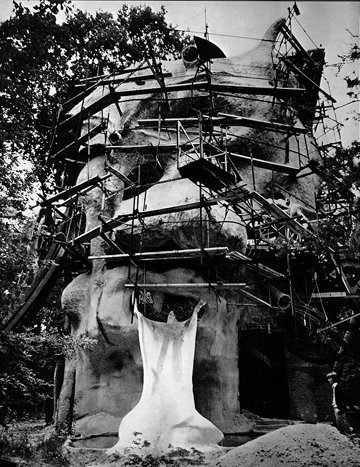
[Le Monstre Dans Las Foret - Monster in the Forest - a super-collaboration-individual-long-distance-permanent-collective-Gigantoleums-appart under construction since 1970]
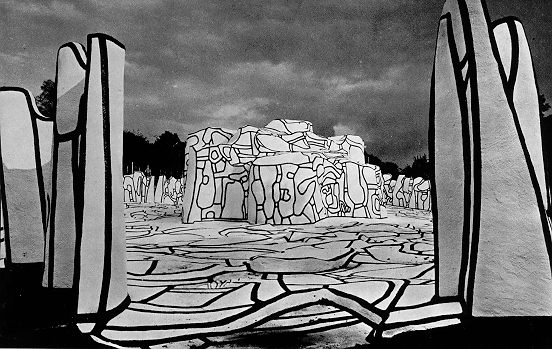
[Closerie (cloister) Falballa, Perigny-sur-Yerres France - Jean Dubuffet]

[house in Knokke, Belgium by Niki de Saint Phalle (also a contributor to Le Monstre)]
The most successful of organic architecture developed in this period seems to be that developed as earth covered houses and buildings, the reason being that the thermal mass of earth helped improve climate control while also hiding exteriors shell surfaces which were often far less attractive than the interiors. Sometimes architects working exclusively in the field of earth sheltered architecture discovered organic design as a means of supporting the naturalist and ecological ideals they wanted to express through the underground architecture concept. Well known earth shelter advocate Malcom Wells is a case in point, though the bulk of his work in this area does not employ organic design.
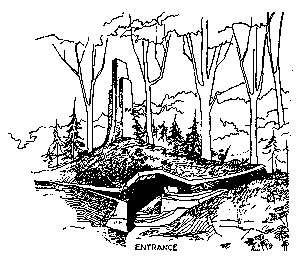
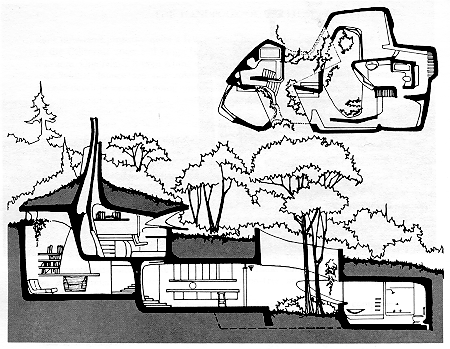
[A Random House by Malcom Wells - one of the finest examples of 70s organic architecture yet a singular design among the many works of this earth shelter advocate]
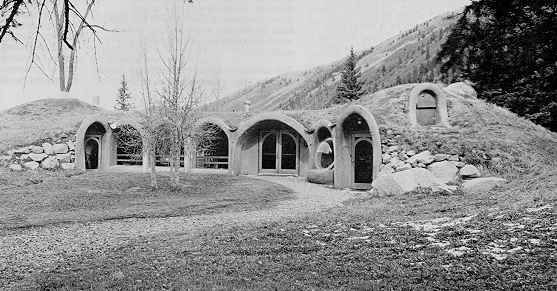
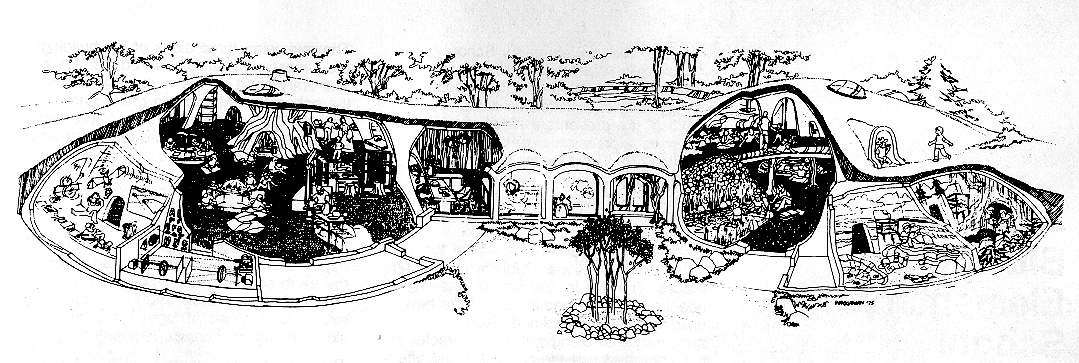
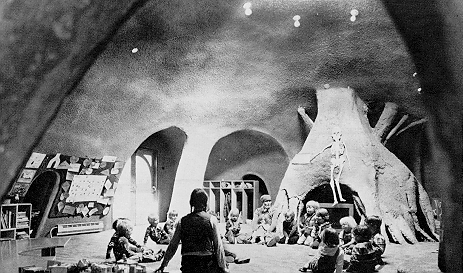
[Wildwood School, Pitkin County (near Aspen), Colorado by David F. Gibson. Note the `rabbit hole` entrance upper-right above the nature room and the`tree trunk` fireplace in the arts room]
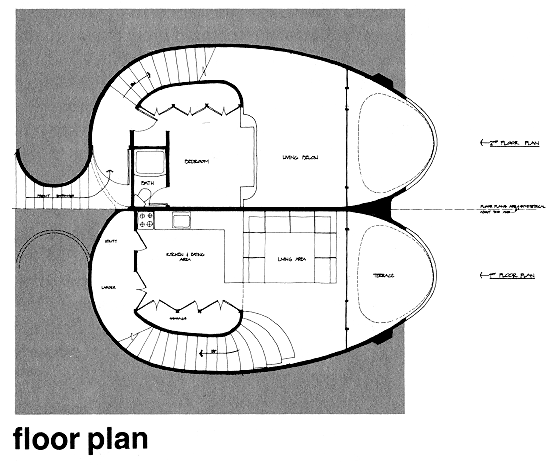
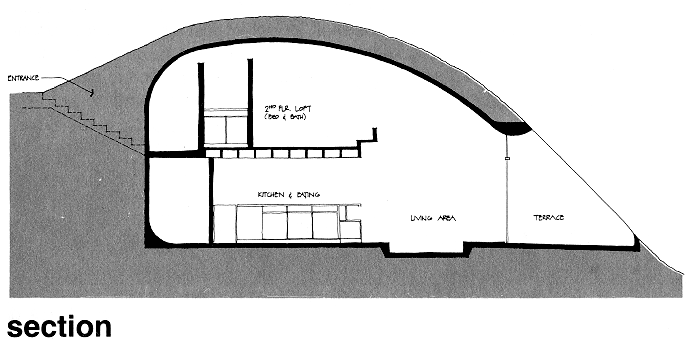
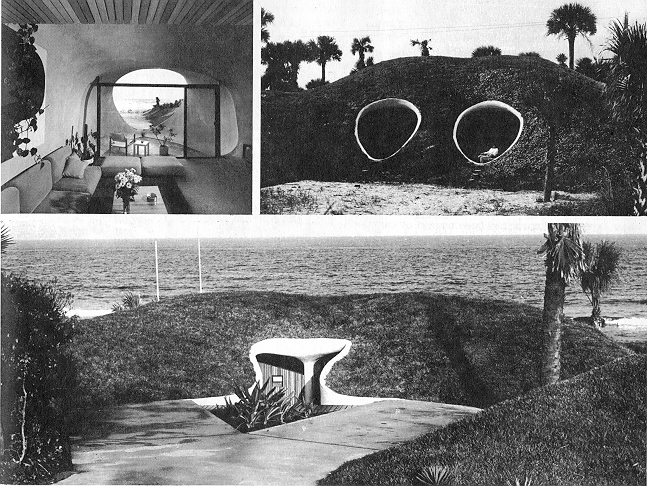

[Dune House, Atlantic Beach, FL. Multi-family unit housing by William Morgan. - A model for Aquarian breakwater housing?]
