| V.2 No 1 | 69 |
On solution for an infinite heteroheneous line |
|
|
|
In the first section there propagates the progressive wave whose phase shift is determined by the complex multiplier in the square brackets of (42): |
|
|
(45) |
In the second section we see a complex vibration process determined by the similar expression in brackets in (43). On one hand, the wave process in this section has the phase |
|
|
(46) |
depending on parameter x0 nonlinearly. On the other hand, the wave amplitude depends on this parameter nonlinearly too. Its value is proportional to |
|
|
(47) |
The amplitude reaches its extreme values at the points |
|
 |
(48) |
where p = 0, 1, 2, ... . In the first case the expression (47) is equal to v2, and in the second case – to v1. Depending on the relationship between the wave propagation velocities in related sections, at these points we observe the maximums and minimums of the wave process. The results obtained for the first and second sections essentially differ from the conventional concept based on a simple superposition of the direct and reverse waves. According to this concept, “the amplitude reflection coefficient |
|
|
(49) |
the amplitude transmission coefficient |
|
|
(50) |
(where A1,
A2, B1 are respectively
the amplitude coefficients of direct, reflected and transmitted waves;Z1= In the third section of elastic line we observe the progressive
wave having the along-the-line phase delay |
|
|
|
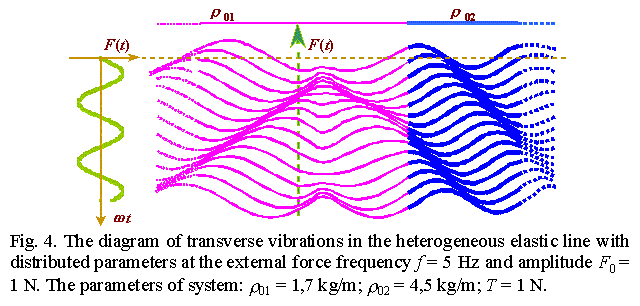
To see the typical vibration pattern, conveniently pass from the longitudinal to transverse vibrations. It will be sufficient for it to direct the external force perpendicularly to the line axis and to substitute in the solutions (42) – (44) the longitudinal shift x - x0 by the transversal shift y . The typical diagram of transversal vibrations in a heterogeneous elastic distributed line is shown in Fig. 4. The pattern presented in it completely corroborates the above analysis of solutions (42) – (44). |
|
Contents: / 60 / 61 / 62 / 63 / 64 / 65 / 66 / 67 / 68 / 69 / 70 /






 01
01 1 =T/
1 =T/  and are the same
for the waves of any frequency. They are real and do not introduce any phase shifts except
the shift by
and are the same
for the waves of any frequency. They are real and do not introduce any phase shifts except
the shift by  changing the
sign of the term” [11, p.123]. As we see from this analysis, when reflecting from the
heterogeneity transition, there forms a complex wave process whose phase and amplitude
depend directly on the external force frequency, the same as on elastic line parameters.
These conclusions are true also for the transmitted wave.
changing the
sign of the term” [11, p.123]. As we see from this analysis, when reflecting from the
heterogeneity transition, there forms a complex wave process whose phase and amplitude
depend directly on the external force frequency, the same as on elastic line parameters.
These conclusions are true also for the transmitted wave.