| V.2 No 1 | 63 |
On solution for an infinite heteroheneous line |
|
|
|
|
|
When for i |
|
|
(11) |
for k
|
|
|
(12) |
and for i
|
|
|
(13) |
where |
|
|
(14) |
|
(15) |
In the first section related to i The less difference
between the element masses m1 and m2
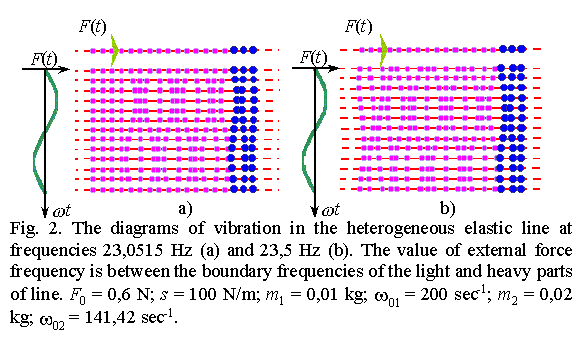
is, the more vibration amplitude is. Basically, at m1 When the expression in square brackets in (11) vanished, i.e. at |
|
|
(16) |
| the vibration amplitude in the first section vanishes, as it is visual in Fig. 2a. And in the above case, when all sections have vibrated periodically, such phenomenon was impossible, because of the phase shift presence in the summands in the braces of (2). In (14) the phase shift vanishes, due to the heavy section transition to the aperiodical regime. | |
|
|
Contents: / 60 / 61 / 62 / 63 / 64 / 65 / 66 / 67 / 68 / 69 / 70 /



 2 exceeds the unit
value, in the heavy part of line the aperiodical vibration regime settles. With it all the
terms in the right-hand parts of the system (2) – (4) transform as according to (8),
and this system takes the following form:
2 exceeds the unit
value, in the heavy part of line the aperiodical vibration regime settles. With it all the
terms in the right-hand parts of the system (2) – (4) transform as according to (8),
and this system takes the following form: k
k

 n
+ 1
n
+ 1


 1 and the amplitude depending on the
parameters of both sections of line. However, the general phase delay has changed. If in
(2) the vibration process has delayed by
1 and the amplitude depending on the
parameters of both sections of line. However, the general phase delay has changed. If in
(2) the vibration process has delayed by  relatively to the external force phase, then in (11) the general
delay is determined by the parameter (-
relatively to the external force phase, then in (11) the general
delay is determined by the parameter (- 2). At
  +1 we have
  we have
  , not zero.
 i
i  and cos