
| MATERIALS. TECHNOLOGIES. TOOLS | 16 |
S.B. Karavashkin |
|
|
|
|
|
Thus, the solution (17) determines a whole class of implicit functions satisfying the linear wave equation. And the presence of a new class of functions being the solution of differential equation (12) does not violate a least the theorem of uniqueness of solution of differential equation, because under definite conditions |
|
 |
|
the expression (14) degenerates into (13). Hereby it is proved that the solution known before is a particular case of more general class of functions. The found class of implicit functions determines a non-linear wave;
its degree of deformation depends on the type of functions |
|
|
(18) |
the solution of a wave equation (12) describes a
progressive wave propagating along the axis x and inclined by the angle
Studying the changes appearing in the wave physics solutions, we must touch briefly the changes in the vector algebra equations appearing when taking into account the dynamical processes in power fields. The main conservation laws related to the vector flux are known to be formulated on the basis of Ostrogradsky-Gauss theorem about the flux of vector through a picked out space region. The Ostrogradsky-Gauss theorem is known in its turn to be formulated for stationary fields, i.e., for the case when the vector of flux does not depend on time directly. In dynamical fields the pattern essentially changes. Actually, let in some bounded, connective, free of sources
spatial region |
|
|
(19) |
Pick out of
this region four surfaces a0, a1, a2, a3
perpendicular to the wave propagation direction, and form with their help three picked out
volumes V01, V02,
V03 bounded by the corresponding surfaces and
lateral surface connecting them. Noting that the wave is 1D and On the basis of this model, consider a conventional definition of the divergence of vector (see, e.g., [5, p.166]) |
|
|
(20) |
where
V is the studied region containing the point ( Since the picked out regions V01, V02, V03 were finite, study first the expression |
|
|
(21) |
where
i=1, 2, 3. For it, plot the time-spatial variation of |
|


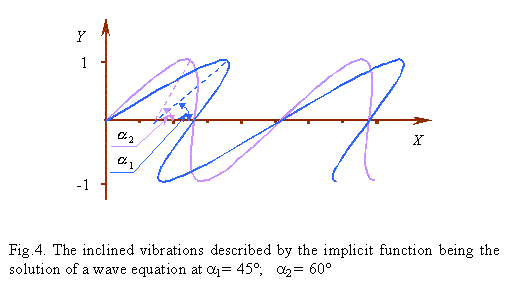
 1(y)
and
1(y)
and 
 , which completely
corresponds to the inclined vibration in an 1D line considered above.
, which completely
corresponds to the inclined vibration in an 1D line considered above.  propagate a plane-parallel wave whose power vector
  (x,t)
has a standard form
(x,t)
has a standard form

 ); S is the closed-loop surface limiting
the region V;
); S is the closed-loop surface limiting
the region V;  here denotes the most distance from the point (

 0i =
0i =