|



Since
there was no official flag during the first year of the United States,
there
were a great number of homespun flag designs.
This
flag is without question the most well known of those.
The
Betsy Ross Flag!
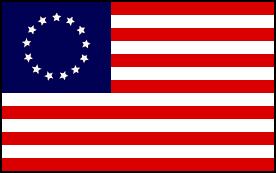
The
First Official United States Flag: This 13-Star Flag became the Official
United States Flag on June14th, 1777 and is the
result
of the congressional action that took place on that date. Much evidence
exists pointing to Congressman Francis
Hopkinson
as the person responsible for its design.The only President to serve under
this flag was George Washington
(1789-1797).
This Flag was to last for a period of 18 years.
Each
star and stripe represented a Colony of which there were thirteen, united
nearly one year earlier by the Declaration of
Independence.
The thirteen Colonies are listed below with the date that each ratified
the Constitution and became a State.

(1st)
Delaware December 7th, 1787
(2nd)
Pennsylvania December 12th,1787
(3rd)
New Jersey December18th, 1787
(4th)
Georgia January 2nd, 1788
(5th)
Connecticut January 9th, 1788
(6th)
Massachusetts February 6th, 1788
(7th)
Maryland April 28th, 1788 |
(8th)
South Carolina May 23rd, 1788
(9th)
New Hampshire June 21st, 1788
(10th)
Virginia June 25th, 1788
(11th)
New York July 25th, 1788
(12th)
North Carolina November 21st, 1789
(13th)
Rhode Island May 29th, 1790 |
The
Star Spangled Banner: This Flag became the Official United States Flag
on May 1st,1795. Two
stars
were added for the admission of Vermont (the 14th State on March 4th, 1791)
and Kentucky (the
15th
State on June 1st, 1792, and was to last for 23 years. The five Presidents
who served under this
flag
were; George Washington (1789-1797), John Adams (1797-1801), Thomas Jefferson
(1801-1809),
James
Madison (1809-1817), and James Monroe (1817-1825).
The
15-star, 15-stripe flag was authorized by the Flag Act of January 13, 1794,
adding 2 stripes and 2
Stars.
The regulation went into effect on May 1, 1795. This flag was the only
U.S. Flag to have more
than
13 stripes. It was immortalized by Francis Scott Key during the bombardment
of Fort McHenry,
Sept
13, 1814. The image above is representative of the actual flag that flew
over Fort McHenry on
that
day and which is now preserved in the Smithsonian Museum. You can notice
the "tilt" in some of
the
stars just as in the original Star Spangled Banner.

The
1818 Flag:Realizing that the addition of a new star and new stripe for
each new State was
impractical,
Congress passed the Flag Act of 1818 which returned the flag design to
13 stripes and
specified
20 stars for the 20 states.
This
Flag became the Official United States Flag on April 13th, 1818. Five stars
were added for the
admission
of Tennessee (the 16th State on June 1st, 1796), Ohio (the 17th State on
March 1st, 1803),
Louisiana
(the 18th State on April 30th, 1812), Indiana (the 19th State on December
11th, 1816), and
Mississippi
(the 20th State on December 10, 1817), and was to last for just one year.
The only
President
to serve under this flag was James Monroe (1817-1825).

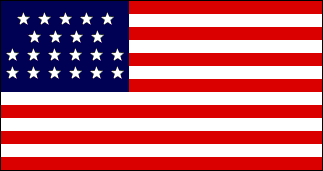
The
21-Star Flag: This Flag became the Official United States Flag on July
4th,1819. A star was added
for
the admission of Illinois (December 3rd, 1818) and was to last for just
one year. The only President
to
serve under this flag was James Monroe (1817-1825).
|
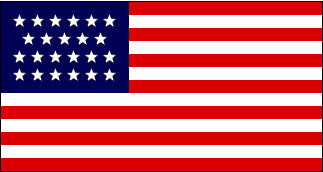
The
23-Star Flag: This Flag became the Official United States Flag on July
4th, 1820. Two stars were
added
for the admission of Alabama (the 22nd state on December 14th,1819) and
Maine (the 23rd
state
on March 15, 1820) and was to last for 2 years. The only President to serve
under this flag was
James
Monroe (1817-1825). |
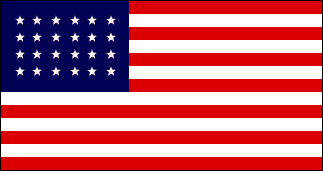
The
24-Star Flag: This Flag became the Official United States Flag on July
4th,1822. A star was added
for
the admission of Missouri (August 10th, 1821) and was to last for fourteen
years. The Presidents
who
served under this flag included James Monroe (1817-1825), John Quincy Adams
(1825-1829), and
Andrew
Jackson (1829-1837). |

The
25-Star Flag: This Flag became the Official United States Flag on July
4th, 1836. A star was added
for
the admission of Arkansas (June 15th, 1836) and was to last for just one
year. The two Presidents to
serve
under this flag were Andrew Jackson (1829-1837) and Martin Van Buren (1837-1841). |
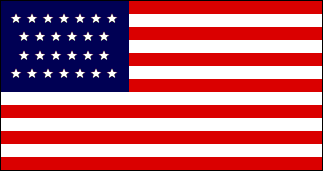
The
26-Star Flag: This Flag became the Official United States Flag on July
4th, 1837. A star was added
for
the admission of Michigan (January 26th,1837) and was to last for 8 years.
The four Presidents to
serve
under this flag were; Martin Van Buren (1837-1841), William Henry Harrison
(1841), John Tyler
(1841-1845),
and James Polk (1845-1849). |

The
27-Star Flag: This Flag became the Official United States Flag on July
4th, 1845. A star was added
for
the admission of Florida and was to last for only 1 year. The only President
to serve under this flag
was
James Polk (1845-1849).
|

The
28-Star Flag: This Flag became the Official United States Flag on July
4th, 1846. A star was added
for
the admission of Texas (December 29th, 1845) and was to last for only 1
year. The only President to
serve
under this flag was James Polk (1845-1849).
|

The
29-Star Flag: This Flag became the Official United States Flag on July
4th, 1847. A star was added
for
the admission of Iowa (December 28th, 1846) and was to last for only 1
year. The only President to
serve
under this flag was James Polk (1845-1849). |
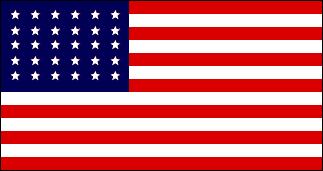
The
30-Star Flag: This Flag became the Official United States Flag on July
4th, 1848. A star was added
for
the admission of Wisconsin (May 29th, 1848) and was to last for 3 years.
The three Presidents to
serve
under this flag were; James Polk (1845-1849), Zachary Taylor (1849-1850),and
Millard Fillmore
(1850-1853). |

The
31-Star Flag: This Flag became the Official United States Flag on July
4th 1851. A star was added
for
the admission of California (September 9th, 1850) and was to last for seven
years. The three
Presidents
who served under this flag were; Millard Fillmore (1850-1853), Franklin
Pierce (1853-1857),
and
James Buchanan (1857-1861). |

The
32-Star Flag: This Flag became the Official United States Flag on July
4th,
1858.
A star was added for the admission of Minnesota (May 11, 1858) and was
to last for just one
year.
The only President to serve under this flag was James Buchanan (1857-1861)
|

The
33-Star Flag: This Flag became the Official United States Flag on July
4th, 1859. A star was added
for
the admission of Oregon (February 14, 1859) and was to last for 2 years.
The two Presidents to
serve
under this flag were James Buchanan (1857-1861) and Abraham Lincoln (1861-1865). |

The
34-Star Flag: This Flag became the Official United States Flag on July
4th, 1861. A star was added
for
the admission of Kansas (January 29th, 1861) and was to last for 2 years.
The only President to
serve
under this flag was Abraham Lincoln (1861-1865). |
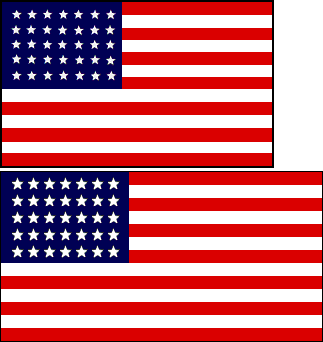
The
35-Star Flag: This Flag became the Official United States Flag on July
4th, 1863. A star was added
for
the admission of West Virginia (June 20th, 1863) and was to last for 2
years. The two Presidents to
serve
under this flag were Abraham Lincoln (1861-1865) and Andrew Johnson (1865-1869). |
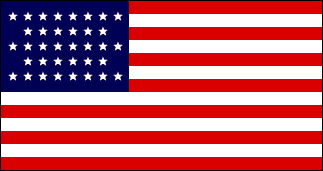
The
36-Star Flag: This Flag became the Official United States Flag on July
4th, 1865. A star was added
for
the admission of Nevada (October 31st, 1864) and was to last for 2 years.
The only President to
serve
under this flag was Andrew Johnson (1865-1869). |

The
37-Star Flag: This Flag became the Official United States Flag on July
4th 1867. A star was added
for
the admission of Nebraska (March 1st,1867) and was to last for ten years.
The three Presidents who
served
under this flag were; Andrew Johnson (1865-1869), Ulysses S. Grant (1869-1877),
and
Rutherford
B. Hayes (1877-1881).
|
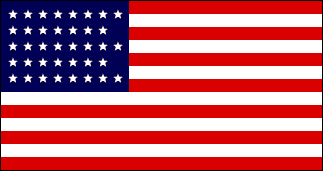
The
38-Star Flag: This Flag became the Official United States Flag on July
4th, 1877. A star was added
for
the admission of Colorado (August 1st 1876) and was to last for 13 years.
The five Presidents to
serve
under this flag were; Rutherford B. Hayes (1877-1881), James A. Garfield
(1881), Chester A.
Arthur
(1881-1885), Grover Cleveland (1885-1889), and Benjamin Harrison (1889-1893).
|
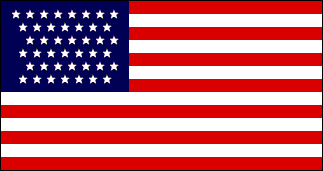
The
43-Star Flag: This Flag became the Official United States Flag on July
4th, 1890. Five stars were
added
for the admission of North Dakota (the 39th State on November 2nd,1889),
South Dakota (the
40th
State on November 2nd,1889), Montana (the 41st State on November 8th,1889),
Washington (the
42nd
State on November 11th,1889), and Idaho (the 43rd State on July 3rd, 1890)
and was to last for
just
1 year. The only President to serve under this flag was Benjamin Harrison
(1889-1893). |
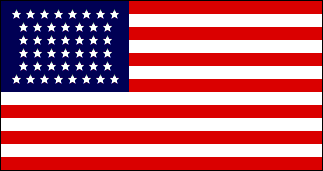
The
44-Star Flag: This Flag became the Official United States Flag on July
4th, 1891. A star was added
for
the admission of Wyoming (July 10, 1890) and was to last for 5 years. The
Presidents to serve under
this
flag were Benjamin Harrison (1889-1893) and Grover Cleveland (1893-1897).
|

The
45-Star Flag: This Flag became the Official United States Flag on July
4th, 1896. A star was added
for
the admission of Utah on January 4th, 1896, and was to last for 12 years.
The Presidents to serve
under
this flag were Grover Cleveland (1893-1897), William McKinley (1897-1901),and
Theodore
Roosevelt
(1901-1909). |
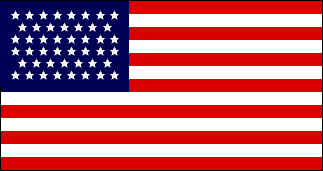
The
46 Star Flag: On July 4,1908, the U.S. flag grew to 46 stars with the addition
to the Union of
Oklahoma
(November 16, 1907). Theodore Roosevelt (1901-1909) and William H. Taft
(1909-1913)
served
as President under the 46 star flag. This was the official flag for 4 years.
|
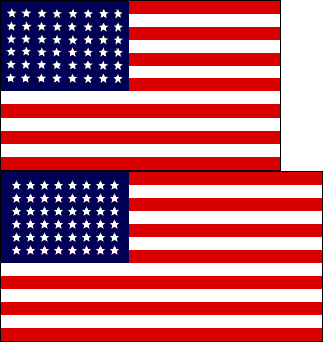
The
48 Star Flag: On July 4,1912, the U.S. flag grew to 48 stars with the addition
of New Mexico
(January
6th, 1912) and Arizona (February 14, 1912) Executive Order of President
Taft dated June 24,
1912
- established the proportions of the flag and provided for arrangement
of the stars in six horizontal
rows
of eight each, a single point of each star to be upward. This flag was
official for 47 years, longer
than
any other flag, through two World Wars and the emergence of the United
States of America as
the
leading nation of the world. Eight Presidents served under this flag; William
H. Taft (1909-1913),
Woodrow
Wilson (1913-1921), Warren Harding (1921-1923), Calvin Coolidge (1923-1929),
Herbert
Hoover
(1929-1933), Franklin D. Roosevelt (1933-1945), Harry S.Truman (1945-1953),
Dwight D.
Eisenhower
(1953-1961)
|

49-Star
Flag: On January 3rd,1959 Alaska was formally granted statehood placing
the 49th star on our
Flag.Executive
Order of President Eisenhower dated January 3, 1959 - provided for the
arrangement of
the
stars in seven rows of seven stars each, staggered horizontally and vertically.
The
first 49-star flag was made in the Army Quartermaster Depot at Philadelphia,
and was used in the
White
House ceremony when President Dwight D. Eisenhower (1953-1961) signed the
proclamation
admitting
Alaska to the Union. Subsequently, this flag was carried to Philadelphia
by Senator Hugh
Scott
of Pennsylvania, who gave it to the mayor of Philadelphia to raise over
Independence Hall on
July
4th, 1959. After these ceremonies Scott gave the flag to his colleague,
Senator Earnest Gruening
of
Alaska, who, in turn, delivered it to Governor William A. Eagan to be flown
over the state capitol at
Juneau.
This flag was later given to the Alaskan State Mueseum for preservation.
The
49-Star flag was official for only one year, until July 4, 1960, when Hawaii
achieved its Statehood
and
the 50-Star flag was born. President Eisenhower was the only President
to serve under this flag.
|

50-Star
Flag: Executive Order of President Eisenhower dated August 21, 1959 - provided
for the arrangement of the stars in
nine
rows of stars staggered horizon tally and eleven rows of stars staggered
vertically. This is the current flag of the United
States.
Hawaii was admitted as the 50th state on August 21st, 1959. The 27th flag
of the United States became the official
flag
on July 4th, 1960. Nine presidents have served under this flag; Dwight
D. Eisenhower (1953-1961), John F. Kennedy
(1961-1963),
Lyndon B. Johnson (1963-1969), Richard M. Nixon (1969-1974), Gerald R.
Ford (1974-1977), Jimmy Carter
(1977-1981),
Ronald W. Reagan (1981-1989), George Bush (1989-1993), and William J. Clinton
(1993-2000), George W. Bush(2000-present)
|
Long
May She Wave!
 


|

