

Evolution
of the United States Flag
No
one knows with absolute certainty who designed the first stars and stripes
or
who made it. Congressman Francis Hopkinson seems most likely
to have designed it,
and
few historians believe that Betsy Ross, a Philadelphia seamstress, made
the first one.
Until
the Executive Order of June 24, 1912, neither the order of the stars nor
the
proportions
of the flag was prescribed. Consequently, flags dating before this
period
sometimes
show unusual arrangements of the stars and odd proportions, these features
being
left
to the discretion of the flag maker. In general, however, straight rows
of stars and proportions
similar
to those later adopted officially were used. The principal acts affecting
the flag of
the
United States are the following:
On
June 14, 1777, in order to establish an official flag for the new nation,
the
Continental Congress passed the first Flag Act:
"Resolved,
That the flag of the United States be made of thirteen stripes, ."
Act
of January 13, 1794 - provided for 15 stripes and 15 stars after May 1795.
Act
of April 4, 1818 - provided for 13 stripes and one star for each state,
to be added to the flag
on
the 4th of July following the admission of each new state, signed by President
Monroe.
Executive
Order of President Taft dated June 24, 1912 - established proportions of
the flag
and
provided for arrangement of the stars in six horizontal rows of eight each,
a
single point of each star to be upward.
Executive
Order of President Eisenhower dated January 3, 1959 –
provided
for the arrangement of the stars in seven rows of seven stars each,
staggered
horizontally and vertically.
Executive
Order of President Eisenhower dated August 21, 1959 –
provided
for the arrangement of the stars in nine rows of
stars
staggered horizon tally and eleven rows of stars staggered vertically.

The
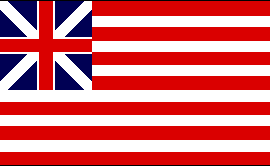
Grand Union 1775: Also known as the Continental flag, it is the first true
U.S. Flag. It combined the British King's Colours
and
the thirteen stripes signifying Colonial unity. George Washington liked
this design so well that he chose it to be flown to
celebrate
the formation of the Continental Army on New Years Day, 1776. On that day
the Grand Union Flag was proudly
raised
on Prospect Hill in Somerville, near his headquarters at Cambridge, Massachusetts.
The
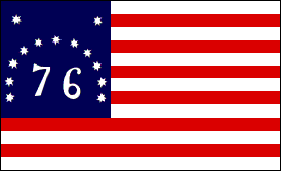
Bennington Flag: Used in the Battle of Bennington, August 16, 1777, by
Vermont militia. This flag is the first to lead
American
armed forces on land. The original is preserved in the museum at Bennington,
Vermont.
The
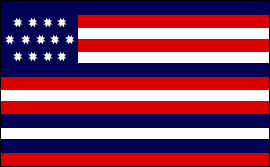
Serapis Flag: Designed with 13 stripes alternating red , white and blue.
This flag was raised by Captain John Paul Jones
on
the British frigate Serapis during the most famous Revolutionary naval
battle.
He
was born John Paul in Scotland in 1747 and went to sea when he was only
twelve years old. By the time he arrived in
Philadelphia
in 1775 as an experienced sea captain, he had changed his name to John
Paul Jones.
After
conducting sea raids on the coast of Britain, he took command in 1779 of
a rebuilt French merchant ship, renamed the
U.S.S.Bonhomme
Richard to honor Benjamin Franklin. On September 23, 1779, Jones engaged
the British frigate Serapis in
the
North Sea, daringly sailing in close, lashing his vessel to the British
ship, and fighting the battle at point-blank range.
During
the fight two of his cannon burst, and the British captain asked Jones
if he was ready to surrender. Replied Jones: "Sir,
I
have not yet begun to fight." The American crew finally boarded the Serapis
after the British had struck her colors, and from
the
deck of the Serapis they watched the U.S.S.Bonhomme Richard sink into the
North Sea.
The
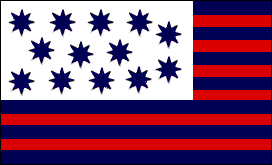
Guilford Flag: This unusual flag was made with thirteen 8-pointed stars
in a wide field. Historical records report this flag
carried
by North Carolina militiamen at the Battle of Guilford Courthouse, March
17,1781.
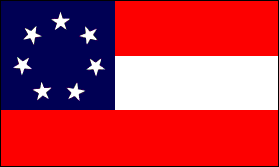
The
First Official Flag of the Confederacy. Although less well known than the
"Confederate Battle Flags",the Stars and Bars
was
used as the official flag of the Confederacy from March 1861 to May of
1863. The pattern and colors of this flag did not
distinguish
it sharply fom the Stars and Stripes of the Union. Consequently, considerable
confusion was caused on the
battlefield.
The
seven stars represent the original Confederate States; South Carolina (December
20, 1860), Mississippi(January 9, 1861),
Florida
(January 10,1861), Alabama (January 11, 1861), Georgia (January 19, 1861),
Louisiana (January 26, 1861), and Texas
(February
1, 1861).
The
Confederate Battle Flag. The best-known Confederate flag, however, was
the Battle Flag, the familiar "Southern Cross".
It
was carried by Confederate troops in the field which were the vast majority
of forces under the confederacy.
The
Stars represented the 11 states actually in the Confederacy plus Kentucky
and Missouri.
The
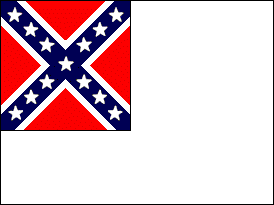
second Official Flag of the Confederacy. On May 1st,1863, a second design
was adopted, placing the Battle Flag (also
known
as the "Southern Cross") as the canton on a white field. This flag was
easily mistaken for a white flag of surrender
especially
when the air was calm and the flag hung limply.
The
flag now had 13 stars having been joined officially by four more states,
Virginia (April 17, 1861), Arkansas (May 6, 1861),
Tennessee
(May 7, 1861), North Carolina (May 21, 1861). Efforts to secede failed
in Kentucky and Missouri though those states
were
represented by two of the stars.

The
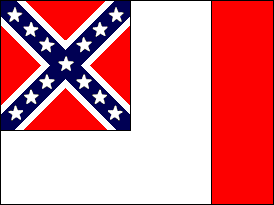
third Official Flag of the Confederacy.On March 4th,1865, a short time
before the collapse of the Confederacy, a third
pattern
was adapted; a broad bar of red was placed on the fly end of the white
field.
Confederate
Navy Jack: Used as a navy jack at sea from 1863 onward.
This
flag has become the generally recognized symbol of the South.