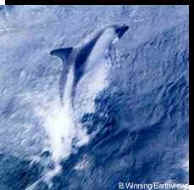
Peales Dolphin
|
Peale's Dolphin can be found in cool coastal waters of southern South
America, including the Falkland Islands. Classification:
The first specimen, harpooned and brought aboard an United States
Exploring Expedition ship in February 1839, was described, measured and
eventually named by Titian R. Peale in 1848. No subspecies are recognised,
and the specific name refers to this dolphin's southern distribution. Local Names:
Blackchin Dolphin; Peale's Black-Chinned Dolphin; Southern Dolphin;
Peale's Porpoise; Delfin Austral (Spanish).
Description:
This dolphin has a robust body and short, indistinct beak. The large grey-black
dorsal sits atop the predominantly grey-black back, which is interrupted
by a gradually widening grey-white streak along each side. The face,
gently-sloping melon and flippers are also dark. The sides are grey-white,
and are separated from the white belly by a distinct dark line. There is
also a brilliant white patch at the 'armpits'. There are 27-33 pairs of
teeth per jaw. The largest specimen recorded measures 2.16m in length and
weighed approximately 115kg. Recognition at
sea:
Peale's Dolphins are most likely to be confused with the similar Dusky
Dolphin. However, the former's non-forked blaze along the flanks and dark
'face' should aid correct identification. The Hourglass Dolphin may also
be confused with Peale's Dolphins, but the former is strikingly
black-and-white. Habitat:
Peale's Dolphins have a restricted distribution, preferring the coastal
waters around South America. They prefer cool temperate inshore waters. Food &
Feeding: It
is not fully known what Peale's Dolphins prey upon; the stomach of one
specimen beached in the Falkland Isles contained octopus. Behavior: This
species have been observed in groups of between 5-30 individuals. They
like to bowride, often porpoising out of the water with long, low-angled
leaps. They often speed ahead and leap high into the air, only to fall
back into the sea with a loud slapping noise. It is not thought that these
dolphins mass strand.
|
|
|