
Hourglass Dolphin
A little-known species, Hourglass Dolphins occur in the cold waters of the Southern Hemisphere.
Classification: In 1824, Quoy and Gaimard originally classified this dolphin as Delphinus cruciger. The specific name refers to the criss-crossing hourglass pattern - it is taken from the Latin for 'cross' (crucis) and 'carry, bear' (gero).
Local Names: Wilson's Dolphin (after the Antarctic explorer); Southern White-Sided Dolphin; Delfin Cruzado (Spanish).
 Description:
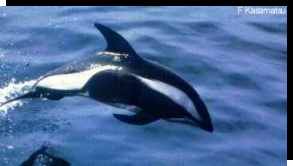
Hourglass Dolphins are essentially black and white in a crude hourglass pattern.
The short beak is black, as are the flippers, dorsal fin and flukes. There us a
dark patch around each eye. The cape and sides are also black, the latter
interrupted by two white patches which are joined in a criss-cross 'hourglass'
shape. The underside is also white. There is a strongly curved keel under the
tail stock. It is thought that Hourglass Dolphins reach a maximum length of
between 1.6-1.8m.
Description:
Hourglass Dolphins are essentially black and white in a crude hourglass pattern.
The short beak is black, as are the flippers, dorsal fin and flukes. There us a
dark patch around each eye. The cape and sides are also black, the latter
interrupted by two white patches which are joined in a criss-cross 'hourglass'
shape. The underside is also white. There is a strongly curved keel under the
tail stock. It is thought that Hourglass Dolphins reach a maximum length of
between 1.6-1.8m.
Recognition at sea: Due to the striking pattern of colours, Hourglass Dolphins are not likely to be confused with any other species.
Habitat: Hourglass Dolphins prefer deep pelagic waters with a surface temperature of 1-10ºC.
Food & Feeding: It is thought that Hourglass Dolphins prey on small fish.
Behavior: This species is normally found in units of between 1-6 animals, and occasionally up to 40 individuals gather together for a short amount of time. They associate with Fin Whales and Southern Bottlenose Whales and are highly active. They are well-known for bowriding, and when porpoising they create a highly visible spray. They are commonly seen travelling through a series of low-angled leaps.
