
Hector's
Dolphin
|
Hector's Dolphins occur in the coastal waters of New Zealand. Classification: Hector, the New Zealand zoologist, collected the first species in 1869. In 1881, van Beneden gave it the name Cephalorhynchus hectori. Local Names: Little Pied Dolphin; New Zealand Dolphin; New Zealand White-Front Dolphin.
Recognition at sea: Due to the striking combination of colours and the characteristic dorsal fin, Hector's Dolphins are not likely to be confused with any other species. Habitat: Hector's Dolphins prefer coastal waters of less than 300m deep. Normally spotted within 1km of the shore, they rarely travel further than 9km offshore. Food & Feeding: Hector's Dolphins seem to prey on small fish, such as mullet and cod, as well as squid. Behavior: This species is normally found in units of between 2-8 animals, and occasionally up to 50 individuals gather together for a short amount of time. When this happens, activity (mainly leaping and lobtailing) increases. They avoid boats moving faster than 18kph and have been known to bowride slower boats and spyhop.
|
|
|

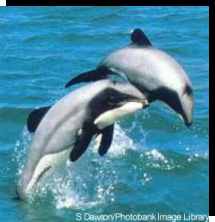 Description:
Hector's Dolphin is small and stocky with a characteristic round black
dorsal. The back and sides are light grey, with a dark streak stretching
across the middle. A grey-black forehead can be seen above the
black-tipped indistinct beak. There is a dark patch from beak, across the
eye, to the flippers. The throat, chest and belly are white with a dark
border. A white finger-shaped lobe extends across the flanks towards the
tail, and there is a white 'armpit' behind each flipper. Adults reach
between 1.2-1.5m in length, and weigh 50-60kg.
Description:
Hector's Dolphin is small and stocky with a characteristic round black
dorsal. The back and sides are light grey, with a dark streak stretching
across the middle. A grey-black forehead can be seen above the
black-tipped indistinct beak. There is a dark patch from beak, across the
eye, to the flippers. The throat, chest and belly are white with a dark
border. A white finger-shaped lobe extends across the flanks towards the
tail, and there is a white 'armpit' behind each flipper. Adults reach
between 1.2-1.5m in length, and weigh 50-60kg.