
Heaviside's Dolphin
|
Heaviside's Dolphin can be found in
cold waters along the south-western coast of Africa. Classification:
Gray first described Heaviside's Dolphin after a specimen was brought to
him by a Captain Haviside in 1827. The additional 'e' in the name is
probably a case of mistaken identity - another captain, this time Captain
Heaviside (complete with 'e'), was a surgeon who collected non-cetacean
specimens. Originally assigned to the Delphinus genus, this species was
re-assigned to Cephalorhynchus by Cuvier a year later. Local Names:
South African Dolphin; Benguela Dolphin.
Recognition at
sea: Due to
the striking combination of colours, Heaviside's Dolphins are not likely
to be confused with any other species. Habitat: Heaviside's
Dolphins prefer coastal waters of less than 150m deep. Food &
Feeding:
Heaviside's Dolphins seem to prey on fish, though information about this
is limited. Behavior: This species is normally found in units of between 2-10 animals, and occasionally up to 30 individuals gather together for a short amount of time.
|
|
|

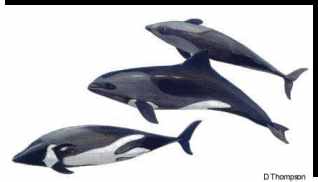 Description:
Heaviside's
Dolphin is small and stocky. The fore half of the body is uniformly grey
in colour, with the dorsal cape, fin, flanks and keel being dark
blue-black. A similarly-coloured stripe runs from the blowhole to the
cape. The flippers and eyepatch are the same colour. The beak is
indistinct, and there are 44-56 teeth in each jaw. The underside is white,
with white 'armpits' behind the flippers and a rhombus shape on the chest.
A finger-shaped patch extends from the belly along each flank. Adults grow
to around 1.7m in length and weigh around 60-70kg.
Description:
Heaviside's
Dolphin is small and stocky. The fore half of the body is uniformly grey
in colour, with the dorsal cape, fin, flanks and keel being dark
blue-black. A similarly-coloured stripe runs from the blowhole to the
cape. The flippers and eyepatch are the same colour. The beak is
indistinct, and there are 44-56 teeth in each jaw. The underside is white,
with white 'armpits' behind the flippers and a rhombus shape on the chest.
A finger-shaped patch extends from the belly along each flank. Adults grow
to around 1.7m in length and weigh around 60-70kg.