
Boto
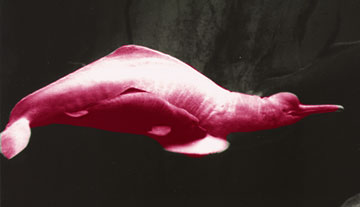
The boto is the largest river dolphin, weighing up to 180 kg (400 lb) with a length up to 2.6 m (8.5'). Most adult botos are pink, although some have a darker back or are partially gray. Although the boto's eyes appear small and inconspicuous, they are actually, in the skull, as large as those of marine dolphins. Thus the boto can see well. On the other hand, it can also rely on its sonar as it swims through a murky flooded forest. Its bulbous forehead ends in a long, tube-shaped beak bearing sensory bristles that allow it to feel for food in a river’s depths. The pectoral fins are broad and paddle-like; the flukes are broad and triangular; and it lacks a prominent dorsal fin, possessing instead a low ridge along the back.
The boto uses fresh waters of all types as habitat but is not found in estuaries or other saline waters. It appears to favor areas such as confluences, sharp bends, and sandbars, particularly the deeper waters in these areas. In the central Amazon basin, large changes in water levels affect the local distribution of botos. A significant increase in water level during the flood season leads to the inundation of large areas of forest. Botos move out of the main river into channels and small lakes and then into the forest itself, swimming among the trees, as the rising waters flood the forest.
The boto is a generalist feeder. Its diet is known to include over 50 species of smaller fish, as well as freshwater crabs and river turtles. Feeding is usually done close to shore, in shallow bays, in flooded forests, or at confluences. The boto is a slow-moving animal that usually swims at 2.4 - 5.1 km/h (1.5 - 3.2 mi/h) with bursts of more than 23 km/h (14 mi/h). Its dives usually last less than 1 - 2 minutes. The boto is mainly solitary, with less than 1/4 of sightings involving pairs (usually a mother and calf). Larger groups are rarely seen, although loose aggregations have been observed at feeding areas.
The boto occurs throughout much of the Amazon and Orinoco watersheds, being found almost everywhere it can physically reach without venturing into marine waters. The principal limits to its distribution seem to be impassable rapids, waterfalls, and very small or shallow rivers. Its current distribution may be little different from that in pre-colonial settlement times. The boto is vulnerable to human-induced habitat changes and suffers some incidental mortality in fisheries, but it has not yet been depleted to anything like the extent of its Asian counterparts, such as the baiji, the Ganges River dolphin, and the Indus River dolphin. Threats include bycatch in fisheries; hydroelectric development; deforestation; and pollution from agriculture, industry and mining.

