INFECTIOUS DISEASES
|
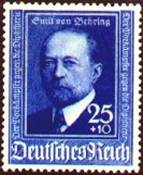
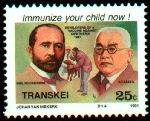
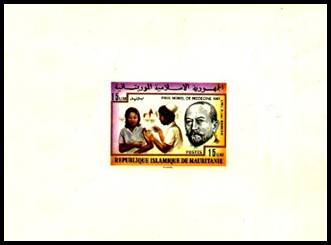
Emil von Behring 1854 – 1917 He was assistant of Robert Koch.
This famous physician worked about serum therapy and discovered diphtheria vaccination. |
Shibasaburo Kitasato 1852 – 1931 This physician was also assistant of Koch and
discovered bacillus of pest. He discovered tetanus vaccination with Behring. |
Diphtheria |
|
Proof of Behring
from |
Behind of the stamp of E.v.Behring,
watermark |
E. v. Behring 13.03.1954 first day cancellation |

Robert Koch explained tuberculosis on
|
Epidemiology in Clinic 25.01.196 Epidemiology is medical science that involves
the study of the incidence and distribution of diseases in large populations
and the conditions influencing the spread and severity of disease. Initially
epidemiology concerned itself with infectious diseases. |
Infection is injurious contamination of the
body or part of the body by pathogenic agents such as fungi, bacteria,
protozoa, rickettsia or viruses or by the toxins
that these agents may produce. An infection may be local and confined to one
area or generalized and spread throughout the body.
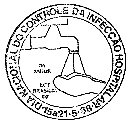
Hospital Infection must be under control! 15-21.05.1968 Once the infectious agent enters the host and
begins to proliferate the defense mechanisms of the body react to the
infection producing the characteristic symptoms of pain, swelling, reddening
at the site of infection,functional
disorders, rise in body temperature and pulse rates, and an increase in the
number of white cells. |
Parasitology 19.08.1978 Parasite is any organism living on or in
another living organism and deriving part or all of its nutrients from the
host without contributing anything to the host. In most cases, parasites
damage or cause disease in the host. Such parasites as lice, which live on
the surface of the host, are known as ectoparasites.
Parasites that live within the body of the host—threadworms for example—are
known as endoparasites. Permanent parasites pass
most of their life cycle in or on a host; temporary parasites spend a brief
period of time in or on a host and are free-living organisms for the
remainder of the life cycle. Parasites that cannot survive without a host are
called obligate parasites; facultative parasites are those able to feed
either on a living host or on dead material. Heteroecious
parasites such as the liver fluke, require different
organisms for various stages of the life cycle. Autoecious
parasites such as the pinworm, pass the parasitic
stage of their life cycle in only one host. The scientific study of parasites
is known as parasitology. |

Malaria is disease of human beings
and also birds, monkeys and other primates, lizards, and rodents, caused by
infection by protozoans of the genus Plasmodium and
characterized by chills and intermittent fever. The causative organisms of
human malaria are transmitted by the bite of about 60 species of mosquitoes in
the genus Anopheles. The disease may occur in subtropical and tropical regions
in almost all parts of the world as well as in other areas of differing
temperatures.
 Alexander Yersin
1863 – 1943
discovered bacillus of pest in Hong-Kong.
 Hyacinthe Vincent
1862 – 1950
Angina Plaut–Vincent : Disease influenced by fusiforme bacterium of throat, tonsils, gingival, lips and
cheeks; yellow-brown colored, pseudo-membrane ulcerations; low tempered.
Treatment ð Antibiotics
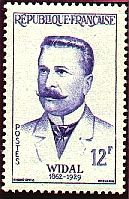 Fernand Widal
1862 – 1929
discovered agglutination test about typhus. He
also explained causes of hemolytic jaundice and reference between asthma and anaphylaxis.
 Smallpox is acute,
highly contagious viral disease, often fatal, that appears to have been
completely eradicated. After a 12-day incubation period, the first phase was
marked by high fever, prostration, and toxicity, followed three or four days
later by a rash, characteristically on the face, the palms, and the soles of
the feet. During the next six to ten days the rash developed into pustular pimples. The return of the fever and toxicity
initiate the second stage of disease, during which the pustules could become
secondarily infected by bacteria. As recovery began, the pustules became crusted, often leaving scars, and the fever and toxicity
subsided. Death was caused by infection of the lungs, heart, or brain. A person
with smallpox was infectious from about the third day through the erupting
phase.
Smallpox is acute,
highly contagious viral disease, often fatal, that appears to have been
completely eradicated. After a 12-day incubation period, the first phase was
marked by high fever, prostration, and toxicity, followed three or four days
later by a rash, characteristically on the face, the palms, and the soles of
the feet. During the next six to ten days the rash developed into pustular pimples. The return of the fever and toxicity
initiate the second stage of disease, during which the pustules could become
secondarily infected by bacteria. As recovery began, the pustules became crusted, often leaving scars, and the fever and toxicity
subsided. Death was caused by infection of the lungs, heart, or brain. A person
with smallpox was infectious from about the third day through the erupting
phase.
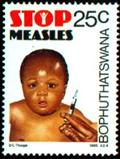 Measles is
acute, highly contagious, fever-producing disease caused by a filterable virus
different from the virus that causes the less serious disease German measles or rubella. Measles is characterized by small red dots
appearing on the surface of the skin, irritation of the eyes (especially on
exposure to light), coughing and a runny nose. About 12 days after first
exposure, the fever, sneezing and runny nose appear. Coughing and swelling of
the neck glands often follow. Four days later, red spots appear on the face or
neck and then on the trunk and limbs. In two or three days the rash subsides
and the fever falls; some peeling of the involved skin areas may take place.
Infection of the middle ear may also occur.
Measles is
acute, highly contagious, fever-producing disease caused by a filterable virus
different from the virus that causes the less serious disease German measles or rubella. Measles is characterized by small red dots
appearing on the surface of the skin, irritation of the eyes (especially on
exposure to light), coughing and a runny nose. About 12 days after first
exposure, the fever, sneezing and runny nose appear. Coughing and swelling of
the neck glands often follow. Four days later, red spots appear on the face or
neck and then on the trunk and limbs. In two or three days the rash subsides
and the fever falls; some peeling of the involved skin areas may take place.
Infection of the middle ear may also occur.
|
|
Whooping C |