History of the Richmond Fayette Artillery
Battery "B", 38th Battalion Virginia Light Artillery
Brief Back Ground information
The 1st Virginia Infantry of the Confederate States Army was organized on May 1, 1851 from nine militia units in the Richmond area. The first commander was Colonel Walter Gwynn. Gwynn served in that capacity until 1853, when he was replaced by Thomas Pearson August. August served until 1860 when he was promoted to Brigadier General of Militia, and given command of the 2nd Brigade, 4th Division, Virginia Militia. August was followed by Colonel Patrick Theodore Moore, who served until 1862 when he was wounded and disabled. Lewis Burwell Williams, Jr. suceeded in command and led the unit until he was killed at Gettysburg, Pennsylvania on July 3, 1863. Frederick Gustavus Skinner was the final commander of the 1st Virginia, serving until the end of the war.
The Militia units which orignally formed the 1st Virginia Infantry were:
Richmond Light Dragoons, formed in 1807. This unit ceased to exist in 1854.
Richmond Fayette Artillery, formed in 1824
Richmond Grays, organized on January 29, 1844
Richmond Eagle Infantry, organized in 1849
Richmond Light Infantry Blues, formed on May 10,1793
Richmond German Rifles, formed in 1850
Montgomery Guard, organized in 1850
Caledonian Guard, organized in 1851.
THE RICHMOND FAYETTE ARTILLERY
Prelude to the Storm
1821-1861
When Virginia voted In favor of secession in April 1861, Richmond buzzed with activity as men rushed to join the various companies that sprang up. The Richmond Fayette Artillery was one of the few companies that stood ready for the coming war.
Originally the company had been organized as the Richmond Light Artillery in a meeting at the Rising Sun Tavern on May 3,1821. Twenty-one-year-old John Rutherford, a graduate of Princeton and a prominent local lawyer, was elected the company's first captain. Nathaniel Charter, John B. Richardson, and Samuel Overton were elected lieutenants.
On May 16 the new captain notified Governor Thomas Mann Randolph of the organization and expressed the hope that the sixty-nine-man company would be permitted to draw the necessary quantity of sabers and belts as soon as possible. Governor Randolph consented and issued commissions to the company officers on May 29,1821. Furthermore, two brass six-pounder guns, which had been used by the Public Guard to fire salutes on the Capitol Square, were turned over to Rutherford's company.
Three years later, in July 1824, in honor of a visit of the Marquis de Lafayette, the company renamed itself the Lafayette or Fayette Artillery. Flattered by such an honor, Lafayette presented the company with two brass six-pounders which he had brought to the country during the American Revolution.
The citizen battery proved itself worthy of praise in the years that followed. Not only was it a worthy opponent in artillery firing competitions, but it was frequently called upon to fire 4th of July salutes and provide escorts and salutes to visiting dignitaries and for funerals of several legendary Americans. Among the men the Fayette Artillery honored in death were Peter Francisco, President James Monroe, and Henry Clay.
On August 23, 1831, the battery and Captain Randolph Harrison's Richmond Light Dragoons assembled to assist in suppressing the Nat Turner Insurrection, which had broken out in Southampton County two days before. While Harrison's Dragoons took the land route to the Southampton County seat at Jerusalem [now Courtland), the Fayette Artillery, under Captain Richardson, boarded the steamboat Norfolk, carrying with them a thousand stand of arms and a plentiful supply of ammunition for the militia of Southampton and Sussex counties.
Twice along the route the boat ran aground. Finally at 8 p.m. on August 25, Richardson's Battery went ashore near Smithfield. In Smithfield, the battery was ordered to remain until it received further orders. The following morning as the battery formed for its forty-mile trek to Jerusalem, orders were received to return to Richmond.
Back in Richmond, the battery continued to maintain a peaceful but elegant stature for quite some years. In December of 1846 the new captain and company were honored by a tune entitled "Captain Ellis' Artillery Quickstep," written by Harvey B. Dodworth (Thomas Harding Ellis had been with the company since 1836, and attained the rank of captain in 1842). Exactly how popular the music became is uncertain, but it was written in three different versions.
On May 8,1851, the Fayette Artillery was organized with 1st Regiment Virginia Volunteers. The regiment consisted of a number of colorful Richmond units, which In turn contained a number of colorful citizens. On May 29 the Fayette Artillery paraded with the new regiment and was particularly complimented on the "handsome new uniforms, blue trimmed with red, red plumes.... The officers in frock coats."
More than a year later, on July 26,1852, when rendering salutes at a funeral procession in honor of Henry Clay, one of the battery's guns exploded. An article in the Richmond Enquirer stated that after the procession had reached the front gate of the Capitol Square, "No. 4 gun of the left halt battery, which had been firing minute guns on the area facing the Capitol Portico, exploded, while it was being loaded, carrying away the right hand of Corporal Eddins, and otherwise wounding him about the face, and the left hand of Corporal Bohannan." For the benefit of the wounded men, events were held to supplement their Income in otherwise difficult times.
By March of 1859 the Fayette Artillery had come very close to collapse. On March 10, the Richmond Daily Dispatch indicated that the company was nearly in a "state of disorganization"; however, "On public occasions Major Nimmo is always placed in charge of the artillery and never falls to find men enough to work the guns." Again on March 20, the Dispatch reported, "The artillery is to be rejuvenated and uniformed in gray.... and when once a regimental uniform is adopted there will be no difficulty in maintaining the strength of this corps."
After Nimmo improved the company standing and organization, and after being refurbished, the Fayette Artillery marched in its first parade in some time on October 19, in new gray uniforms and manning two guns. The Dispatch again indicated, however, that the company still needed a great deal of reorganization. Colonel Thomas Ellis of the 4th Regiment Artillery, Virginia Militia, the former captain of the Fayette Artillery, called for a meeting and reorganization.
As the prospect of a national crisis grew nearer, the need to keep the local citizen-military organizations Intact grew. Following South Carolina's break from the Union, tension continued to increase throughout the south. On January 2,1861, the new captain of the Fayette Artillery, Henry Coalter Cabell, called for the unit's members to assemble at their armory for company drill and a meeting. Cabell stressed "that every member should be present." The prelude to the storm was over and Virginia finally stood on the eve of a horrible but fascinating war.
A Life on the Peninsula
1861
Within a week of Virginia's passage of the ordinance of secession rumors began to circulate that the gunboat U.S.S. Pawnee was steaming up the James River toward Richmond. on Sunday, April 24, then after known as "Pawnee Sunday," the Fayette Artillery, the Richmond Howitzers and Captain R. Milton Cary's Company F of the 1st Regiment were called out to defend against the threat. By dusk the contingent had reached Wilton's Bluff on the James, about eight miles below Richmond. By the following day the Pawnee scare had passed and the artillery-Infantry element from the list returned to the capital.
On April 25, the Fayette Artillery was officially mustered into state service with a complement of four officers (Cabell still as captain) and one hundred and eight enlisted men. It cannot be determined just how many of the company's members were battery members prior to the April 25 muster, but it is interesting to see that the surnames of even the earliest members of the company are the same as some of those men of '61. Undoubtedly, there must have been some instances of a Fayette Artillery family tradition.
Detached now from the 1st Regiment, but still part of the 4th Regiment of Artillery, Virginia State Militia, Cabell's battery moved into barracks near the Baptist Seminary and began the daily rigors of drilling.
On May 8, the Fayette Artillery was ordered by Colonel J.B. Magruder to report to Gloucester Point, which would be its home for the next several months. After being delayed in obtaining ammunition and other necessary articles, Cabell's company finally assembled at the Richmond depot at 1 p.m. By 4:30 p.m. Cabell reached West Point and report to Captain Whittle, where the company was directed to board the steamer Logan. Remaining for the night, the steamboat and the Fayette Artillery got underway the following morning.

Upon arriving at Gloucester Point at 8 a.m., Cabell reported to Colonel W. B. Tallaferro, commanding the post, and was ordered to move the battery into position to protect the heavy guns mounted there. At 11 p.m. Colonel Tallaferro warned of a possible attack that might occur the next morning. After briefing his artillery crews, and despite Tallaferro's order to let the men rest, Cabell had the guns manned throughout the night.
At daybreak the guns of the Fayette Artillery were moved to a high embankment overlooking the river. Cabell recalled that "the Island at this point runs into the river," on a line nearly at an angle where there was a plateau rising slightly above the river level. After putting the cannon on line, Cabell accompanied Colonel Tallaferro on a reconnaissance to the rear of the site.
It would not be until the following day at 1 p.m. that "an armed steamer" finally approached the battery. As the vessel (probably the U.S.S. Yankee) came within "2 or 3 miles," Cabell's gunners sprang to their pieces and prepared for action. The policy of dealing with enemy shipping had been described to Colonel Taliferro In a message from General Robert E. Lee just under a week before the Incident of May 10. The first measure to be taken was to fire across the bow of the vessels. Second, if the ship was not deterred, fire over her. Third, it the vessel still persisted in crossing Gloucester Point, fire into the vessel. If fire was returned by an enemy vessel, Tallaferro's Instructions were to capture it. The enemy vessel on May 10, however, would not give the colonel the chance to test the prescribed doctrine. Caboll wrote, "We all expected an attack, but she turned and proceeded down the river, and dropped anchor near its mouth." Another ship, sighted farther off in the distance, also anchored.
The following morning "four ships or steamers passed beyond the first steamer, proceeding rapidly from north to south." At about 8 a.m., "The attacking steamer weighed anchor and left.... " The shore batteries had not been given the opportunity to test their enemy's naval capabilities.
Following the short-lived affair, Cabell went into great length in his post-action report in describing what he believed was the immense importance of Gloucester Point. It is interesting to read Cabell's concerns, as it seems he prophesied about things to come:
I regard this point as next in importance to Fortress Monroe.... It is, in my opinion, invaluable, both for military defense and the commercial necessities of the State .... This point properly secured, and no effectual blockade can continue; no ships can pass up the York River; no attack can be made on Richmond except by long land marches.
The light artillery in the defenses of Gloucester Point in early May consisted of just eight guns. Four guns and three caissons overlooked the river on one side. Others overlooked the plateau below and the river beyond. Two of the old iron six-pounders of the Fayette Artillery were placed on the lower plateau under Lieutenant M. C. Macon. Two howitzers of the soon-to-become-famous Richmond Howitzers were placed near Macon, under Lieutenant J. Thompson Brown. In the months to come, the Fayette Artillery often would be the only light battery at Gloucester Point.
While the gunners of Cabell's company kept watchful eyes on the York, comfort in camp became a problem. In the hasty move out of Richmond, the company had procured no tenting. In lieu of a "white canvas" camp, Cabell's camp was full of "extempore" tents made by extending blankets on poles. In an effort to remedy the problem, Cabell proposed the raising of wooden shelters, the planks and nails to be furnished by the company. It is uncertain just when the wooden buildings were actually erected, if at all. In the meantime, Colonel Magruder saw to It that a "few" tents were furnished from the artillery barracks. Magruder also saw to the supply of horses, which had also been in great demand, to the Fayette Battery.
On May 30 Cabell's company was pulled from the works at Gloucester and ordered to Yorktown by Magruder. Moving again on June 10, the Fayette Artillery crossed the York River and made a forced march to Big Bethel, where it finally arrived after the battle there had concluded. After remaining for several days, the battery's guns and caissons moved back on the road again and returned to Gloucester Point.
Back in the works at Gloucester, Cabell prepared the company's first muster rolls on June 30. In the rolls, the Fayette battery was reported as "well equipped" with four six-pounders and was "well uniformed" in blue flannel. Cabell stated that the company's discipline was good and its "drill excellent." a total of 106 enlisted men and three officers stood ready for duty.
The Fayette Artillery served without much activity for the duration of the summer. In July and August, Captain Cabell and Lieutenant Macon began a hard drive for new recruits, but failed in their attempt to raise a 2nd Richmond Fayette Artillery. Though the enlistments fell short of expectations, a great number did enlist while at Gloucester Point and swelled the ranks of the original Fayette Battery.
In August, while Cabell and Macon occupied themselves with their intensive project, Lieutenant Clopton was dispatched with forty men to man the guns of Peyton's Heavy Artillery at Yorktown. After remaining for several weeks, Clopton's section returned to the drilling and the otherwise dull routine of camp life at Gloucester Point.
Perhaps the most significant event of the fall occurred when Captain Cabell resigned his captaincy on September 23 for the command of the newly formed 1st Virginia Artillery Regiment. The Fayette Artillery followed Cabell still and became Company I of that organization. Macon was raised to the post of battery commander on September 24. Macon was a peculiar figure and it seems amazing that the man stayed in that position as commander as long as he did. Not only was he absent from nearly every one of the Fayette Artillery's major engagements, but his career as an officer seems full of complications. What is most amazing Is his relationship with the company. As a commander he seemed relatively indifferent to the affairs of the company, but he must have had some air about him. Regretfully, no further documentation or personal letters are available to indicate his stand or the men's outright views of Macon as a leader.
Just over a month after Macon had taken the reins of the company, another muster was made. It showed that life at Gloucester Point was beginning to take a toll. Macon stated that "Discipline may not be considered very good at this time if they are to be considered as regulars." The company, Macon said, had received the "compliment of the Colonel commanding on every month except October." Though its morale was sinking rather low, the battery's armament had been increased by the addition of one three-inch rifle.
As autumn brought on colder weather, the Fayette Artillery moved out of the fort of Gloucester Point and prepared winter quarters just to its rear. Though the first year of the war had fallen short of any heavy engagements for the old battery, 1862 promised to make up for missed opportunities.
A Very Spirited Affair
1862
After enduring the winter near Gloucester Point, the Fayette Artillery on February 22, moved off the point for the last time and into the Yorktown lines. From the time the battery left that place (later remembered by Clopton as a "bed of roses") Lieutenant W. I. Clopton recalled that it was nothing but "scout, scout, skirmish, skirmish." Just more than one month later, on April 3, the Fayette battery was In its first noteworthy action of the year, at Harrod's Mill. The following day the battery moved to a position where it would remain for sometime to come, at Wynn's Mill. That same day, General George B. McClellan and his huge Federal army began their advance up the peninsula toward Magruder's (now a General) lines.
The afternoon of the following day, under a cloudy and rain-filled sky, General McClellan's left came upon the works where the Fayette battery stood waiting. Lieutenant Clopton wrote:
On Saturday 5th inst. we had a very spirited affair - the fight lasting from 11 a.m. till dark. It was principally an artillery duel and I suppose they fired 1000 cannon shots at us.
For the rest of the month, Macon's Battery was engaged almost daily against the enemy guns. "During all this time," wrote Clopton, "I was under fire and sleeping, eating and living in the trenches without a tent." Despite the uncomfortable arrangements the company experienced, Clopton made It clear that the soldiers' confidence was high. On April 15, Clopton wrote to his mother and sisters:
We have a very large force on this line now and a very fine natural position and are confident of success. I am quite used to the sound of shot and shell now. . . . Yesterday we had another duel and expect another today.
As the month progressed, General Joseph E. Johnston arrived on the peninsula and took command. Realizing that McClellan was bringing up heavy guns and understanding that his line would not be able to hold against such a threat, Johnston decided to withdraw his army farther up the peninsula. On May 4, after a terrific demonstration by the Confederate artillery, Johnston's Army of the Potomac slipped out of the Yorktown line without being detected.
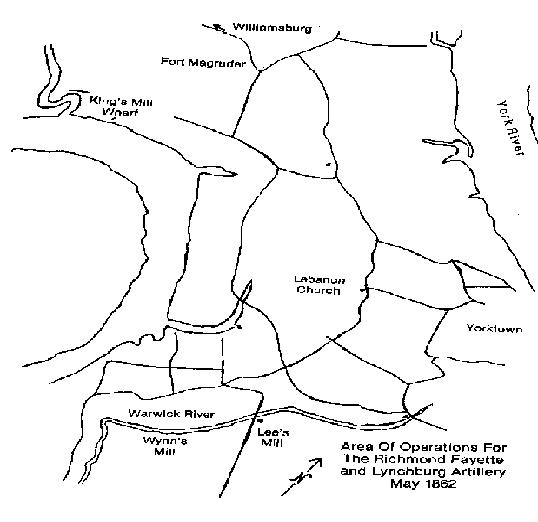
In the darkness of the night, Macon's Battery accompanied Brigadier General R. H. Anderson's Brigade out of the line near Wynn's Mill. By the morning of May 5, the Fayette Artillery was In position with a single piece from Coke's Williamsburg Artillery and a section of the Richmond Howitzers under E. S. McCarthy just to the south of Williamsburg and in the works at Fort Magruder.
As a Federal division advanced against the works and opened the action on the following morning, a section from the Fayette Artillery became immediately engaged and was recorded to have fired with good effect. The section was not free from enemy fire, however; it received a "galling fire from the enemy sharpshooters In front." Sometime later in the day, near mid-afternoon, a section of guns under Lieutenant Clopton (Macon was sick) was called up into Fort Magruder, where Dearing's Lynchburg Artillery had been fighting for some time. After reporting to Colonel Micah Jenkins, commanding the fort, Clopton was ordered to Dearing who sent the lieutenant's guns to the right of his own, then positioned outside and on the left. In the first few minutes after Clopton's gunners came on line, the Richmond-Lynchburg combination provided a nasty fire upon the enemy guns in front of Fort Magruder, finally forcing them to withdraw.
Following the withdrawal of the enemy artillery, the Fayette and Lynchburg sections returned to the safety of the fort. Once the guns had secured new positions behind the cover of the works, Clopton and Dearing opened again, until the Confederate infantry drove the Federals from the front. It would seem from available records that the Fayette Artillery may have been withdrawn following this latest repulse. In fact, it appears that Captain R. M. Stribling's guns were sent into Magruder as relief for Clopton's section. A factor that may have contributed to the Fayette section's withdrawal is the high number of casualties sustained: four killed and nine wounded. In his post-action report, Colonel J. Thompson Brown commented on Clopton's gunners: "The conduct of the officers and men is highly commended by all who witnessed their coolness and determinetion under fire." The Fayette Artillery, after forty years, had finally experienced its first real test under fire. Of those wounded, two would not return. Joseph Beck, having suffered from a gunshot wound to the chest, died more than three weeks after the battle. The rolls only indicate two killed, Delaware Branch and George K. Smith.
Despite the repulse of McClellan at Williamsburg, Johnston still felt threatened and continued to withdraw toward Richmond. The Fayette Artillery, having "closed up the rear of the retreat," arrived at Richmond on May 23. On the 31st, the battery was, according to a postwar reference, in action at Seven Pines. Of their service that day, however, little remains clear. On June 27, several weeks after General Robert E. Lee had assumed command and had the army dig in, the Fayette Artillery was called forward to report to Lee at Mechanicsville. Together with Coke's Williamsburg Artillery, and under the command of Major Lewis M. Coleman, the batteries were held in reserve as the fighting rag ad at Gaines's Mill. The following day the Fayette Battery accompanied General A. P. Hill in his passage to the south side of the Chickahominy.
On Sunday, June 29, Hill's men fell in behind Longstreet and began a long and difficult march. Despite the heavy rain of the day before, the trek southeast along the Darbytown Road was extremely dusty and the day intensely hot. By evening the movement was still on time, however, and bivouac was made at Atlee's farm. Resuming the march on the following morning, the Fayette Artillery kept up with Hill's men as they passed along the Long Bridge Road. By noon, word arrived that the Federals were not far away and were waiting and ready for battle. When Longstreet arrived upon the scene, he ordered L. O'B. Branch's Brigade, to which the Fayette battery had been attached, to protect the right. At 5 p.m. the fight finally opened. While Branch's men had a hard time of it that evening, the Fayette Artillery, though placed in position, was not permitted to fire. The following day near Malvern Hill would not be much different; the battery came under fire, but was unable to return it.
Though Macon's battery was not an active participant in the action around its home city, Lieutenant Clopton did report:
I was in all the fights on the Chickahominy and terrible ones they were - my heart sickens when I think of the gallant spirits that then fled from us forever. Yet I am unhurt.... I am utterly broken down and exhausted....
Colonel J. Thompson Brown commented of the battery's service for the 30th and 1st: "The men of the Fayette Artillery as well as the officers, exhibited sufficient coolness and alacrity under fire."
Following the close of fighting around Richmond, the Fayette Artillery turned to supply matters. In the largest of transactions and procurements, Macon saw to it that their one ten-pounder (having been taken from the Federals during the fighting, abandoned and spiked and the carriage broken) was exchanged for one state rifle.
As McClellan slowly became a lesser threat to the safety of the Confederate capital, many of Longstreet's batteries reconnoitered the area near Harrison's Landing and occasionally harassed Federal naval vessels. On the night of July 31, Colonel Brown and Lieutenant Colonel Coleman were detailed with several batteries to proceed to Hood's Point, or to Claremont "if necessary and practicable." Their target was the enemy shipping near Coggin's Point. The group of a dozen guns was to begin the move at 4 p.m. and then under the cover of darkness move to positions to open up. However, as it turned out, the mission encountered immense difficulties in the darkness. Moving fast into the night, the batteries at some point made a mistake in their march and the cluster of guns and caissons became jumbled on bad roads. By the following morning the batteries had reassembled at their starting points, having accomplished nothing. The Fayette Artillery returned to its campsite near Blakely's Mill.
With Lee's attentions redirected toward General John Pope's mass of Federals near Fredericksburg, the first great movement of the Army of Northern Virginia got underway against the new foe. The Fayette battery, now assigned to General Lafayette McLaws' Division, would not move until well after the bulk of the army had gone forward. Finally on August 23 the battery struck out with the division along the road to Hanover Junction. After almost a week the battery arrived at Rapidan Station. By August 30, while another battle raged at Manassas, the division had reached Culpeper Court House. In haste, Clopton scribbled a letter on August 31: "After a somewhat tedious but pleasant march we are now here in the mountains of Orange.... We start in a few moments forward to the main army."
Macon's Battery did not arrive at Manassas in time to take part in the battle, but its pace of movement was little eased. Lee was wasting no time in striking into the North. Clopton wrote:
The Fayette Artillery left Leesburg and crossed the Potomac on the 6th of Sept.... After crossing the Potomac we pushed on to Frederick City. This is quite a large place and pleasantly situated in the centre of a beautiful valley. Indeed this portion of Maryland is remarkable for the beauty of its scenery - its admirable farms and the richness and fertility of its soil. The Dutch element is sadly predominant in these lovely vallies. You ride along the road - the whole country is open land up to the tops of the mountains - residences are found every few hundred yards - but Dutch-like the houses are little insignificant concerns and the barns are invariably fine, large brick buildings. The people remind me more of hogs than anything else. We found no welcome in Maryland.
Lee wanted to make sure that his rear was clear of any Federal threats. If a threat were to come, it would draw strength from Harpers Ferry. Therefore, dividing his command, Lee set into motion a plan to take the garrison. McLaws' division was to move with that of R. H. Anderson and was to follow Longstreet as far as Middletown. At that point the division would turn south toward Harpers Ferry and eventually man Maryland Heights to assist in the capture.
After moving through Burkittsville and across the mountain through Brown's Gap, McLaws' division entered Pleasant Valley. On September 12 the division was divided, Kershaw's and Barksdale's brigades being sent on to Harpers Ferry. The Fayette Artillery and Manly's North Carolina Battery were left with Semmes at Brownsville to assist In protecting the South Mountain passes.
On September 13, Lieutenant Clopton recalled, "it was announced that the enemy was coming and we went back to the top of the mountain to meet them." Whether or not any part of the Fayette battery went "to the top" that day is unclear. The battery did consist of enough guns to be divided into three sections. The battery went into the campaign armed with two ten-pounders, one twelve-pounder howitzer, and four six-pounder smoothbores. Furthermore, and though Clopton's letters always immediately followed an event, it would seem the lieutenant's recollection of dates might for once be inaccurate. Available records show that the battery did not go forward until the following day. A section of Manly's Battery and the 32nd and 15th Virginia Infantry moved up on the 13th between Brownsville and Burkittsville to await the enemy.
The sudden and rapid movement of the Federal army, again under McClellan, resulted from discovery of Lee's operational plans. If the gaps fell the operation against Harpers Ferry would be severely jeopardized. The Confederates there had to hold.
At about 9:30 a.m. on September 14, the vanguard of General William Franklin's VI Corps was spotted as it moved through Jeffersonton. Feeling that his position would soon be in trouble, Colonel E. B. Montague of the 32nd called to Semmes for help. In response, the brigade commander sent the 53rd Georgia, one gun from Page's Battery, and three pieces of rifled artillery from the Fayette Artillery.
Around 11 am., Franklin finally made a decision and moved up two of his brigades, mostly masked "under a hill and wood about three miles... and advanced by the left flank into a f laid opposite" Montague's position. As the enemy skirmishers deployed to Montague's front, the artillery was moved to the left of the infantry about 100 yards away and began to open on the bluecoats. From the report Montague gave, it would seem that the mass of six guns was all commanded by Macon. "Captain Macon, the senior artillery officer, managed his guns most handsomely, and he and his juniors are entitled to all the credit of the occasion, if any is due."
Corporal John T. Parham of Company C of the 32nd Virginia recollected the service of the guns:
. . . A battery of artillery... was just to the left of my regiment, and early in the afternoon opened fire on the Federals as they came through and to the south of town [Burkittsville]. This battery [actually a mass of the three battery sections] had a fine position and I had clear view of the enemy's advancing column, and as I looked down upon them it appeared to me that the men had come out of the ground - there was such a multitude of them. I never saw so many bluecoats in my life....
As Macon continued to encourage his gunners the shells commenced hitting in the Federal ranks. For a while, it seemed that the enemy had been repulsed. However, at about 3:30 p.m., Franklin again tried his luck and sent on Bartlett's and Newton's brigades. Bartiett's Brigade, being nearly 1000 yards ahead of Newton, felt the wrath of the Confederate guns first. Again Parham wrote:
... They were marching In line of battle four or five deep, officers riding and cheering the men on. It was a grand sight and I will never forget it.... The battery near me played terrible havoc among them. The shells would burst and tear large gaps in the Federal lines, but they would close up and forward on. As they reached the foot of the pass that our brigade held they seemed to oblique to the right and push into Crampton's Gap....
Though Montague saw that the cannon were moved farther to the left to deal with the onslaught, Franklin's legions continued to press on, avoiding Brownsville Gap and thrusting toward Crampton Gap. By dusk the line holding the gap was broken and Semmes' Brigade was forced to retreat into Pleasant Valley. The following morning, before another Federal attack occurred, Harpers Ferry fell.
Though all immediate threats had seemed to pass, at 1:30 a.m. on September 16 Semmes' Brigade was again in line and marching for the Potomac. After passing through Harpers Ferry the column continued until near Halltown, where bivouac was made. While the men commenced preparation of fresh rations, a man rode up In search of General McLaws, to guide him to another place. The division was now more than three hours behind. However, McLaws and his staff had gone on to Charlestown to see where John Brown had been hung. McLaws would not return until near dusk, delaying the division even more.
After returning to the march for some time, the column was again halted at 10 p.m. and the men were permitted to rest. After about three hours the men were again on their feet and moved at a quicker pace. By daybreak McLaws' division had arrived at Boteler's Ford, opposite Sharpsburg.
Listening to the roar of battle, McLaws' division crossed the river. After halting near General Lee's headquarters long enough to get something to eat, the division, less its artillery, went forward to patch up the Confederate left. McLaws' batteries, meantime, stayed in the rear and offered "long arm" support. Clopton commented that they were "all day long In the great battle of Sharpsburg. This was the most terrific affair and at night both parties rested on their arms completely satisfied with each other with the dead and wounded lying on the field." The lieutenant described the carnage: "That Is the most unnerving part of a fight to see the poor wounded fellow lying uttering helpless and to hear their agonizing groans."
The following day Macon's Battery recrossed the Potomac (claiming to be the last battery to cross) and moved back into the Old Dominion. Clopton wrote on September 25 of being in camp in a "fine oak and hickory grove on the delightful bank of the Opequon."
After moving closer to Winchester, the Fayette Artillery enjoyed a quiet and peaceful rest. The order to consolidate batteries did not affect Macon's Battery, as it did so many others. By October 2, however, the battery was attached to Kershaw's Brigade. While in camp, Clopton wrote mostly of the poor postal service. On October 11, the young lieutenant described the diet of the battery: "We are living very well now - Items of the mess table - chickens, ducks, turkey, butter, honey, bacon, lard, tomatoes, potatoes, beef, mutton, shoat, and bread - besides apples, peaches and milk." Dividing the cost of the provisions between the officers five ways, fine dining cost the brass little more than $20 a month. The staff also had four servants to prepare the delicacies.
Clopton wrote of the locally popular "apple-butter boils." Though the lieutenant found the whole ceremony "disgusting," he went to great lengths to describe it to his family;
They put a large cauldron on the fire and fill it with cider and as the cider bolls all the young girls from the neighborhood are there to cut apples. We were invited to one the other night and I tell you twas a sight to see. The girls form a ring around the pot in this wise. The first one is placed and she says, "I form a wreath" - "what kind of flower" - "a rose" - "who shall the next flower be" - "Capt M[acon]" and he walks up, and kisses the young lady, or as they classically express it, "puts on the trimmings" and there he is questioned as above and the young lady chosen comes up "puts the trimmings on" takes her place in the ring and so on until all the party are circling around the fire, dancing and singing and kissing - it is altogether very disgusting. They go thro'a great many games too numerous to mention; but in all of them the chief aim and object is to accomplish as much kissing and hugging as possible. The closing of the ceremony is the forming of a bridge for the apple butter to pass over - this is formed in a manner very similar to' the ring. I proposed a regular dance and a fiddler but they were all horror-stricken and said they could not as they belonged to the church - What a parody this is on religion and virtue! A good many of the boys seemed to think however it was fine fun. I can't say I did not enjoy the "boil" for the apple-butter was delicious. This beats a So. Ga. shinding all to pieces and it occured not two miles from classic Winchester.
On October 30 the battery left the environs of Winchester and followed Longstreet's Corps as It marched to Culpeper Court House. Clopton wrote of the move:
.... passed the Shenandoah Saturday at daybreak and encamped that day and night in a beautiful valley among the mountains near Front Royal. At dawn the battery moved again and passing up the road near Chester Pass, just as the sun rose reached the summit of the Blue-Ridge. The scene was indescribably grand. It seemed as if a wild, broken, boundless sea were spread out before me.... Every tint of beauty was there and the light curlclouds were tinged with the most glorious hues.... Oh! It was glorious. Well might one exclaim Oh! Virginia though art the virgin land of beauty and delight. Unwillingly I left and as the column moved slowly down the steep descent the bands of the brigades were heard in the rear and the flash of thousands of bayonets in the sunlight was seen all the way up the mountain side.
The movement continued down the mountain toward Little Washington. Along the way some of the men were able to delight themselves with a glimpse of Belle Boyd. "She is find looking," wrote Clopton, as he and Peyton had the chance to catch a glimpse through the trees. At 1 a.m. that night, after a brief pause, the column started again under beautiful moonlight. On November 3 the Fayette battery made camp near Culpeper, where Colonel Cabell visited the officers of the company. After a fine dinner Clopton "rolled up In my blanket by a rousing chesnut fire and listening to the wind In the trees and the rushing of the stream, fell asleep - to awake this morning with frost all over my blanket."
In a few short weeks the Fayette Artillery would be reorganized with another element of the army. Among old comrades, Macon's gunners would stand in Dearing's Battalion along with the men of the Lynchburg and Fauquier batteries. With this new battalion, the Fayette gunners would continue to be worthy of praise and gain many accolades in the upcoming fights.
Tabulations From The Rosters Commissioned and Noncommissioned Officers Of The Richmond Fayette Artillery
Cabell, Henry C., Captain
Macon, Miles C., Captain
Clopton, William I., Sr. 1st Lt.
Johnston, Peyton, Jr., 2nd Lt.
Jones, William W., 1st Lt.
Fleming, Robert I., 2nd Lt.
Fontaine, William W., 4th Lt.
Rex, Jacob W., 1st Lt.
Robinson, Benjamin H., 2nd Lt.
Taylor, Mathew P., 2nd Lt.
Quarles, Preston M., Asst. QM
Williams, Milton G., Sgt. Major
Clark, James N., lst Sgt.
McCurdy, Peter B., 1st Sgt.
Blunt,Joseph E., QM Sgt.
Ritter, William B., QM Sgt.
Brown, George W., 2nd Sgt.
Burrows, Howard L., 5th Sgt.
Byron, Rudolph J., Sgt.
Edwards, Abble C., 6th Sgt.
Gaines, Elijah W., Sgt.
Garnett, William F. G., 3rd Sgt.
Kula, August, Sgt.
Newton, George, Sgt.
Pope, Charles W., Sgt.
Robertson, Walter H., 2nd Sgt.
Sutton. John C., Sgt.
Webber, John S., Sgt.
White,James P., Sgt.
Pollock, Richard D., Bugler
Beck, Jacob, 2nd Cpl.
Caskie, John S., Cpl.
Clark William G., 4th Cpl.
Cole, Haley, lst Cpl.
Grubbs, Anderson B., Cpl.
Elam, William, lst Cpl.
Hartseberger, Peter A., Cpl.
Jarvis, Ottoway, Cpl.
Jones, B. S., Cpl.
Leary, John H., Cpl.
Martin, Patrick K., Cpl.
Martin, William T., Cpl.
McCann, Daniel C., Cpl.
Pippin, Elijah, Cpl.
Tally, Robert A., 5th Cpl.
Tyree, James H., Cpl.
Vaughan, James C., Cpl.
Statistical summary of Losses
"Richmond Fayette Artillery"
On Roster: 272
Postwar References: 2
Actually Enrolled: 270
Killed in Action before joining the battalion:
2 (0.7%)
Wounded in Action before joining the battalion:
7 (2.6%)
Died of Wounds:
1 (0.3%)
Captured:
13 (4.8%)
Sick at Least Once:
88 (32.5%)
Died of Sickness or Disease:
9 (0.3%)
Deserted or AWOLw/NFR:
57 (21.0%)
Transferred:
13 (4.8%)
Detailed/Detached w/N FR:
6 (2.2%)
Discharged:
30 (11.0%)
Resigned or Retired:
3 (1.1 %)
Casualties From April 1863 to April 1865
Co. B (Richmond Fayette Artillery) Percentage Lost By Total Number Enrolled
KIA: 12 (4%)
WIA: 31 (11%)
Residences at Enlistment or Birthplaces if former is unavailable
(99 Available)
Richmond: 16 +
Pittsylvania Co.: 14
Ireland: 10
Henrico Co.: 7
Chesterfield Co.: 5
Philadelphia, Pa.: 4
Hanover Co.: 4
Norfolk: 4
England: 3
Germany: 3
King William Co.: 3
Baltimore, Md.: 2
Canada: 2
France: 2
Goochland Co.: 2
Nansemond Co.: 2
New Kent Co.: 2
One each:
Alabama
Alexandria, Va.
Caroline Co.
Culpeper Co.
Charles City Co
Fredericksburg
Isle of Wight Co.
Kentucky
King and Queen Co.
New York
North Carolina
Prince William Co.
Sardinia
Williamsburg, Va.
Occupations at Enlistment
(128 Available)
Carpenter: 15
Painter: 12
Cooper: 8
Laborer: 8
Clerk: 8
Printer: 6
Blacksmith: 5
Lawyer: 5
Machinist: 5
Salesman: 5
Miller: 4
Sailor: 4
Tobacconist: 4
Farmer: 3
Merchant: 2
Barkeeper: 2
Molder: 2
Cigar maker: 2
Tinner: 2
Engineer: 2
One Each:
Baker, Butcher, Boat builder, Cabinet maker,
Caulker, Coach maker, Confectioner, Dirt digger,
Driver, Druggist, Gas fitter, Gunsmith, Jeweler,
Lithographer, Locksmith, Mason, Papermaker, Plumber,
Railroad agent, Shoemaker, Student, Tailor, Teacher, Teamster
Ages at Enlistment
(131 Available)
16 - 1
18 - 7
19 - 9
20 - 16
21 - 21
22 - 10
23 - 7
24 - 9
25 - 19
26 - 2
28 - 7
30 - 6
31 - 1
32 - 1
34 - 2
35 - 6
36 - 2
40 - 1
41 - 1
42 - 1
44 - 1
45 - 1
Percentage in Teens - 12.9%
Percentage in Twenties - 69.5%
Percentage in Thirties - 13.7%
Percentage over 40 - 3.9%
MUSTER REPORTS AVAILABLE FOR THE RICHMOND FAYETTE ARTILLERY
Also referred to as the Fayette Artillery or Cabell's - Macon's - Clopton's Battery
6/30/61
8/61
10/61
11/61
2/13/62
2/28/62
6/22/62
7/62
8/63
11/2/63
11/10/63
7/18/64
7/27/64
9/3/64
2/8/65
3/l/65
3/15
This account is from the book entitled: The Richmond Fayette, Hampden, Thomas, and Blount's Lynchburg Artillery from the H. E. Howard book series by Robert H. Moore II Copyright 1991.
 Battalion History page
Unit Roster page
Return to Home page