

The word planet (planetes) in Greek means "wanderer" due to their nature of roaming the heavens in their own paths, including the phenomenon of retrograde motion. This phenomenon occurs when it appears that a planet stops and then moves backwards instead of forwards. It is however an optical illusion created by our viewpoint from Earth and the fact that the orbits of planets are all different ellipses. When the Earth becomes parallel to that of another planet it appears that the other planet becomes temporarily stationary before moving backwards for a time as we pass it by.
This never applies to the "luminaries", i.e. the Sun or the Moon as the sun is the centre of our universe (well, allegedly, for now at any rate, the Earth was flat only a few hundred years ago - you never know what's coming next) and our moon orbits around the Earth.
In the early days of human habitation upon the Earth when the world was full of mystifying and unexplained phenomena it is not difficult to see how the regularity of the motions of the heavenly bodies would pique curiosity and inspire hope for finding a key to solve the mysteries surrounding ourselves everyday.
The most obvious example would be the correspondence between the planets and the seasons, which affects arable manipulation and is thus crucial to human existance.
Hesiod's Works and Days reads very much like a farming almanac:
"But when Orion and the Dog Star move into the mid-sky and Arcturus sees The rosy fingered dawn, then Perses pluck the clustered grapes and bring your harvest home"
The ancient Egyptians started their year in mid-June with the heliacal rising of Sirius (the Dog star), i.e when the planet appeared back on the horizon after a 70 day period it heralded the annual flooding of the Nile. They also knew that the heat of their summer was about to get more harsh when the star appeared to take on a red hue.
We have created the calendar from these natural phenomena so that we can equip ourselves in time for the changing seasons.
The Mayan calender was calculated by the movements of Venus upon which they had deduced their seasons to run by.
Because their movements are so regular and immutable the heavenly bodies were thought to be immortal and thus inevitably came to be regarded as gods. Heroes in mythology were often believed to have become stars or constellations, for instance, Andromeda, Orion, Pegasus and Cassiopeia.
Epicureans believed that the planets were in fact gods, but that they were too far away from us to influence us as they do in the Greek myths.
The mummification process of Egypt is said to be of 70 days in order to correspond with the amount of time that Sirius is visible in the sky and then not-visible for an equal number of days until it seems to be re-born into the sky.
In the cult of Mithras the soul was supposed to pass through the planets before it's incarnation picking up gifts from each which it would return after physical death as the soul reversed it's journey.
The immutability of movement was of interest in the cult of Mithras and also to Plato and Pythagoras, there was also a close connection to the beliefs in Solar monotheism where the sun, as the greatest of all stars was the leader of the planetary choir and so the sun-gods were the top of the hierarchy of all gods. (e.g. Amun Ra - the chief god in ancient Egypt was the sun god who created all life on Earth and who's genealogical tree the pharoes added themselves to in order to assert themselves as the living embodiment of gods as their divine right of kings). Solar monotheism the began the varied beliefs in one god in contrast to a whole pantheon of gods). Anaxagoras was indicted in Ancient Greece on a charge of impiety for saying that the sun was not divine but merely a hot stone.
Astronomy and Astrology were the same discipline even until the middle ages when Nostradamus was reputed to have been an "Astronomer", a term which also implied his knowledge of Astrology which is evident in his quatrains.
Since then they have gained individual status, of the divide now manifest between the two practices, the etymological roots of the words themselves provide the difference. Astronomy derives from the Greek (aster) meaning star and (nomos), meaning the "law" or "custom" (of the stars) and so now defines observation of celestial phenomena, whereas Astrology derives from (logos), the "word" of the stars, thus this is the term adopted for interpretation of our astronomical observations. It was widely believed in the ancient world that true rational analysis was provided from both. In modern times Astronomy is considered a science and Astrology a pseudo-science.
Until Hesiod people did not realise that the stars were ever present in the skies, despite the fact that they are not always visible during the day, believing that the stars and the Sun took turns in circling the Earth. Hesiod realised that the only reason that the stars were not visible during the day was because of the light of the Sun.
The Ancient Greeks also came up with the theory that rather than emitting it's own light, the moon merely reflects that of the Sun.
Long before the development of any writing systems was established, astronomer-priests kept records of the sun's annual motion and connected it to the progress of the seasons, thus they were able to predict when floods would occur. They were also able to predict the tides by watching the moon (because of the gravitational pull) which Seleucus observed to be connected even though he could not understand or explain the exact reasoning behind it.
Records were kept by Mesopotamian priests with astounding accuracy as far back as 4000 years ago. Only the Chinese records, which noted eclipses back to 1361, rival them. They also mapped out the plane of the ecliptic - the path that the sun takes through the heavens in its yearly path, (more commonly known as the zodiac belt). The Sumerians kept records of their observations of celestial phenomena in 2 libraries built in Mesopotamia for over two millennia. This made it possible to forecast solar and lunar eclipses, although it was left to the Greeks to explain them. There are also the remains of the Mayan calendar still in use in Western societies; they devised the length of the lunar months and solar years very accurately, including February the 29th.
After Ptolemy's Almagest, which is our main source of knowledge of Greek astronomy, there was not much written about Astronomy of any value. Europeans paid no attention to the supernova recorded by the Chinese in 1054 CE, the remains of which are now the Crab nebula.
Thales was credited with predicting the year of an eclipse of the Sun as the 28th of May in 585 BCE. It is most likely that he learned of the recurrence of eclipses every eighteen years and eleven days from the Babylonian records.
This led to the belief in what is termed mundane astrology ("Mundi" being Latin for "world"), the aspects that the planets make to each other are believed to affect the Earth physically and the living creatures upon it psychologically, influencing/heralding such things as tidal waves, earthquakes and sexual revolutions.
"Tempests and gales of wind produced by certain aspects of the Moon, or the fixed stars, towards the Sun"
Ptolemy's Tetrabiblos Bk1 Ch2
"all bodies... are subjected to the motion of the stars, but also that the impregnation and growth of the seeds from which all bodies proceed, are framed and moulded by the quality existing in the Ambient (Aether) at the time of such impregnation and growth"
Ptolemy - Tetrabiblos (BkI ChII)
It is believed that radio waves are affected by the aspects that the planets make to each other; when planets are in "easy" aspects (for instance trines) the radio signals are clear, but when planets are in "hard" aspects (e.g. square) there is a lot of interferance, just as bad weather affects them.
From the fundamental belief in the interconnectedness of all things, it was believed that it was possible to create a microcosm of the macrocosm of the skies down on Earth. This is the most likely explanation for such ancient sites as Stonehenge as some kind of measuring apparatus set from the position of the sun during solstices, and the relatively new theories that constructions by ancient Egyptians correspond to the constellation Orion or the heliacal rising of Sirius.
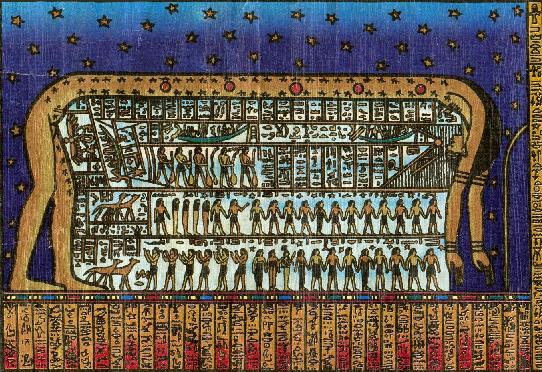
The Egyptians used to bury their dead on the West bank of the Nile. The land on that side is often more rocky and inhabitable anyway, but a theory for this is that the sun and moon rising in the East to set in the West is like a daily birth and death. In fact the sky goddess Nut was believed to swallow the sun at the end of every day and to give birth to it again in the morning (the picture above was often painted on the ceilings on the tombs - usually 2 of them back to back)
Thus they took the East side to represent life and the west side to represent death, using the Nile as the diving line.
They also belived that the souls of the dead went to the Milky way.
In "The Orion mystery" it is put that perhaps the 3 pyramids at Giza represent the 3 stars in Orion's belt in order to create a map of the heavens on earth ("On Earth as it is in Heaven") in which case the Nile would serve as a representation of the Milky way. It is also possible that the Egyptians equated Orion with Osiris - the god of the underworld.
From all this you can see how the stars were deeply embeded in the myths and practices of Egyptians.
From the seven planets (this number includes the luminaries) that were known without the aid of telescopes to view the outer planets of Uranus, Neptune and Pluto, the Babylonians (known as Chaldeans to the Romans) implemented a seven day week, each day corresponding to a planet. They also ascribed various metals to each day through their association with the planets
We still retain these correspondences, albeit in the terms of the classical counterparts in Norse mythology. The English language of course has carries the baggage of every race England was conquered by (Angles, Picts, Jutes, Scots, Britons, Vikings, Saxons, Normans - Vikings in their own turn, Romans etc) although our language remains mainly Germanic now having evolved from Anglo-Saxon rather than from Latin, if you look at other countries conquered by the Romans such as France and Spain you can see the Romanised roots more clearly - e.g. Lunes, Martes, Miercoles, Jueves, Vienes, Sabbado, Domingo; Lundi, Mardi, Mercredi, Juedi, Vendredi, Samedi, Dimanche
The Mesopotamians built seven story towers, probably in honour of the five planets and the sun and moon, immortalised by the Hebrews as the tower of Babel.
These Babylonian structures served as temples as well as observatories.
BIBLIOGRAPHY
Barton, T. - (1994) Ancient Astronomy
London: Routledge
Bergamini, D. - (1977), The Universe
Virginia: Time-life Books Inc.
Hesiod - (1973) "Works and Days" Hesiod and Theognis
London: Penguin. Tr. Dorothy Wender.
Plato - (1974) The Republic
Middlesex: Penguin, Tr. Desmond Lee
Ptolemy - Tetrabiblos
Sagan, C. and - (1975), Planets
Leonard, J.N. Nederland: Time-life International
Wright, M.R. - (1995), Cosmology In Antiquity
London: Routledge
DeBok, D. Astronomy of the Greeks Early Philosophy The Planets The Sun
Frasco, J. Ancient Greek Astronomy

Home
Ancient Cosmology / Early Astronomy / Ancient Astrology
View My Guestbook - Sign My Guestbook
