|
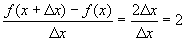
Determine the slope of the line tangent to ƒ(x)=2x-3 at point (x,y). Solution by the four-step process, 1) ƒ(x+ 2) ƒ(x+ = 2 3)
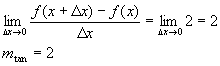
4)
Note in Example 1 that the slope of ƒ is constant. This is not surprising since we know that the graph of ƒ is a line. Of course, not all graphs have constant slope, as the next example illustrates.
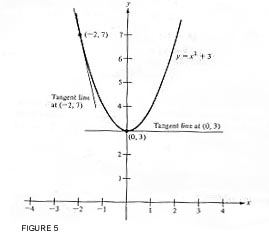
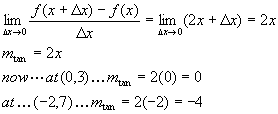
Determine the formula for the slope of the graph of y = x2 + 3 (see figure 5).
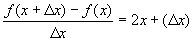
Solution by the four-step process, 1) ƒ(x+ 2) ƒ(x+ = 2x( 3)
4)
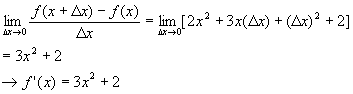
Find the derivatives of ƒ(x)=x2+2x. Solution 1) ƒ(x+ 2) ƒ(x+ = 3x2( 3)
4)
          
|



 x) = 2(x+