| KLV Amplifier Problems: | |||
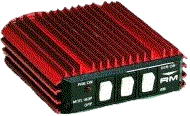
KLV--200P Amplifier
|
-------------------------------------------------------------------------------
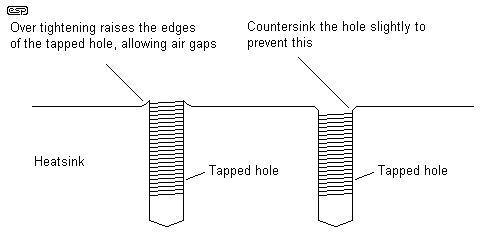
The main problem that I can see with these amps is that, although the overall build quality is good, they do have problems with the quality of soldering and the output transistors are improperly mounted. The final output transistors are mounted to the heat sink with sheet metal screws and heat sink compound. It appears that during the assembly process, the screws are over tightened. This causes the base of the mounting flange to buckle and distort. This distortion of the mounting base lifts the mounting base up and away from the heat sink. Proper cooling of the transistor is greatly diminished when this happens. Even though there is more than enough heat sink compound ( too much really) between the flange and the heat sink, the transistor can overheat because of the distortion gap. The heat sink itself is another problem because they use sheet metal screws to mount the final output transistors. When too much force is applied to the screw, the heat sink material around the screw is lifted and this further lifts the transistor above the level of the heat sink. Countersinking the holes helps to avoid this condition. Proper torque on the fasteners is crucial as well. Here's an Illustration:
Graphic
by --------------------------------------------------------------------------------------------------------------- Solder Problems: You might notice upon inspection, that some of the solder connections look dull in appearance. This usually indicates a cold solder joint and must be fixed to insure proper contact between the PCB and the part. All that is usually needed is a good clean soldering iron and resin core solder. Never use acid core solder !!! Acid core solder will corrode the connection over time. Apply enough heat to the joint to melt the solder, then apply the solder between the soldering tip and the part being soldered. When properly done, the finished joint/connection will have a shinny appearance. If the joint looks dull, it's usually because not enough heat was applied before the solder was added. Use only enough solder to make a smooth joint, too much solder is as bad as not enough. Be sure to check for solder bridges ( short circuits to other parts or 'pads').
Solder splashes may be noticed at various locations on the PCB. These can usually be removed without any damage because they are just sitting on top on the solder mask ( the green areas) of the PCB. Nudging them with a soft tool, such as a wooden Popsicle stick should dislodge them. Give the PCB a good overall visual inspection for these 'stray' solder splashes and remove them if found.
Now that we know what the problems are, how do we fix them??? The first step is to open the case. These amps are very easily opened. The 200p has a rear plastic panel that just slides away from the rear of the unit to expose the internal PCB. The 351P has 4 screws on the rear panel that must be removed and then a bottom panel can be slid to expose in PCB. Once the unit is opened, you will observe that the PCB is mounted to the heat sink with sheet metal screws through brass standoffs and through the final output transistor mounting tabs as well. The main PCB is soldered to the front control switches and at the rear of the PCB, to the S0-239 antenna connectors. By removing the front panel screws, the S0-239 screws, the brass standoff screws and the final output transistor mounting screws, the PCB can be lifted straight up and away from the heat sink. If you have the 351P, there is another small transistor mounted to the heat sink in the corner of the PCB. Be sure to remove it's mounting screw as well. The front panel and the two S0-239 antenna connectors will still be connected to the PCB of course. Try to keep the screws separated and identified so that you don't mix them up. Try to replace the screws to where they were originally installed.
|
||
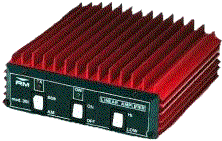
KLV-351 Amplifier |
|
||