
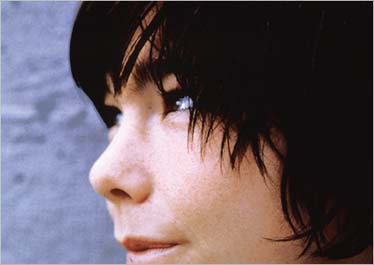

The 90's in a very condensed nutshell. Minus 'grunge' —a good thing.
It's easy to listen to this album, over a decade later, and pick it apart and point out its flaws. But when it originally came out? Sheeeeeiiit. Nothing —and I mean nothing— was able to sythesize so many things into one irresistable package. Therefore, nothing really sounded like it, though it seemed like, soon enough, everything did. Unfortunately. But this is the original, real deal thingamabob. And it's one of those rare records that pleases both newcomers and long timers. Newcomers because it's so irresistably catchy and executed. Long timers because everything that's great about Björk is present here. First, there's the hits: "Human Behavior", "Venus As a Boy" and "Big Time Sensuality." All perfect dance-pop numbers that are, at once, (for the time period) on the cutting edge of the dance music scene and perfectly radio ready. But not in that slimey way that makes you cringe. In that "Just Like Heaven" way where you just can't help but smile and feel a slight sense of victory for good music when it comes on the radio. Then there's the deeper album cuts that we nerds will play in excitement for someone when we've just found out they are new to Björk: the brilliant segue of the drunk-in-the-club-and-loving-it (sort of) "There's More To Life Than This" into the harp driven ballad "Like Someone In Love" and the quintessentially Björk (complete with swooping vocal bridge) electro-strings number "Come To Me." There's not a bad one in the bunch. Just ones that will hit you harder, depending on where you're at in your life (which is going to be a recurring theme with her solo material). Where she would focus on very specific things before and after this album, this is the one that stuffs it all into one package. It may not be her most unique work, and it certainly isn't her overall best, but it is one of the most recognized albums of its era. And for a reason, too: it's the crowd pleaser of her solo catalogue. It's certainly a defining moment in 90's pop music.
~Austin
Essentially, a more polished Debut —also a good thing.
It would be easy to write this one off as an attempt to rehash the ideas offered on Debut: both eleven songs, both about fifty minutes long, both rely on at least a few house-inspired tracks to break the mid-tempos. But, that's only one way of looking at it. Another way (a/k/a 'The Right Way') of looking at it would be that Björk was just in a zone and repeating herself in a way that was not only adequate, but necessary. At the same time that the songs here are just overall better, they used the then current dance scene (and I realize that that is a very general term, but bare with me) trends and ideas as mere foundations for something bigger, something more soul wrenching, more cinematic, something that's —and I use this term very rarely— entirely more soulful than any of its contemporaries. Case in point: "Hyperballad," the album's second cut. The number of equally as expressive and flat out beautiful simple love songs in the post-punk cannon that rival it can —to my ears— be counted on one hand. Plus the fact that it starts out as a genuine electro-pop ballad, but morphs into an all out, four to the floor thumping, but natural and organic, house track makes it all the more enticing. And that's all I have to say about that. And it may be a different story if that were one of maybe three or four highlights on the album, but the fact that it's preceeded by "Army of Me" and followed shortly thereafter by "It's Oh So Quiet" —one a post-industrial, Led Zeppelin-sampling piece of trip-pop, the other an irresistable neo-Broadway sendup, complete with a big band accompaniment— is simply an accomplishment of jaw-dropping sincerity. And that's the great thing about this album: for all its searching and scouring for different electronic sounds and ideas, it all feels natural. "Possibly Maybe", while sounding exactly like the type of Portishead-ish trip-pop that everyone was butt crazy for in the mid-90's, sounds, at its core, like a song that was never meant for anyone except Björk to sing. Ultimately, that's what makes this record even better than Debut: Björk's personality. Sure, anyone could have conjured up these musical backings at this point in the mid-90's, but it's Björk's presence that makes these songs unforgettable. Maybe not as well-known as Debut, but easily a more enjoyable, and infinitely better, album.
~Austin
Post remixes. Decent, but hard to mess up when the source material is that good.
A stopgap album, to be sure, but a well done one, to be absolutely exact. Because everything here is a remix of something from Post, it is inherently a good companion piece. But it's also a good album just on its own. The remixers here do a fine job of distancing themselves from the originals, even within the first two tracks. The mixes offered up on tracks one and two are actually quite radical pieces. The mix of "Possibly Maybe" puts a nearly obnoxious effect on the vocals while retaining zero of the original's melodic appeal and the mix of "Hyper-ballad" is basically a strings and vocals re-recording that brings out the traditionality of the tune. Elsewhere, the mixes of "Isobel" and "I Miss You" seem to pinpoint the back to basics organic naturalness of 'neo-soul' a few years before the fact. As good as this thing is though, there are a couple things that bring the affair down. Perhaps a bit too 'avant dance' for me are the mixes of "Enjoy" and "Army of Me." I admit right here and now: I don't get it. Which is possibly the point. In which case, I wouldn't like it anyway. When things are taken to that next level, where boundaries are respectfully disregarded and excitement outweighs posturing, such as on the brilliant drum'n'bass revisit of "Cover Me" and the "Headphones (0 Remix)" (which easily outdoes its predecessor) is when things really get interesting. Kind of a 50/50 affair, but it stands on its own as a proper album; which says a lot, considering it's essentially an afterthought remix album.
~Austin


The point at which Björk goes from making excellent contemporary music to making epic timeless music.
Not counting Telegram (which is good, but not really a 'new' record), Björk had outdone herself with each new album she put out. When her third album hit the market in 1997, nobody, probably not even Björk, could grasp fully the caliber of the music it contained. For the first time in her career, Björk's music sounds entirely her own. Where she took cues as a launching pad in the past, this album disregards the dance pop of her previous solo works and crafts something that is wholly and stunningly unique —quite a feat at this point. The success in the album's timeless sound is the toned down danciness. Here, electronics are used subtly and while there are dancey aspects to the music, they are more implied, instead of being advertised. There is a definite cold, distance to the music as well, with the chilly electronics crashing head on with a bittersweet string section and Björk's most captivating vocal performance yet heard. Indeed, some of these songs will certainly conjure up images of the desolate, wide open snowy landscapes of Björk's homeland. A comforting album, even in the midst of all the distance. "All Neon Like" finds Björk delivering, "Don't get angry with yourself. I'll heal you", but it's unclear whether or not the receiver of the message is also its sender. It simultaneously feels like her most complete and best work and her least accessible work, because of the album's beautifully melancholy introspective tone. A perplexing contradiction to be sure, but seemingly intentional (the album's most radio ready song, "Alarm Call" contains a nearly screamed eff bomb, for example). Definitely her most inward looking material up until this point, which is perhaps why it resonates so heavily, over a decade later. A striking climax to her opening trilogy of solo albums, it often feels like the epic heartwrenching climax to a movie many years in the making. When the quiet, restrained "All is Full of Love" closes out the record, it feels like the accompanying music to the end credits. It would have been a very good note to go out on, albeit a very bittersweet one. That seemed to be confirmed when, shortly after her tour supporting the album, she turned to acting. Hard to come to grips with the fact that things would get even better, and more emotionally involving, when she would finally get back around to making records.
~Austin


Some duets and some and other stuff, performed by Björk in character.
After her longest break between albums up until that point, Björk returned with a somewhat confusing new record. It was billed as music from the soundtrack to Dancer in the Dark, a film that Björk played the starring role in. Selma (her character in the film) is a fan of musicals who is unfortunately going blind. And the songs here, while they were written by Björk, they were performed as Selma. And that, coupled with the fact that the album is just seven songs (one of those an instrumental, three of them duets), clocking in at a total of just over thirty minutes, makes for a pretty stopgap piece. The music here is actually pretty decent. "Cvalda" (with Catherine Deneuve) and "I've Seen it All" (with Thom Yorke) are both musically quite interesting, featuring bizarre rhythmic syncopations that build from bizarre percussive sounds. As a whole though, the musical backings take the 'musical' theme too far. With sporadic big band and string arrangements which build to big crescendos and fall apart several times within a given track (recalling a less successful "It's Oh So Quiet"), it makes for a sometimes uncohesive and over the top affair. Only one song, the centerpiece "Scatterheart", shows hints of what Björk (as Björk) was up to musically. Otherwise, there's not much else in her catalogue that sounds like it and that is both a gift and curse. Hard to call this the proper follow up to Homogenic because, without her role in the movie, Björk probably wouldn't have recorded this album. But it is an interesting piece for fans and served as a frustrating teaser of a table setter for her next move.
~Austin
Björk falls in love and records an album inspired by it, the results of which make me feel like I could grow wings and fly. Seriously.
Four years on and she was back. Just as Homogenic was the climactic apex of her opening trilogy of albums, it serves equally as the gateway to the beginning of her next trilogy of albums. In fact, the evolution between Homogenic and Vespertine is one of the most logical, naturally artistic progressions I've ever heard. Everything on Vespertine makes absolute sense coming after Homogenic, but it seems like it could not exist without the important stepping stone that Homogenic has now revealed itself to be. Musically, the backing tracks are just as lush and pretty as ever, recalling familiar territory within the first two tracks. But that's the kicker: there are almost no electronics employed here. The basis of the musical backings here consist of heavily treated celeste, harp, various keyboards, an all female vocal choir and strings. Every track is fantastically executed, building off of incredibly thoughtful melodies, lush harmonies and the most affecting vocals of Björk's career. Although there are numerous highlights —"It's Not Up To You", "Undo", "Pagan Poetry", "Aurora", "Heirloom" and the stunning closer "Unison"— the album is best when digested as a whole experience. It may sound alien upon initial listens, but in no time, it will reveal itself to be Björk's most soul baring, resonating and epic album. Cinematic in its scope, resonating beyond belief and one of the most overall pretty sounding albums I've ever heard, a good chunk of her fans consider it her best work. It's easy to see why.
~Austin
A strange attempt to summarize Björk's entire career. Slightly successful.
A box set consisting of five three inch mini CDs and one standard size five inch CD, billed as "Björk's greatest hits as chosen by Björk" (more on that in a minute). The three inch CDs are a pretty scattered bunch. Two are subtitled Roots and are by far the most interesting things found here. You get Björk playing classical music for solo flute, a track from her second band K.U.K.L. and a bunch of original demos for songs from the Sugarcubes first album and from her solo catalogue. The second set of double three inch CDs is subtitled Strings and finds Björk backed by the Brodsky Quartet, performing some past favorites, exposing the beauty that hung beneath all the electronics (and it should be noted that an all strings recording of "Jòga" appears on the Roots discs). Part three is a single three inch CD, subtitled Beats, plays up the dancier aspects of Björk's early solo work. One song, "The Modern Things" is a demo appearing in a very different setting than the finished version that ended up on Post. The other three songs are mostly vault tracks and outtakes and all are very much worthwhile and will probably be like new songs to most fans, depsite the fact that all are anywhere from three to eight years old. As a whole, the mini CDs pack a wallop for fans but, the Roots disc especially, barely scratches the surface. Nice to have some of this stuff readily available, but far from a definitive document.
~Austin
BJöRK'S GREATEST HITS...
The Family Tree set comes with a normal sized CD titled "Björk's greatest hits as chosen by Björk" and that's because, released simultaneously was another disc called Björk's Greatest Hits, which was chosen by a vote held among fans. The tracklists do vary quite a bit between the two. The fan selected disc, perhaps expectedly, showcases the poppier side of Björk's work, while Björk's disc focuses more on album tracks, only containing a handful of singles. There are merits to both sets, but neither is all that satisfying. There is a crappy aspect to the whole thing though: fans who bought Family Tree for the rarities got a different Greatest Hits disc that contained no rarities at all. Whereas the single disc, fan-chosen version contained the hard to find b-side "Play Dead" (which was included in a new recording on the Strings disc on Family Tree, but not the superior original version) and an excellent brand new song called "It's In Our Hands." If fans wanted those two things —which most of us would, because they're both great— they had to buy the single disc Greatest Hits in addition to the Family Tree box set. A crappy move, if you ask me.

Fantastically mesmerizing.
An album consisting mainly of vocals (augmented here and there by slight keyboard accents) was a move that pretty much nobody saw coming and left more than a few people scratching their heads. Seemingly, a very blatantly uncommercial move on Björk's part and, especially in 2004 with record sales plummeting, a seriously brave one at that. Where on past albums, those big, swooping vocal explosions that Björk bursts into sporadicaly were sometimes drown out by the ever-so-lush arrangements, this album leaves them bare and naked, with only other overdubbed voices to accompany. Featuring, again, an all female vocal choir, along with vocal noise makers Robert Wyatt, Mike Patton, Rahzel the Godfather of Noize and Japanese beatboxer Dokaka. At its core, Medùlla is an accapella album (in fact, a handful of songs are simply solo Björk performances), and as contemporary ears unfortunately go, most listeners regarded that as a musical handicap. But, if you just listen to the album as the next Björk record, you'd have a hard time grasping the fact that songs like "Where is the Line" or "Who is it" have no instruments —other than human vocal chords— in them. Granted, sometimes the vocals are heavily treated with Pro-Tools effects or run through samplers, they are essentially just accapella. Indeed, the middle trilogy of "Submarine", the achingly epic highlight "Desired Constellation" and "Oceania" is, at once, Björk's most beautiful and most challenging music to date. While most of the songs are very much in the same vein as Vespertine's lush sensuality, the album's closer, "Triumph of a Heart" returns Björk to her dance roots with stunning results. And the fact that the song is so out of place in sonic comparison to the rest of the record —so much so that its placement at the end feels like it was almost an afterthought— it draws even more attention to the tune. An anthemic, four-to-the-floor stomper, it feels almost like it's a subtle way of Björk saying, "I can make hits out of anything. See?" Medùlla may not be as overall catchy as Debut, as cohesive as Homogenic or as prettily satisfying as Vespertine, but its head on collision of all out experimentalism and nearly confrontational heart-on-sleeve emotionality makes it Björk's biggest artistic achievement and, on most days, her best album.
~Austin
TURMOIL! CARNAGE! And a bunch of other crap, too.
Whoo, when "Earth Intruders" kicks off this album, you may think, "Oh SHIT! This fuggin' album is gonna RAWK!" Because the song is the type of sprawling, balls-to-the-wall dance monster, undeniably catchy and simultaneously poignant piece that Homogenic implied. And the outstanding backing track, brought forth from hip hop and R&B hotshot Timbaland, makes good on all the promises of Timbaland's previous works (with folks like Aaliyah, Missy Elliot and Jay-Z) that were equally as pop as they were boundary pushing. When the record moves into its highlight directly afterwards with "Wanderlust" —an incredibly heartwrenching epic that sounds straight out of the Homogenic sessions— you will feel like your initial sentiment is justified. But, hey-who's-that when this stupid, unexplainable seven minute duet (one of TWO, unfortunately) with Antony (of Antony and the Johnsons) comes in and completely disrupts any momentum that had been accrued. And while the rest of the album certainly has its moments (the other Timbaland-produced track "Innocence" is another absolute highlight while the suicide bomber's biography "Hope" is musically on par with the best of Vespertine, while becoming strangely, for Björk, political), but it feels like the album's load is blown within the first four tracks. The rest of the record runs the gamut from the dance pop of Post to the sophisti-pop of Vespertine, none of it reaching the quality of either album. Despite a few very high points, this feels like a holding pattern for Björk. Not bad compared to its peers, but the bar has been set. And this just ain't up to it.
~Austin
