
 |
|
|
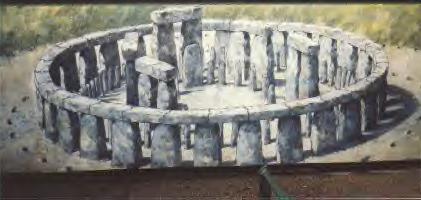
Legend says that King Arthur's magician,
Merlin, by a feat of magic, transported this
great stone monument to England from Ireland, where it had formerly been
called
Giant's Dance.
As Legend has it . . .
 |
 |
The legend of King Arthur gives us "the story of the construction of Stonehenge"
as told by the twelfth century writer, Geoffrey of Monmouth, in his History
of the
Kings of Britain.
According to the Arthurian legend, Merlin brought the stones
to the Salisbury Plain from Ireland.
There had been a massacre of 460 British noblemen by the Saxon leader,
Hengest.
Geoffrey tells us that the high king, Aurelius Ambrosius, wanted to create
a fitting
memorial to the slain men sometime during the 5th century. Merlin
proposed to
mount an expedition to Ireland for the purpose of moving the Giant's Ring
stone
circle to Britain. According to Geoffrey of Monmouth, the stones
of the Giant's RIng
originally came from Africa to Ireland by giants (could anyone else carry
out such a
task?). The stones were located on "Mount Killaraus" and were used
as a site for
performing rituals and healing. Led by King Uther and Merlin,
the expedition
arrived at the spot in Ireland. The Britons proved to be unsuccessful
in all their
attempts to move the great stones. Merlin knew that his magic arts
only would turn
would be able to accomplish the deed. Merlin interceded and used
his magical
arts to dismantle the structure, and then have the stones shipped back
to Britain.
The stones were then reassembled again into a great circle around the mass
grave
of the noblemen. Monmouth also tells us that Aurelius, Uther and
Arthur's
successor, Constantine were later also buried there when their time came.
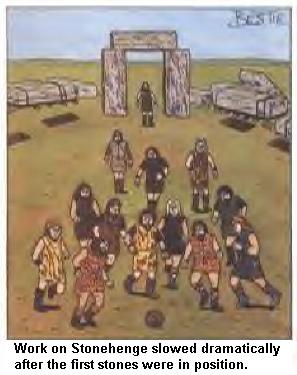
Stonehenge
on the Lighter Side . . .
 |
It is evident that pre-Christian belief lies at the base of Arthurian legend.
Arthur is
described as being the defender of what was left of Roman Christian civilization
in
Britain after the revolt against the Romans, and the struggle of the people
of
Britain with the Saxons that followed.
|
|
 |
|
|
 |
|
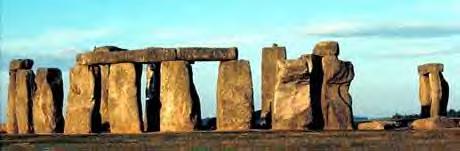
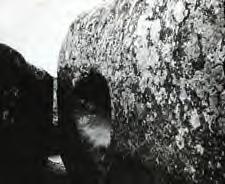
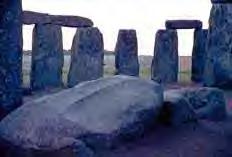
Cap Stones were prepared to fit over the nibs carved on the Sarcen
stones to add stability to the monument as they were laid upon the giant sarcen stones, creating the great Trilithons, of which only a few stand today. |
The whole Arthurian cycle begins at 'Stonehenge' according to many scholars.
Stonehenge was built at least two thousand years before Arthur appears
to have
existed. In the fourth-century BC, a Greek, probably describing the
Island of
Britain, referred to Stonehenge as 'a temple to Apollo - the Sun God'.
Tradition
says that the 'Mother of Apollo' was born here and for that reason the
inhabitants
venerated Apollo more than any other God. "Apollo passed from
Roman into
Celtic Britain and thence into the Welsh Arthurian romances"
.
 |
 |
|
|
|
The symbolism of Stonehenge, the 'Stone Beliefs', and of the 'Earth Mother',
began to be interwoven with the Cycle, early Arthurian talees were full
of
Gods, or their descendants. Both the Celtic and pre-Christian rituals
and belief
in the Gods can be seen to be the immediate forerunners to the emerging
Christian belief. The 4th-century is the fundamental transition period,
when
change in religious practice can be seen to have taken hold in the Arthurian
cycle, and extended the Arthur of historical fact to a semi-mythical legend.
Stonehenge
Today
 |
|
|
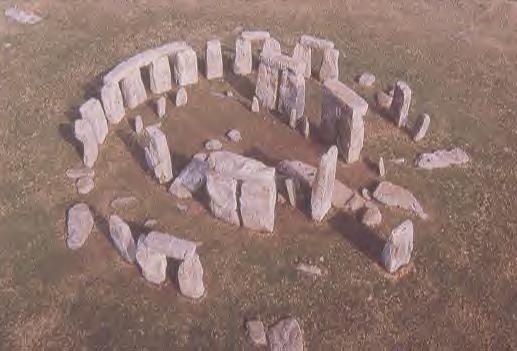
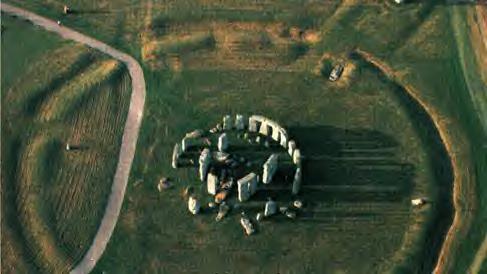
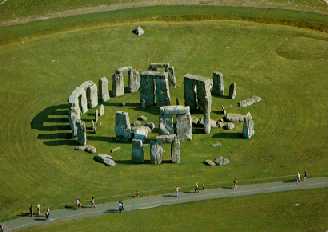
Stonehenge is the most well
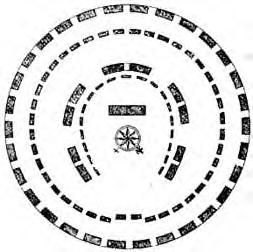
known of the British stone rings. Archaeologists tell
us that it was built during three distinct periods:
 |
|
|
(
radiocarbon-dated to 3100 BC ): Stonehenge was originally a circular
ditch and a bank within. The circle, 320 feet in diameter, had one
entrance, 56
mysterious holes around its perimeter ( filled with human remains ), and
a
wooden sanctuary in the middle. The circle was aligned with the midsummer
sunrise, the midwinter sunset, and the most southerly rising and northerly
setting of the moon. Thus the people who used Stonehenge were able
to
predict
 |
|
|
(
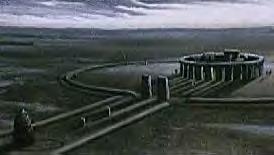
2150 BC ): The wooden sanctuary was replaced with two circles of
"bluestones" ( dolerite stone with a bluish tint ), the widening of the
entrance
to the monument' center, the construction of an entrance avenue marked
by
parallel ditches aligned to the midsummer sunrise, and the erection, outside
the circle, of the thirty-five ton "Heel Stone". The eighty bluestones,
some
weighing as much as four tons, were transported from the Prescelly mountains
in Wales, 240 miles away.
 |
|
|
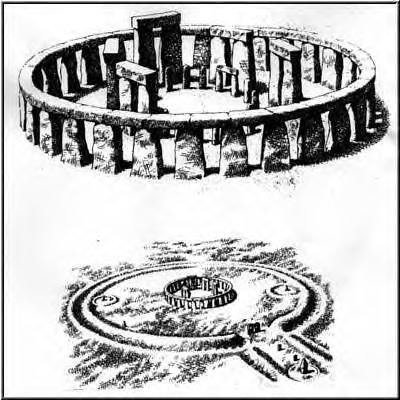
( 2075 BC ): the "bluestones" were taken down and the enormous "sarsen"
stones - which still stand today - were erected. These stones, averaging
eighteen
feet in height and weighing twenty-five to thirty tons, were transported
from near
the Avebury stone rings twenty miles to the north. Sometime between
1500 and
1100 BC, approximately sixty of the "bluestones" were reset in a circle
immediately
inside the sarsen circle, and another nineteen were placed in a horseshoe
pattern,
also inside the circle. It has been estimated that the three
phases of the
construction required more than thirty million hours of labor. Stonehenge
was not
thought to be functioning much after 1100 BC. As a result, the people
living in the
area began to use the stone for their own homes. Consequently, the
monument is
now incomplete, and the site is protected from "vandals" and tourists,
making it
difficult to get close enough to fully enjoy the monument.
 |
|
( 3100 BC - 2075 BC ) |
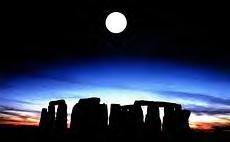
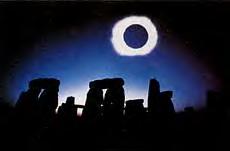
Magical and mystical Stonehenge was an instrument of enlightenment for
the
Druids, much as the Great Pyramid was for the Egyptians. It
was within these
circular borders that they could attune themselves to the "wonders of spirit."
It
was within these circular borders that they could observe the sun and moon
and, understand the universal mind. Their ritualistic practices were
performed
during the powerful times of the year of the greatest imbalance.
The times which
they knew as the uneven times. These uneven times were known
to alter
consciousness. These were times when powerful "spiritual portals"
open that
allow the participant to harness these powerful forces for their own "divine
good.".
 |
|
|
The Druids chose the following times for their spiritual ceremonies:
Mid-summer's day (a day of lunar imbalance)
Mid-winter's day (a day of solar imbalance)
Beltane (the beginning of Summer)
Samhain (the beginning of Winter)
 |
|
|
Current thinking regarding the use of Stonehenge suggests the primacy of
ritual
function rather than astronomical observation. Astronomical observations
would
indeed have been performed. Rather than being for the sake of accumulating
data regarding the movement of celestial bodies, as is the sole purpose
of modern
observatories, the Stonehenge observations were probably intended to indicate
the appropriate days in the yearly ritual cycle. Likely the primary
purpose of the
structure was its use as a ritual site, while its secondary use was as
an astronomical
observation device in service to that ritual function.
 |
Place the Salisbury Plain on your Challenge #3 Map
Sites
from which this Page was Developed,
and
Good Research Sources
LexiLine - Stonehenge
- King Arthur - Knights of the Round ... STONEHENGE The
Legend of King Arthur. For serious background click Norris J. Lacy, editor,
The New
Arthurian Encyclopedia or David Day, The Search for King ...
Mystical-WWW - King
Arthur Fact, Semi-legend or Myth, Part 1 ... As the symbolism
of Stonehenge, of the 'Stone Beliefs', and of ... of a man known as Arthur
who is
documented and revered, not ... perhaps a 'once and future king'. ...
King Arthur
... The Idylls of the King describe the adventures of ... Lancelot,
Guinevere and Arthur himself. These beautiful ... as the creation
date of Stonehenge,
the huge megalith ...
King Arthur
... Arthur has certainly been involved in some ... tree whilst maintaining
a picket of Stonehenge. Many would have given up ... then, not everyone
is the King
of England. ...
King Arthur's historicity
... 2. Tintagel, Round Table, Wroxeter, Stonehenge/Avebury,
and Glastonbury are sites which are ... is mainly material focusing upon
the historic
King Arthur. ...
King
Arthur and the Knights of the Round Table ... The Birth of Arthur-An
interesting
story about the childhood of King Arthur. Building of Stonehenge-A
story of how
Stonehenge was built. ...
Stonehenge
and the Arthurian Legend ... 3000 years ago (more than likely,
several
construction dates over this time). Stonehenge is angled such that on the
... Pictures
Stonehenge construction
... of similar stones, also constructed in post-and-lintel
fashion. ... and at the time of it's construction, the sun would not have
...
Stonehenge sits on a major Grid ...
Techniques
-- Construction Techniques, Stonehenge Lintel with Mortise
Hole Bronze ...
Stonehenge is deceptively small being ... that each upright post supply
on its top ...
Click
on the Grail icon to continue on your Quest

