
 |
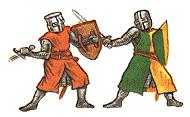
Knights were professional soldiers, most travelling, looking for work,
to do battle. William's
invading army in 1066 and the need for the people of the crown to supply
fighters for the
home lands brought noble knighthood and chivalry to England.
Training of a knight began at the age of seven, serving as a "page" until
he was 14 years
old. He then became a "Squire". This is when the real training
began, learning to use a
lance and start wearing the heavy armor. As a squire, he would serve
as assistant to the
knight. At the end of his tough training, at the age of 21, he became
a knight by means of
a special ceremony.
A young boy spent much of his early years with nurses and the womenfolk.
But he was
soon given a pony and taught to look upon the horse as a huge part of his
life and
education. At about the age of eleven, a boy of noble birth reached
the first important
milestone in his career. He would be sent to become a part of the
household of a great
lord to receive thorough training in the way of courtly behavior and the
management of
horse and weapons. For those with influence, they found themselves
in the king's court,
the highest school of all; but famous knights who had proven their worth
and valor were
also considered as being among the finest possible teacher for a young
boy seeking to
become a knight.
After a short period, with satisfactory progress, the page-knight wannabe
became a squire,
and put on silver spurs. He would be assigned to a knight as master
and became a servant,
waiting his knight at the table, tending his armour and weapons, dressing
him, leading his
horses, fighting at his side in battle and supplying him with fresh arms,
if need be. It was a
hard and complete training experience for which squires won a great reputation.
When the squire attained the age of eighteen, the great day came when his
silver spurs were
exchanged for the golden, or gilded, spurs of knighthood. A formal
ceremony would take
place in the castle garden, witnessed by a festive crowd of womenfolk and
other squires and
knights. But it could also take place in the surroundings of the
field of battle. There was also
an ecclesiastic form of knighting, when the squire laid his arms on the
church altar and kept
a vigil there through the night. A ritualistic bath sometimes was
taken as symbolic of the
purity of the vows to which the knight was committing. The bishop
would act as the knighter.
Every knight had the right of making knights as well, a privilege of which
many are unaware.
Squires and knights, for the most part, were of gentle birth. The
system was often criticized
because the code of chivalry for being restricted to a select class. But,
peasants, tradesmen
and common soldiers, however, could climb the ladder to knighthood.
In early times a feudal tenant paid for his land by fighting, as required,
for his overlord, or
for the king. But, following the Great Plague (1347-1350), by a later
arrangement, this tenant
could pay in cash (scutage) instead of going to war. As soon as this
system arose, it was
possible for another man to render 'knight service' who was not a knight
at all in the chivalric
sense and had no thought of ever becoming one. It was to the kings
advantage to be able to
put as many well equipped knights as possible into the field. This
is probably why they
thought up splendid attractions like mass knightings, and even occasionally
bore the
expence themselves.
As early as the 11th century, these "professional soldiers" were approaching
nobility. The
number of knights declined from the 13th century onwards. The true
knight disappeared in
the 16th century in France, and much earlier in other countries.
Knighthood had flourished
before the time of guns and gunpowder when battles were still being won
by hand-to-hand
combat of heavy armored knights. With the use of gunpowder, both
the knight and the castle
became obsolete, as armor was defensless against the bullet, and the castle
wall could not
withstand the onslaught of cannon fire.
Even in peacetime knights were in search of conflicts in which they might
engage. Fighting
was a regular occurrence, because the common person could not defend himself
against an
invading force. In times like these, the people fled to the protection
of the walls of the castle.
When not fighting, the knight participated in tournaments to win favors,
power, and money.
Often times this would also lead to courtships.
Opportunities for a knight were: marriage to a wealthy
heiress, inheritance of lands, and
service to a noble as a high official. A knight's wages were 8d (
pence ) a day and he would
be expected to serve for 40 days a year. Not all time given to the
noble was combat time.
Some of this service might be as castle guard in a castle.
Being a knight could be quite beneficial, but it was also rather dangerous.
Some knights
inherited, built, or were given powerful castles while others lost
their lives.
Chivalry
 |
 |
Chivalry comes from the French word, "chevalier"
which means "horseman". It originated
in the church of the 11th century during the Crusades. The term was
supposed to give
warriors a "softer" look. Chivalric practice reached its height during
the 12th and 13th
centuries. Toward the end of the Middle Ages, chivalry became more
aristocratic and
exclusive.
It is difficult to find exact rules for the conduct of a knight; but it
is clear that a code was
recognized, even though, in the passage of day to day life, it was rarely,
faithfully lived up
to. Yet, amidst all the treachery, greed, infidelity and cruelty,
shining examples of courage,
gentleness, understanding and mercy can be found. These examples
were inspired by
those rules ( that only a man without flaw could live up to ).
Some Rules of chivalry
You must show courage at all times
You must love your country
You must exhibit great fighting ability
You must refuse to retreat before the enemy
You must be generous and giving of yourself
You must show respect and pity for all weakness and steadfastness
in defending them
You must be faithful to the lord and your savior
You must follow the dictates of moral conscience
You must be willing to defend your values
You must exhibit loyalty to truth and to your pledged word
You must wage unceasing and merciless war against all that is evil
You must be champion of what is right and good at all times, and
at all times oppose the forces of evil.
You must exhibit courtesy and respect for the lady you are courting
You must obey the orders of those appointed above you, as long as
those orders do not conflict with what you know to be just
You must participate in a joust and tournaments
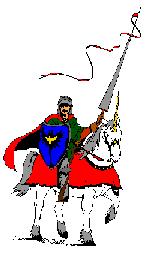 |
The tournaments in the 12th century had been
imitation battles where there was much
bloodshed. They were reduced to carefully arranged jousts in the
13th century. These
tournaments were often "fought" with blunted weapons, and held under the
eyes of the
ladies whose favor was sought by their champion.
Chivalry gradually turned to gallantry, and instead of respect for the
virgin, the knight
began to pursue the ladies. Soon after there were boasts of sexual
love between the
devoted knight and his lady, usually the wife of another.
Chivalric Orders
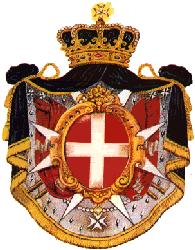 |
The first of the chivalric orders was the
Knights of St. John of Jerusalem, also known as
the Knights Hospitaler, founded in 1070 by a group of devoted Italian knights
protecting
a pilgrim's hospital in Jerusalem.
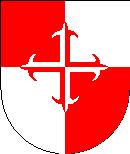 |
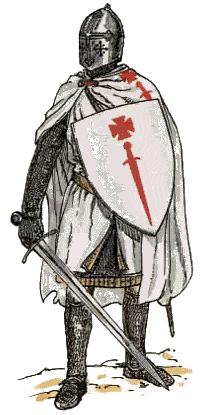
The second great chivalric order was the Knights Templar. Mostly
French knights, the
order, founded in 1119, sought to defend the Holy Sepulcher (Chirst's Tomb)
in Jerusalem,
protect Christian pilgrims and fight the Muslims.
 |
The third great chivalric order was the Teutonic Knights. These were
German Knights
originally formed to protect pilgrims' hospitals in Jerusalem, but later
became a major
power in northeast Europe. They worked to convert pagan tribes in
the Baltic Countries
to Christianity.
The image of a knight as a Christian soldier is expressed clearly.
Military glory and
power were not the only ends of knighthood. Glory was gained and
displayed in the
service of the Church and in the performance of worthy deeds. "It
was not without
reason," wrote St. Bernard, "that the soldier of Christ carries a sword;
it is for the
chastisement of the wicked and for the glory of the good." Even Alfred
Lord Tennyson
gave a definition of chivaly: "Live pure, speak true, right wrong, follow
Christ the King."
Romantic love is perhaps the principal legacy
of chivalry to the modern world; but 21st
century materialism, feminism, pacifism, and atheism represent the antitheses
of chivalric
values.
Some Rules of Chivalrous Love
  |
You must avoid avarice like the deadly pestilence
and thou shalt
embrace its opposite
You must keep thyself chaste for the sake of her whom thou lovest
You must not knowingly strive to break up a correct love affair that
someone is engaged in
You must not choose for thy love anyone whom a natural sense of
shame forbids thee to marry
You must be mindful completely to avoid falsehood
Patience is the greatest virtue of love
You must be obedient in all things to the commands of ladies
In giving and receiving love's solaces let modesty be ever present
You must speak no evil
You must not be a revealer of love affairs
You must be in all things polite and courteous

Sites
from which this Page was Developed,
and
Good Research Sources
Medieval Knighthood
Dictionary
of Medieval Knighthood and Chivalry -- People, ... People, Places,
and Events
By Bradford B. Broughton -- Illustrations ...
The Origins Of
The Knight ... THE ORIGINS OF THE KNIGHT The medieval knight
is
generally perceived as an ... until the 12th Century that knighthood and
chivalry become
inextricably associated ...
Knighthood, Chivalry & Tournaments
Resource Library ... to bring historical documents,
articles, reviews and essays on knighthood both as it applied to the medieval
knight and as
it applies to modern re-enactors and ...
NM's Creative Impulse..Medieval
... site. Knighthood, Chivalry and Tournaments - Resource
library of terms, events, oaths....very good site to get a real feel for
the Medieval environment. ...
The Knighthood Chivalric Code
Catholic Encyclopedia:
Chivalry ... Join New Advent's Catholic ... Chivalry. Chivalry
(derived through the French cheval from the Latin ...
www.newadvent.org/cathen/03691a.htm
The Ring of Chivalry. Chivalry-. Code of knighthood of medieval times.
British Orders of Chivalry
Welcome to the British Orders of Chivalry Web Site. This site,
`
which is a collection of articles giving details of the British Orders
of Chivalry, their
insignia and their...
Chivalry - The Conquest ... Welcome to Chivalry.
Bulfinch's Mythology, 'The Age of Chivalry ... The Age of Chivalry or Legends of King Arthur
Chivalry Sports -- Renaissance
Knighthood and Orders
of Chivalry There are many, many books on the topic of orders
of chivalry.
The Truce of God
Catholic Encyclopedia: Truce of God
Truce
of God, 1063 1063. Drogo, Bishop of Terouanne, and Count Baldwin
have
established this peace with the cooperation of the clergy and people of
the land. ...
Truce of God
2 pages The pope's efforts to bring a cessation of wars between kings in
the West ...
Truce of God
-- Slider Search: The ... truce of God. In the Middle Ages, an attempt
by the
Catholic church to limit ...
The Peace of God
Medieval
Sourcebook: Peace of God - Synod of Charroux, 989
.
Anniina Jokinen
-- Heroes of the Middle Ages. ... valiantly held the field for
God and
country. An apotheosis ... to a time of peace when the knight can go ...
Hero in the
Early Middle Ages." Concepts of the Hero ...
The chivalric
code ... Christianity and the Middle Ages. The early Middle Ages
had
been a chaotic time in ... adopted the programs known as the Peace of God
and the
Truce of God. The ...
Lives from Late
Antiquity and the Early Middle Ages. ... The Peace of God: Social
Violence and the Religious Response in ... the Middle Ages
History Courses ... F.
"St. Augustine and the Just War in the Early Middle Ages.". ... of
Elne-Toulouges (1062) Head, T. "The Development of the Peace of God In
Aquitaine.". ...
Baylor
University Church-State Studies ... 824; Synod of Charroux: Peace
of God
Proclaimed, 989 [fordham]; Drogo of Terouanne: Truce of God, 1063 [fordham].
High
Middle Ages: Investiture Controversy: Papal ...
Medieval
History - ... and Empire: The Besançon Episode Peace of God
(synod at
Charroux, 989) La ... Age Le Péril franc (Early French Middle Ages,
7th - 9th centuries)
La place ...
Click on the Grail icon to continue on your Quest

