
Painting Better Every Day: by Kenneth Taba revised –5/2/2000
[Back to the Table of Contents]
Ooops, I've gotten paint on the wrong area. What to do.
I have a special brush to deal with this. It's an old used brush with bristles I've cut down to about 1/4 inch or less in length. I use this brush as a little scrubber and I have it handy for accidents. What I do when I accidentally get paint somewhere it's not supposed to be is to immediately rinse off the brush I'm using and try to mop up most of the paint. Then I use my scrubber, I dip the scrubber in water and scrub the remaining offending paint from the miniature.
Spray Primer vs. Paint on Primer
Spray on Primer is all right for doing pieces your going to be playing with, but for competition pieces, you want more control. A paint on primer gives more control because you control how much goes on so as to avoid clogging up details like the eyes, and it goes on smooth. Granted, sprays adhere better (which is good for playing pieces) but for competition painting, you want as much control of the painting process as possible.
Spray Primer comes out of the nozzle as little droplets that partially dry before they coat the miniature and leave the primed surfaces slightly textured and it's also prone to over spraying and clogging up details.
Black primer is available in spray, and it's fine for doing rank and file playing pieces that are almost all armor. Black primer also mutes the brighter colors that are painted over it, which is good if you're going for the Gothic look.
I recommend you use a white primer (Paint on). Your colors will be brighter. And it's easier to paint dark colors over white than it is the other way around.
Which parts should you paint first
Generally I suggest painting from the inside out, like the face, then clothes then hands, then weapons etc. But When I paint, I always paint the Hair, fur & feathers first. This is because I dry brush hair, fur & feathers, and I don't want to get paint on other areas due to dry brushing, then I paint from the inside out.
What is this Black lining (a.k.a. Dark lining) that I hear about?
This is a black or dark line separating parts of the miniature, like where the sleeve meets the hand, or where the belt meets the tunic. Dark lining is a dark line, just like in comic book drawings. The purpose of this is to give definition to different areas of the miniature that has been painted. Because the miniature is so small, the details and colors end up blending into each other if it's not dark lined. There is a lot or reasons why this is so, but basically, if done properly the paint job just looks better.
How to do eyes - My secret way, even though I tell anyone who will listen
There are several recommended ways to do eyes, "this is my way. "
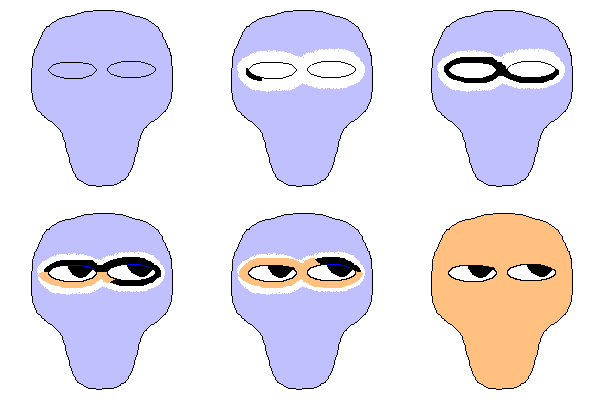
First I paint the whole eye area white, not just the eye (so it looks like a Raccoon).
Then I paint black around the shape of the eye to define the eye shape (looks even more like a Raccoon).
Then I dot the eye for the cornea in the direction that the miniature will be looking.
And the last step is to paint over the black surrounding the eye with your flesh tone, leaving just a fine line of black to surround the eye.
( I think my method is much easier than other methods I've seen described in other articles which involve trying to paint a really fine black line all around the eye, or trying to paint white eyeballs over black )
( Remember crayon coloring books ) Keep all your painting in its area. Don't be sloppy and have paint from the hand overlapping the sleeve etc.
Paint all those little gems, belt buckles, chains, rings, doodads, etc.
Your painted miniatures should be "Clear Coated." A clear coat protects your finished paint job. It keeps the paint from being rubbed off, getting dirty or chipping too easily. There are 2 ways to apply them and 3 types of clear coating.
Spray On comes in spray cans and is good for overall coating of the miniature.
Paint on comes in a bottle and is applied with a brush. The good thing about this is you can spot coat part of the miniature. (say you wanted matte coat on the miniature but you also wanted the sword blade or gems to be gloss coated so as to be shiny)
Matte Coat gives a matte finish. It is not shinny at all and doesn't reflect light. The finish of this coating is slightly porous and is the least durable.
This is my preferred type of coat. Unfortunately, all the brands of spray coats that I find now-a-days that are labeled Matte Coat are in actuality a Semi-Gloss finish. Ugh!
Gloss Coat gives a shinny finish. It reflects light and is good for making something look wet. The finish of this coating is non-porous and the most durable.
Semi Gloss Coat is halfway between Matte and Gloss.
Unfortunately this seems to be the only kind that I can find anymore and is also labeled Matte Coat
If you want a really durable finish that isn't shinny, you can first apply Gloss Coat then apply a Matte Coat to kill the shine "sometimes called Bullet Coating".
Continue on to next section "Improving Your Painting Skill and Winning Contests"
Back
to Index of Painting Guides
[Table of Contents] [Preface] [Tools]
[Model Preparation] [Assembling
Your Miniature] [Cleaning] [Environment] [Physical]
[Mental] [Bases] [Techniques] [Q & A and Other
Tips] [Improving Your Painting Skill and Winning
Contests]
