|
The
Band
Individual biographies are coming!

Early Days |
Coming of Age | The End of a Legacy
Early
Days
The
infamous, guitar touting Jimmy Page was, and still is, considered
the creator and leader of the hit rock group, Led Zeppelin. The beginning,
although subtle, began when Jimmy Page left the Yardbirds in 1968, a
group that fell apart after Jimmy's exit. He had begun in the music
industry at the tender age of 24, and after quitting the Yardbirds,
he was on a mission to form a band of his own - consisting of a
vocalist, a drummer, a bassist, and himself on guitar.
During
Page's struggle to put the pieces together to form a band, Robert
Plant, an endeavoring singer in the small, local bars of England, was
looking for a break. Plant finally caught a break when he was
recommended to Page. Page invited him over and they began to form
the band that very night in 1968. Page brought in two more acquisitions
to complete the band - John Henry Bonham and John Paul Jones. the small, local bars of England, was
looking for a break. Plant finally caught a break when he was
recommended to Page. Page invited him over and they began to form
the band that very night in 1968. Page brought in two more acquisitions
to complete the band - John Henry Bonham and John Paul Jones.
Bonham
had played the drums with Page in The Band of Joy, another one of
Page's lost dreams. Jones had been invited over informally, but
turned out to be a very talented pianist and bassist. Page now had
the parts, and it was now his time to revolutionize rock and roll as
we know it.
The
band's name wasn't formed until the creation of their album. The
first album sported a Zeppelin, colored in gray, crashing to the
ground. When The Who's drummer said that their band was destined to
sink like a "Lead Zeppelin", the name stuck with the quartet and never let
go. It was eventually shortened to Led Zeppelin because of
pronunciation problems.
Coming of Age
Zeppelin
signed an unusually large deal with Atlantic Records of $200,000 and
released their first album, Led Zeppelin I, in January 1969. The
album turned out to be no more than a good hit - nothing tremendous,
but it possessed such songs as "Good Times, Bad Times" and
"Communication Breakdown" that would become a signature of
sorts at many of the band's live performances.
The
now somewhat recognizable rock group toured the area extensively,
promoting their album. As soon as they garnered a substantial fan
base, Zeppelin began to record their new album, Led Zeppelin II.
They decided to record it on tour, a move Page later said to be
"ridiculous." No matter how crazy this move seemed, the
success from the album was immense, and "Whole Lotta Love"
rose to #4 on the Billboard charts. By October of 1969, the band was
already on their fourth tour of the United States, 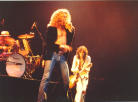 and became
contenders with such rock legends as Santana, James Gang, and Isaac
Hayes. and became
contenders with such rock legends as Santana, James Gang, and Isaac
Hayes.
By the
time the third album, Led Zeppelin III, released in October 1970,
Zeppelin was on it's way to becoming one of the leading rock and
roll groups of the decade. Led Zeppelin III marked a change in the
music of the band. Songs such as "Immigrant Song" featured
harder rhythms and more frantic guitar pounding. This was
drastically different from past Zeppelin releases such as "I
Can't Quit You Baby" and "Babe, I'm Gonna Leave You",
which featured heavy Blues influence and a calmer demeanor. Despite
the changes, this album soared the group into the utmost of
popularity.
While
bathing in this newfound glory, Zeppelin released a rather odd
album - of which there was no title. However, most people refer to
this album as Led Zeppelin IV. The cover featured no indication of
anything, no names, nothing. The inside cover had mysterious
markings symbolizing each of the band members. Even though the album
was abnormal, the music within was some of the best ever written by
Led Zeppelin. The song "Stairway to Heaven" soon became a legendary
hit, and was recently nominated the #1 rock song ever by the radio
station 94.5 The Hawk - a Philadelphia-based classic rock station.
The
band's next album catapulted them into glory. Houses of the Holy
was an absolute hit, topping charts and making people flock to
Zeppelin's live performances. "D'yer Mak'er", an adventurous
song that echoed Reggae themes, was one of the more poignant songs
in the album. "The Crunge" revisited the days of the
band's roots and offered a blues-themed experience. Zeppelin's
concerts were now concentrating over 50,000 people and they later
released a live album called The Song Remains the Same.
In
1974, the band formed their own record label, in agreement with
Atlantic Records - it was named Swan Song. In 1975, Zeppelin
released their first album under this label called Physical
Graffiti, a two-disc set that featured a mixed bag of new songs
and old outtakes of the earlier albums. The 1975 tour of England was
a massive success. The only stage fit for the band was as large as
an American baseball stadium, and they used gigantic video screens
so the audience could see them live not only on the floor, but up on
the screens - this now commonly used feature was first used by Led
Zeppelin at this very concert. However, this amazingly popular and
successful band was about to take a turn for the worse and send them
spiraling into demise.
The
End of a Legacy
Unfortunately,
all things come to an end, and now it was Led Zeppelin's turn. In a tragic
car crash in the summer of 1976, Robert Plant sustained serious
injuries to his legs. This threw the band into turmoil. While they
finally did release an album entitled Presence, the problems
of the band were reflected in the quality. It did momentarily soar
to number one on the charts, but with rumors circulating that the
band may never tour again, sales faded quickly.
On
April 1, 1977 Led Zeppelin began their final tour of the United
States. However, although extremely successful, Plant's son Karac
became fatally ill and the tour ended early causing many dates to be
canceled. This is viewed as the breaking up of the band, but
Zeppelin had one more album to offer before they crashed.
It was
three years before they would release In Through the Out Door
in 1979, and in that time Zeppelin's style of music faded from
popularity in England. However, this new album featured some hit songs that just managed to keep Zeppelin afloat. In June of 1980,
the band began a tour of England that brought in phenomenal success.
However, just as quickly as they were beginning to look revived,
they crashed. On September 25, 1980, drummer John Bonham died of asphyxiation
from a night of heavy drinking. In December, Swan Song officially
confirmed the band's end.
songs that just managed to keep Zeppelin afloat. In June of 1980,
the band began a tour of England that brought in phenomenal success.
However, just as quickly as they were beginning to look revived,
they crashed. On September 25, 1980, drummer John Bonham died of asphyxiation
from a night of heavy drinking. In December, Swan Song officially
confirmed the band's end.
Coda,
an album released in 1982, contained songs unreleased earlier by
Zeppelin. Recently, there have been rumors of a reunion, but nothing
has been confirmed. Page and Plant are said to be working on an
album together, but we'll just have to wait and see.
Biography
by Bill Kerr
Last updated on February 15, 2003
|