|
Interference
|
Volume
II • Issue 2
|
Play
|
:Waves: |
Sights & Sounds
|
Movie
Legend: = Exceptional
= Solid Effort
= Below Average = Poor
= Exceptional
= Solid Effort
= Below Average = Poor
|
Music
Legend:
= Classic
= Exceptional
= Solid Effort
= Below Average = Poor |
| Film —————————————— |
—————————————— DVD |
|
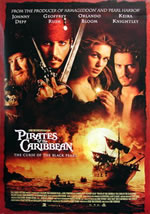
Produced by Jerry Bruckheimer, it is perhaps needless to say that the film features oodles of explosions and lengthy action sequences with lovingly crafted sets and outlandish characters. The effects and set design are very good, but after two and a half hours the whole "normal pirate becomes skeletal soldier by the light of the moon" effect was a bit overused. Bare bones on plot but heavy on humor and fun, Pirates benefits from assured direction and strong performances from Depp and Rush, as Barbossa, the new captain of the Pearl. Fans of the ride will recognize (and I dare say "delight at") some lines included in the film. This is harmless summer fun.
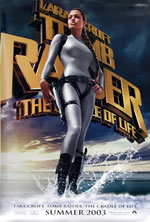
Circling the globe from the Mediterranean to Asia to Africa to the depths of the Cradle of Life (or a cheesy interpretation of such), the scenery once again provides an amazing backdrop to a series of well-choreographed fight and chase sequences. Boasting great outfits, a wealth of fabulous gadgets and some serious sex appeal, Croft seems a female Bond, and the film delivers as well as the last two or three Bond films did. Jolie speaks in a sexy faux-Brit accent, has a calm and collected attitude (even under pressure), handles her dual pistols well, and flirts and fights her way through the various trials. Yes, the film objectifies Croft, but it also objectifies the handsome fellow she meets along the way. A sexy, frequently bare-chested Gerard Butler is sprung from a remote prison to advance the plot (something about Asian gangs; isn't it always?) and add some conflict to the proceedings. An aside: the accent is to die for. Like most movies this summer, LCTR: TCOL is short on story but long on fun. The gizmos and vehicles are neat, the actions sequences are skillfully done, and the film's pace and tone are effective. After flops such as Speed 2: Cruise Control (ick) and The Haunting (<cough> "hack" <cough>), director Jan de Bont may be back on track.
T3: Rise of the Machines is not the first two Terminator films, expertly crafted by director James Cameron and his talented FX teams. However, the film stands on its own as a well-constructed, somewhat hammy summer fluff movie experience. The movie's tone is less serious and more tongue-in-cheek than its predecessors, and the characters all seem to be "in on the joke" that the film isn't entirely necessary. But it's fun. It's great to see Schwarzenegger sink his teeth into a character beloved by moviegoers for nearly 20 years. He plays the T-101, again sent back in time to protect John Connor and his future military cohorts who are struggling to win the war against machines in the future. John Connor (Nick Stahl) has an attractive, jaded Gen Y quality about him, and Danes makes the most of a mostly shrill veterinarian-turned-freedom fighter. The enemy Terminatrix, played with a sexy robotic-ness by newcomer Kristanna Loken, has even more advanced features than Robert Patrick's T-1000 in T2, but she can't quite manage his evil-eyed intensity. All models are robotic to begin with, so it isn't scary so much as like flipping on a runway fashion show. Loken has fun with the part, though, and she makes the most of her scenes. Despite advanced word that he was wrecking the series, director Jonathon Mostow (U-571 and Breakdown) again shows a mastery with intense chase sequences and solid pacing. Overall, though, brawny action takes over where brainy dialogue once reigned in the films, and we essentially get one long action sequence punctuated by short, silent periods of dialogue. There is little character development, but I was surprised at times to find the film thinking about the previous mythology and trying to build off of it with some cleverness. Besides, it is sometimes enough simply to be entertained and not feel "talked down to" by a film. Was Terminator 3 necessary? No. Was it inevitable? Definitely. Like the war in this film, movie sequels are inescapable. But when they're done skillfully, as T3 is, we can at least relish in what once was and hope for greater things in the future.
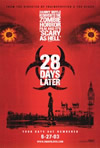
I won't spoil any more of the plot. Jim searches for a way to escape London and the ravages of the rage, and along the way meets some unique characters in some stock-film situations. A choppy, ADD editing style, grainy digital film, and effective use of a sparse soundtrack make the film a visual/auditory feast, and I liked how the "zombies" are not the shuffling, moaning amblers we've seen before. It tends to be a bit too gory in places, and it doesn't always live up to its potential, but 28 Days leaves enough haunting visuals behind to make for some seriously sleepless nights. Horror fans should catch it.
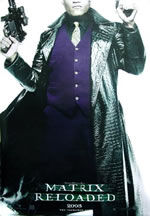
Neo isn’t much more sure of himself in Reloaded, though his powers are quite formidable compared to the first. After a sensational opening sequence, the film detours to Zion, the last human city, for a rave party, some pasty waif-sex with Neo and girlfriend Trinity (Moss), and a ridiculously contrived and not-entirely rousing speech by Morpheus. Fishburne, the powerful core of the first film’s mythology and humanity, finds his talents squandered throughout most of his dialogue in this film. He basically stands around and rehashes his beliefs. Freshly sexed and recharged, the group plugs back into the Matrix, and the film finds a story. Well, it isn’t really a linear story so much as a series of action scenes pieced together with some philosophical discussions both riveting and overcomplicated. An army of 250,000 sentinels (killing machines) is burrowing its way to Zion, and Neo and the gang must infiltrate the mainframe inside the Matrix to stop them. First they await word from the Oracle, which eventually sets up the film’s finest moments, with Neo verbally sparring with the beautifully written Oracle character (the late Gloria Foster) and then physically sparring with a reborn Agent Smith, played with biting humor by Hugo Weaving. The Oracle steers them toward the Keymaker, a man who can help Neo reach the mainframe. Merovingian, a snooty Frenchman populating a largely unnecessary series of scenes, holds the Keymaker. His twin henchman have one of the neatest abilities in the film, and a 20-minute highway action sequence involving Morpheus, Trinity, the Keymaker, the twins, agents and rush hour freeway traffic teeters between a breathtaking, exhilarating thrill and a somewhat disappointing, pasted-on visual experience. The first Matrix basically reinvented the action film, so it isn’t fair to expect the same of the sequels. Some of the “virtual cinematography” and mostly-digital scenes look as though they were rushed to finished product, and though advanced word said the Wachowski's had all but abandoned the ‘bullet time’ effects (at this point overdone and unimpressive), they appear quite frequently in this sequel. However, the effects in certain sequences appear shoddy only because they look so good in others. The sentinels and wasteland of the Real World are inspired, and Agent Smith’s ‘virus’ effect is handled expertly. The flying effect is obviously blue-screened but still a sight to behold, and I like the digitized view that Neo has inside the Matrix. Overall, the performances are on-target, and I liked the shifts in tone despite the pacing. A late conversation reveals certain “truths” to Neo and the audience, yet they are clothed in such convoluted language that I think I missed most of the message, and the final scenes, while not providing an ending, promise more twists and turns in the story to come. I eagerly await The Matrix Revolutions, the final film in the trilogy, come November.
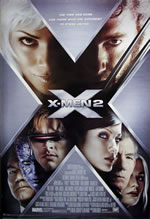
The film is about as busy as the first, swarming with characters and dotted with a few more action sequences to propel the experience along. It also manages to throw “coming out” scenes and more character development into the action mix. Jackman’s Wolverine — whose history with Stryker is uncertain — delves further into his past, Jean Grey (Famke Janssen) fears and doubts her powers, and the Wolverine-Jean-Cyclops love triangle pops back up in a scene or two. Alan Cumming is touching and understated as the devilish and devout Nightcrawler, and Halle Berry’s amazing cleavage returns as Storm. Rebecca Romijn-Stamos’ blue-skinned metamorph Mystique sees more action in this film, and McKellen’s anti-human Magneto spouts a saucy line or two. Mutants such as Iceman, Pyro, Rogue, Colossus and That Girl Who Walks through Walls and Falls Through Floors (you know the one), make a larger impression in X2 — the sequels are already steeped to include some powerful new allies and enemies. I liked the special effects, especially a stunning opening sequence, and the performances seem stronger than in the first (even Berry isn’t quite as wooden this time). I also liked how the film took more time to flesh out the story and humanity of the characters. X2 is a film for fans and non-fans of the X universe, for those who enjoy a bit more emotion in their action films. This looks to be a promising film franchise. |
Bale brings grit and levity to his character John Preston, a Grammaton Cleric/law enforcer who is among the best of his kind. Missing a dose of Prozium and encountering a young "sense offender," Preston gets a feel for the "other side" and hesitates to let go of it. The performances are spot on — Bale as the top gun suddenly thrust into unfamiliar territory, Diggs as the opportunistic young protige cleric, and Emily Watson as the sense offender woman who (along with a particularly adorable puppy) ushers forth emotion in our lead character. The film features some great dialogue punctuated by some intense action sequences. Comparisons to The Matrix are inevitable, but these scenes have a character of their own, combining mathematically precise gunplay and martial arts. I would like to have a bit more character development, but the film does a wonderful job of painting pictures of the various characters, including Father, the leader in this drug-induced dystopian society. As expected, the sound and picture quality on the Equilibrium DVD are top notch. Not many extra features are included, but the "Finding Equilibrium" behind the scenes featurette and commentary from director Wimmer and producer Lucas Foster provide some insight into the production.
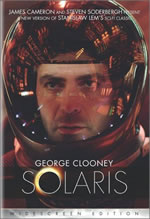
The film is a quiet, meditative look at space, time, memory and the human condition. Clooney stars as troubled psychologist Chris Kelvin, who receives an urgent message from a friend on a space shuttle studying a mysterious planet called Solaris. The cryptic message finds Kelvin on a ship headed for the Solaris orbital. What he finds on the ship drives the film's emotional core. Determined to solve the mystery of the planet and its effects, Kelvin finds himself absorbed by Solaris' power and beauty and mystery. Like life itself, the film's final moments offer partial resolutions clouded by perception and revelation. Taken as a whole, the film feels like a fully realized experience — visuals, dialogue, set design , performances and especially music are tightly woven into an overwhelming mood piece designed for lovers of human interest stories set in a sci fi realm. The DVD has amazing picture, sound and the usual roster of features. Commentary by Soderbergh and producer James Cameron, screenplay stills, theatrical trailers and a few "making of" specials all complement the viewing experience.
The story is only a part of the experience, however. Adaptation's writing and dialogue is alive with wit and subtle humor, with enough subtext and references to keep even the most attentive viewer busy. Cage, not typically a favorite of mine, gives a beautifully neurotic performance, and Streep invests Orlean with just the right amounts of intelligence, madness and sadness. Adaptation is one of a kind, a film with a story to tell — a story with no beginning, middle or ending, yet riveting and inventive until the end.
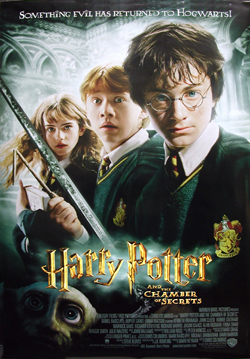
Again, we get powerful and assured performances from Radcliffe, Watson and Grint. Again, we get gobs of special effects wizardry, a sly whodunit mystery with a clever story and sparkling dialogue. Again, we get stunning supporting characters, especially Kenneth Branagh as celebrity wizard Gilderoy Lockhart and Alan Rickman as the slithering Severus Snape. At two hours and 40 minutes, the movie strains attention spans, as did the original. Additionally, the ending featured a few too many happy reunions that could've been condensed a bit, but this doesn't detract from the overall experience. Secrets is the second in what promises to be a powerful series of films. I can't wait until 2004, when the third film is expected to be released. The DVD for Secrets contains 19 extended and deleted scenes, fantastic sound, sharp visuals, and some unique DVD-ROM compatible games and exploratory elements. It's a definite must-buy for Potter fans.
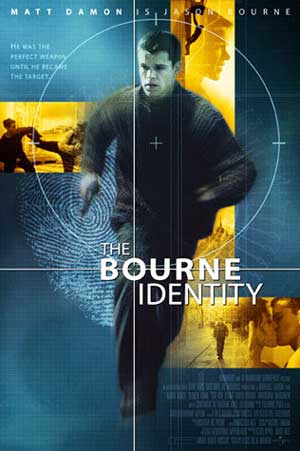
The DVD for The Bourne Identity has solid sound, crisp visuals and several bonus materials. The deleted scenes feature extended moments and an alternate ending (which really wasn't that different). More materials would have helped, but for action fans, this one is definitely worth a rental.
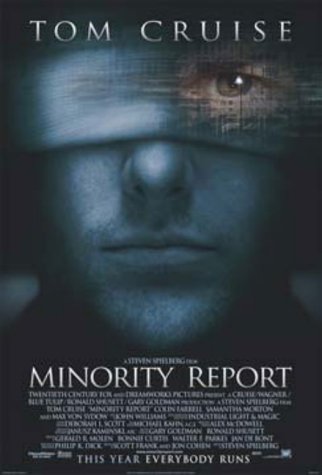
Report is a visionary masterpiece, combining Spielberg's creepily detached, mechanical future in Artificial Intelligence with familiar landscapes and technology that isn't as alien. The film manages to balance action flick, thriller and human interest story without batting a lash. See this film for dazzling FX woven into a tight storyline. See it for wonderful performances from Cruise, von Sydow and the entire cast. See it to experience dialogue that is alive with wit instead of merely dragging viewers from one action scene to the next. See it to watch one of today's most gifted directors fall in love with style and substance, beautifully intertwined, all over again. As typical, the picture and sound are incredible. The muted tones and washed out colors are richly transferred, and the sound rumbles and purrs in all the right spots. The DVD has a surprising number of behind the scenes looks at the production of the film, as well as commentary from Cruise and Spielberg on what it was like to work together. Unless I missed an easter egg, a section on deleted scenes was curiously absent. I would like to have seen more extras on the DVD, but alas, the film itself is plenty. |
| — Music ——————————————————————————————— |
|
For Emotional Technology, a more personal album according to the performer, he steps up as a more focused singer, producer and technology guru. Indeed, the six tracks featuring BT's vocals are the most powerful of the 13-track collection. "Simply Being Loved (Somnambulist)" is the first single from the album, and it features lush, interwoven instrumentation, a twittery breakbeat rhythm, and BT's now famous technique, the stuttering drum machine. It is on par with his most powerful work, including "Mercury and Solace" and "Dreaming." His voice, smoky and sensual and self-assured, portrays great conviction, and the lyrics are heartfelt. However, on some tracks his vocals are over-processed, as though he didn't trust himself enough to let his voice flow freely. On "Dark Heart Drowning," a drowsier rhythm pops in the background while a chorus of voices echo BT's dark vocal: "Violate me like an animal/Like you always do/While the Dark heart is dawning/And the sky is as black as you." This isn't your typical electronic fare. Aside from the songs voiced by BT, the album's other tracks and collaborations basically do not work. Rose McGowan pops up (inexplicably) to mouth off with Some Other Guy (I forget his name and don't care much to look it up) and BT on "Superfabulous," and his fascination with hip hop resurfaces annoyingly on the opening thumper "Knowledge of Self," complete with trite lyric. Other forays into '80s electro and freestyle sound rehashed. Artists cannot seem to get the retro thing down pat. The '80s, for the most part, were better left there. If you can't grasp some technique and update it, don't bother re-treading. In short, BT calls Emotional a further evolution in his musical development. A pianist capable of playing Chopin by age 6, BT's music doesn't seem to possess the lush layers and tremendous heart he puts into it. For all his musical exploration, his albums have become inconsistent at best.
—Modern Classics—
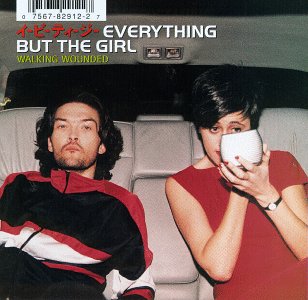
"I don't want excuses/I don't want your smiles/I don't want to feel like we're apart a thousand miles," vocalist Tracy Thorn sings on the album opener, "Before Today," and the floodgates open wide. The listener can immediately tell that they are in for something special — deft lyrics, flawless production and astounding vocals. What follows is eight beautifully constructed tracks and two dance floor-ready remixes. Thorn's lyrics are dead-on, somber and emotional without being depressing, and her voice of heartache and lack of fulfillment is enough to break hearts. "I wanted everything for a little while/Why shouldn't I?" she asks on "Wrong," another powerful track. The most powerful lyric has to be on the title track, however: "Out amongst the walking wounded/Every face on every bus/It's you and me and him and her/And nothing can replace the us I knew." Her words are simple, but the images are powerful, timeless; they speak to everyone on some level. Musician/partner Ben Watt and producer Howie B.'s expert production backs her up. The stuttering breakbeats, lush synths and spacy atmospherics perfectly compliment Thorn's voice. The albums shifts from pop-tronica to downtempo to trip hop-ish rhythms, providing a pulsing urban backdrop to Thorn's images of heartache ("Good Cop Bad Cop"), regret ("Single") and indifference ("Big Deal"). Wounded is a work of amazing genius, expertly crafted and timeless in both its simplicity and power. Rarely is music so affecting. Other Classics: Orbital
— In Sides (FFRR, 1996) |
The gently pulsing rhythms and synths of "Heliopolis" build from background ambience on Disc 1, the stronger of the two, and then flow effortlessly into a series of powerful tracks built from shuffling percussion, unique sampling and haunting vocals. "Drippy" takes a leaky faucet sound and builds it into a jazzy horn-laden track with a strong dub bass line before blending into my favorite track, the 11 minute and 14 second "Last Train to Lhasa." From the simple sound of a simple locomotive steam engine — complete with melancholy whistle — erupts somber moans and chants, eventually breaking into a strong beat with layered instrumentation. There's a definite style at work on this collection: "Obsidian" also builds from the background, unleashing beautiful vocals from Jennifer Folk as the track proceeds. Disc 2 has a slower, gentler rhythm to it, as "Desert Wind" rises to an barely-there beat amid subtle crooning and Middle Eastern instrumentation. Subsequent tracks such as "Celestine" (12:13) and "887 (Structure)" (14:02) percolate just beneath the surface. The ear expects an explosion of sound to happen, but only subdued elements flow in and out. By disc's end, the listener recognizes they have heard something profound, something truly original, some of the best electronic works to come from the past 10 years. The mood tends to bog down toward the middle of disc 2, but fans of new age and spacy, ethereal electronica will find much pleasurable listening from this impressive collection.
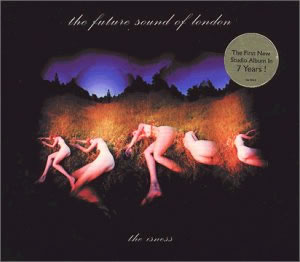
For The Isness, the duo has apparently studied the slow, plodding moods of Pink Floyd along with Middle Eastern instrumentation. That Isness is unique and experimental there is no doubt. However, unique and experimental aren’t the only factors in electronic music. For example, no group in my recent memory has mixed horn sections, sweeping orchestrations and sitars into one swirling mass. FSOL should have asked why no group had blended these instruments — they don’t sound so great together. Other songs blend vocals into the mix, but mostly we get spacy, ethereal atmospheres, slow and languorous beats (if we hear beats at all), wah-pedal guitar lines, and a whole lot of sitar. It makes for a one-sided, uneven recording with a singular mood — drowsy. That explains why I fell asleep during my reviews.
More to come soon! |