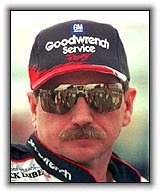
Dale developed a love for the sport that would ultimately fuel one of the most successful careers in the history of motorsports.
In his late teens, Dale began racing Hobby-class cars in and around his native Kannapolis, NC, working full-time by day, welding and mounting tires, and either racing or working on his cars by night.
In 1973, Ralph Earnhardt died of heart failure while working on his race car. Crushed by the loss, Dale eventually learned to cope by becoming more determined than ever to be successful as a driver. He continued to compete on the Sportsman circuit, racing at speedways near his home such as Hickory, Concord, and Metrolina Fairgrounds.
Dale made his Winston Cup debut in 1975, finishing 22nd while driving Ed Negre's Dodge in the World 600 at Charlotte. Over the next three years, he made a total of eight more starts, the last of which was the 1978 Dixie 500 at Atlanta, when he drove a second car for Rod Osterlund. Earnhardt finished fourth in the race, one spot behind Osterlund's regular driver, Dave Marcis.
In his first full season of competition, Dale scored his initial Winston Cup win at Bristol in just his 16th career start. Eight races later, he notched his first career pole at Riverside. By the end of the season, he had driven to 11 Top 5 finishes and beat Harry Gant, Terry Labonte and Joe Millikan for the rookie title in one of the most competitive rookie battles ever. In 1980, Earnhardt beat tough veteran Cale Yarborough for the NASCAR Winston Cup Series title to become the only driver ever to win the rookie crown and the series' championship in consecutive seasons.
Midway through the 1981 season, Osterlund sold his team to Jim Stacy. Earnhardt, disenchanted with the performance of the new team, left after only four races, and finished the season driving for Richard Childress. By the end of the year, Childress realized that his cars were not performing at a level that justified a talent like Earnhardt's, so he urged Dale to accept an opportunity to drive for the well-established team of Bud Moore and big-dollar sponsor, Wrangler. Earnhardt accepted the ride in the #15 Fords, in which he competed for two seasons, winning three races and finishing 12th, then 8th in the points.
Meanwhile, Childress, with driver Ricky Rudd, was building his team into a championship contender. In the off-season between 1983 and 1984, Earnhardt made the decision to rejoin Childress. Driver and owner immediately began a program to achieve the level of performance both believed would take them to a NASCAR Winston Cup championship. Neither could have envisioned the success they would achieve together.
The duo captured their first championship in 1986, beginning a reign that would bring them six titles over the next nine seasons, accumulating records that attest to the talent and ability of one of the greatest drivers ever to have raced the short tracks and superspeedways of NASCAR.
In February 1998, Earnhardt captured the only major victory that had eluded him throughout his career, the Daytona 500. The win was the 71st of his career and came in his 575th Winston Cup start, placing him sixth on the all-time wins list.
The seven-time Winston Cup champion not only continued to find Victory Lane but became a contender again in 2000 finishing 2nd in Winston Cup Points Standing.
In February 2001 at Daytona Int'l Speedway on the Last turn heading toward the checkered flag watching his 2 cars driven by longtime friend Michael Waltrip and his youngest son Dale Earnhardt Jr. Finish 1st and 2nd he hit the wall and was tooken from the nascar world.