
All that has since changed, yet history fails to explain why they ended up in the barren land of Sujan, why their outlook on life and the style of their society has also altered so drastically. The Eldrin know why, but because they have little to do with any of the cultures except the Empire of the Southern Lands, that secret as been kept hidden for many generations.
They are a hardened race, wizened to the ways of the world. They are fierce warriors, adept incantors and skilled sorcerers, loyal to their allies but deadly to their foes, few have stood against them and lived to regret their mistake… Very little is really known about the Eldrin’s past, it is a subject the reserved Eldrin are not willing to discuss to outsiders. It has led to several circles believing that the Eldrin have some dark secret to hide, even from their Arabic and Aegyptus neighbours and these have produced stories of vampirism and cannibalism among other more outrageous claims.
Ever since they sudden absence from the Empire’s courts over 150 years ago, the Eldrin have gained a reputation of being the scapegoats in most of the mysterious happenings of that period, even though there has never been any hard proof or a single sighting of them at all. In fact it had became common acceptance in the last 50 years that the Eldrin had been overtaken by some vile twist of fate and have faded from existence… …But typically, whatever is believed about the Eldrin is often based more on hearsay rather than hard facts, something the Eldrin don’t help with because of their secretive nature!
The Eldrin are bipeds, standing roughly as tall as elves with many similar features (and are often nicknamed “Desert Elves” which is considered by the Eldrin has a grave insult), the most noticeable is the elongated ears. However, they have tough, leathery skin and usually have dark or black hair, their voice is deeper than the elves’ and their eye colour varies greatly from light-blue to dark brown.
Some of the Eldrin have what most would describe as claws at the end of their fingers, which they can use attack with, a few of them also have elongated upper canine teeth, a trait that has led to the rumours that their kind are cursed with Vampirism…
Somewhere upon the body each and every Eldrin, there appears to be a mark of some kind. There are four different marks in total, one distinct mark for each of the four castes.
Typically Eldrin wear light, cool clothing that is white-sandy yellow in colour when encountered in the desert regions above ground The Eldrin live typically to about 400-500 years.
The people give the place a wide birth during the day, and at night tales are told of the creatures that slip from within its shadowed interior, to prey on those hapless enough to be nearby, and come the night the stone can be occasionally heard to howl a strange bestial call. The natives believe the angry spirits are appeased by the leaving of small parcels of food, wine and other gifts nearby, thus in turn the spirits do not bother the people of Sujan.
Elhrana (or Eldrana as the natives of the place call it), is the home to the Eldrin. Since beyond living memory they arrived at the place, living with the huge basalt pillar. Rooms enough to accommodate all the people exist inside the strange rock feature, as the stone was shaped to allow living space, holes were cut into the rock to allow light into its stark interior. It is these holes that cause the stone to howl when the wind is blowing from the east.
The Eldrin are amused by the natives’ fear of the “spirits” locked in Eldrana, but welcome their gifts freely all the same. On numerous occasions, the Eldrin have returned the favour by waylaying many of the native’s enemies before they get too close. From their vantage point high up in the rock they can easily spot and harass any would-be invader long before the natives would be aware of them.
Some Eldrin credit the fact that it is because of them that the tribes of Sujan have lasted so long.
Though many accounts portray the Eldrin as a unified society, this is far from the case. Since their unexplained surrender of their former way of life, the race has split into four distinct castes: the Thalion (warriors), the Fea (healers), the Gul (sorcerers) and the Aina (incantors).
To which caste an Eldra belongs to is not a matter of parentage or choice, only their Ancestor, Felynar, can foretell what role that Eldra will best suit their kin in the future. During the Rite of Becoming, the infant is subjected to the Will of Felynar and a mark is placed upon them, the ritual itself is a great ordeal on the young Eldra and some do not come through completely intact. But that is the design and will of Felynar.
Upon completion of the ritual, the young Eldra is taken from their mother and given totally into the care of the declared caste to begin their basic training. The mother too then returns to her own caste. After finishing their basic training they are put through the Judgement to test the young one on what they have been taught, death can be the ultimate price for failure. Only upon successfully completing the Judgment will the caste finally grant the young Eldra a personal name (The personal name is always in an ancient tongue, used purely for this purpose alone.), based upon his or her skills and nature.
Until the Kith is granted a personal name, he or she will always be seen as the lowest of the caste and will be given the most mundane tasks available, and neither will they be allowed to sit in on the caste’s meetings.
Unlike other cultures, the Eldrin do not have a family structure or name; every Eldra belongs to their caste, in a sense, the caste is the Eldra’s family.
Each of the four castes is ruled over by an Exarch, who together forms the Conclave. It is the job of the Conclave to govern the path of the Eldrin society into the future, to forge treaties and declare war against the Outsiders, to direct each and every Kabal and caravan in the field, keeping everything working to further the Eldrin’s position with as little loss in Eldra life as possible.
The Conclave also acts as the advisors to the Avatar, the supreme ruler of the Eldrin and the Chosen One of Felynar. Bearing the Blood Stone of Felynar upon his/her brow, the Avatar is seen as the divine voice of their Ancestor, none will speak against the orders of the Avatar, and will try to fulfil the wishes of Felynar as fully as possible.
The Eldrin have had long dealings with the numerous nomad tribes of the desert region and the Aegyptus cities, trading with them in goods and aid them in countless campaigns against mutual enemies. Since each caste is specialised in their own area, sometimes it’s more practical to converge members of different caste into one multi-functional group, or Kabal.
A Kabal is created for a specific task and has to be sanctioned by the Conclave, though anyone who has passed the Judgement can petition to his or her Head Caste to have a Kabal formed for a job in the field.
When a Kabal is first banded together, the members are brought before the Avatar who decrees which one will be the Master or Mistress of the Kabal, normally the eldest or the most experienced one in the group.
Most Kabals disband after their assignment has been completed, though in rare occasions some members have been repeatedly put together because they work so well in a group. After awhile, the Conclave can decide to keep a Kabal active, some of these “established” Kabals have made quite a reputation both in Eldramar and the Royal court of the Empire in the past.
The naming of the Kabal and the selection of the badge icon is left to the Master or Mistress, though there is no formal statement, the use of a certain colour scheme is also down to the leader of the Kabal to decide and enforce. Some Masters and Mistress have, in recent times, reused the names of honoured Kabals from days past, maybe as a source of inspiration or even luck…
It is common knowledge that the Eldrin flatly refuse to learn Elvish grammar, keeping only to using the remnants of their own ancient language for the sacred purpose of granting a name to a Kith, as says the Laws of Felynar.
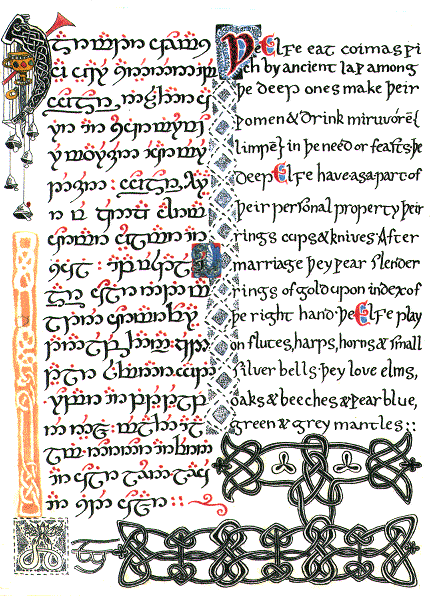
The Eldrin still use a runic alphabet in their written works, known as the Kirth. Though it is similar to the formats to other runic alphabets used by numerous cultures, the Eldrin are not willing to teach their version to outsiders; instead they will use other written languages to communicate with foreign cultures.
The earliest records indicate that the Eldrin had several Ancestors, each one held a major influence over a certain aspect of their lives. Somewhere along the path of history though, believed to be at the same time as the Eldrin’s sudden shift in society structure, most of them faded into legend. There is no hardened proof to support any theory to explain this, but it is enough to know that only one now remain: Felynar, the Cat-headed Guardian of the Eldrin race.
Felynar carries out many tasks in her role as the Eldrin’s Ancestor; she sees the myriad possible futures and knows all that has gone before. When an Eldra dies, she comes to ushers the life-patterns of the fallen from this world into her Halls of the Dead, guiding, protecting and preparing these souls for the coming of Teldagoruth.(Teldagoruth: The Last War Of Anger. When the life-patterns of the deceased Eldrin will come forth from the Halls of Felynar to aid their living kin. This is why the Fea mummify as many bodies as possible, so the spirits have a shell to use during the battles.)
As well as being the guide and guardian of the dead, Felynar cares and tends to the living, it is believed that Felynar taught the Eldrin the art of warfare and the secrets to the arcane arts of spellcasting.
It is expected of every Eldrin, regardless of whether they are within the city of Eldramar or out in the field, to offer prayers up to Felynar each and every day at sunset. Within the Shrine of Felynar, the Exarch, Tar-Aina leads the gathered mass in prayer. In the field, it is the role of the highest ranked Aina to direct the Kabal during this sacred time.
It has been known for the Eldrin to pause during a battle to begin their prayer; not even the ringing of combat will stop them from performing their religious duties to their Ancestor.
…Their greatest influence is during the War of the Races, where they worked from the shadows to support the uprising of the younger races against the might of the Elder Races. Why would they do that?
The answer to that is simply that the Eldrin saw an opportunity to deliver their first blow in revenge back at the Elven races, using the younger races as their weapon. Their first blow was more successful that any Eldrin ever dreamed, and for a time the Elder races disappeared from trace.
After generations and generations of this doctrine the Eldrin care little for any Elf, regardless of whether they are from a culture that were involved in the heinous crime against them or not, an Elf is an Elf and the Eldrin want to deliver back to the whole Elven race the same as what they suffered- hundred fold. The painful memory of the genocide inflicted on the Eldrin by those few Elven extremist groups has turned to a poison that burns in the heart of every living Eldrin, a poison that is the source of the deep-rooted hared to all Elven cultures.
But the Eldrin are not stupid, they know that every single Elven culture can defeat them in sheer weight of numbers alone. Because of this, the Eldrin search for willing cultures to move directly against the Elves instead of themselves. Do not mistake this for cowardice, for the Eldrin would love nothing more than to do the task themselves in honor to their fallen kin! But the Eldrin have a calculated mind that controls their insatiable desire for revenge when the moment isn’t right or when something can be gained by not giving into the rage.
Recently, with the increasing amount of Elder races (mainly the Elves) reappearing in the Heartlands again, the Eldrin have decided to step up their Jihad against their hated cousins and take a more active role in the world affairs, backing the Jackal Faction in joining the Gathering of Nations Treaty. The Gul caste have also recently used the Elves’ total arrogance to the facts of history to their advantage by “befriending” several Elven groups to gain vital information before the Jihad turns bloody, an idea not supported by the Fea caste at all…! In some isolated occurrences, single nomad elves have been kidnapped and interrogated to gain information instead. Though some feel that this approach will only serve to undermine the other false alliances with the other Elven groups should the word get out about what is truly happening.
The personal doctrine of the caste declares that:
The Fea caste take on the roles of both physicians and undertakers, healing the sick and preparing the dead bodies for mummification; it is believed that Felynar taught the first of the Fea caste the secrets of embalming and alchemy, as well as the Necromantic arts needed to complete the full process. It is via the gift of power over life and death that the Fea can see when it is close to the time when a mortal’s life is near the end, though the exact time is never certain. A fact that the Fea understand they cannot change, and willingly accept. The Fea do not openly talk to outsiders about this, for the gift of future sight can be abused by those who don’t understand, and may try to exploit the power such knowledge can give a person. This is why to outsiders the Fea are a secretive lot, and with good reason.
The personal doctrine of the caste declares that:
In their long search, the Eldrin have learnt many of the old arcane spheres now since lost to the rest of the world. These different arcane disciplines are guarded jealously; only the most gifted of the Eldrin are allowed to study these rare, long-forgotten spells.
The personal doctrine of the caste declares that:
The Thalion would not consider wearing any armour greater than heavy leather and ring mail. Besides it being uncomfortable locked inside a plate mail suit while in the warm climate of their homeland, Thalion prefer to move quickly and freely, and as they do not fear death, the purpose for armour is only to delay the enemy, not to protect the hides of the Eldrin.
The Thalion glorify war scars, the most scars a warrior has, the more he is revered by the others of the caste, for it is clear that Felynar does not want him/her to die yet. After every battle, injured Thalions rub the ashes of their cremated enemies into their open wounds to cause them to scar. Every Thalion knows how each wound was inflicted and when it was inflicted, all Thalion love to tell the stories to the Kith of their caste the gory details of each scar.
The personal doctrine of the caste declares that
Eldramar ~ The Hidden City
Eldrin Society
Language
Eldrin Faith
All Eldrin zealously follow the Khabar, the first formal teachings of Felynar, it has been said that the khabar is the true strength of the Eldrin, the only thing that has allowed them to endure the painful centuries of revival and the drive for the continuation of the Jihad. The teachings present the Khabar as a castle guarded by seven towers; if any tower should fall, then the castle is lost. The seven towers of the Khabar are as follows:
This refers to the bond of loyalty between brethren and individual. Loyalty to the culture is absolute, and the masses’ interests always have precedence over the interests of the individual. The Eldrin has become known and feared over the centuries because its members are so willing to risk and face destruction in order to achieve the people’s aims. Less melodramatically, every Eldra has a duty of unquestioning obedience, which is balanced by a duty of the brethren’s leadership to be worthy leaders and place the Eldrin’s interests above their own ambitions. Even the Exarchs are still a child of Felynar and a servant of the Avatar.
Running alongside the bond of Loyalty to the culture is the bond of Ikhwan, or Brotherhood between all of the Eldrin. Eldrin are forbidden to fight each other under any circumstances, even across the caste divide. They must assist each other in all things, except in Assassinations; this is a holy task, to be undertaken alone.
Though the khabar is often referred to as a code of honor, only the concept of Muruwa addresses personal honor directly. An Eldra’s honor comes first according to the doctrine of asabiyya, but each Eldrin is expected to take great care regarding personal honor. An Eldra’s word is practically unbreakable and only a fool or an ignoramus would insult an Eldra by demanding an oath or a written contract. Eldrin contracts are absolutely unbreakable, since they are regarded as a sacred duty to Felynar. Likewise, another's word given to an Eldra is regarded as unbreakable, and the culture will enforce this, if necessary. The other cultures and races may cheat and lie to each other if they wish, but Eldrin require absolute truth in all things.
Vengeance is a vital concept to the Eldrin ---Vengeance for the culture as a whole and for fallen kin. In many ways, it is the prospect of eventual vengeance, which gives the Eldrin the strength to carry on and stay true to the Khabar despite enormous pressure. Vengeance is the duty of each individual and the clan as a whole. There is only one exception to the Hadd: An Eldra who was destroyed in the execution of a contract (whether or not the contract succeeded) are not avenged, unless they were betrayed by bad information or tricked to their doom by a false contract. Those betrayed by outsiders are given the title of Shahid, and are avenged to the uttermost limit of the culture’s power. The Eldrin will continue to pursue the betrayer till they are wiped from the earth.
The duty of secrecy is ingrained in each member of the culture through millennia of danger; the overwhelming odds that the Eldrin would have to face should their Elven cousins discover the truth of the Jihad. Eldramar must never be found by outsiders, and outsiders must never learn anything of the culture from an Eldra. In addition, the principle of Taqqiya permits an Eldra to pose as an outsider in the furtherance of a contract-- something that would normally be forbidden by the strict rule of muruwa. While posing as a non-eldra, it is permissible to lie, cheat, steal, and murder in order to maintain the deception and facilitate the closing of the contract, without compromising one's personal honor.
The duty of faith demands complete and unquestioning devotion to Felynar and acceptance for the wisdom of the khabar.
The idea of community is central to Eldrin’s survival, and it is enshrined in the principles of asabiyya and ikhwan as well as in the duty of umma. This last demands that the individual should serve their kin humbly, according to the culture’s needs and the individual's gifts, and without reference to the individual's own desires and ambitions. Because of this, the culture’s scholars, mages, and other specialists are as respected as the warrior and assassins. Members are sometimes required to go out and obtain skills and knowledge needed by the culture, and this is as sacred and honorable a task as performing an assassination.
The Jihad
The Aina Caste
The Aina also tend to those Kith who are disfigured during the Rite of Becoming, though they are not seen as a part of the caste themselves. Many of these Felyn will enter into the service of the temple as the Guardians of the Shrine of Felynar.
The Exarch of the Aina Caste always takes the name of Tar-Aina, regardless of his or his previous name.
The Fea Caste
The Exarch of the Fea Caste always takes the name of Tar-Fea, regardless of his or her previous name.
The Gul Caste
The Exarch of the Gul Caste always takes the name of Tar-Gul, regardless of his or her previous name.
The Thalion Caste
The Exarch of the Thalion caste always takes the name of Tar-Thalion, regardless of his or her previous name.
