Competition: The
Adventures of Robin Hood, Alexander's Ragtime Band, Boys Town, The
Citadel, Four Daughters, La Grande illusion, Jezebel, Pygmailion, Test
Pilot
Other
Winners:
Best Actor: Spencer
Tracey, Boys Town
Best Actress:
Bette
Davis,
Jezebel Best Supporting Actor:
Walter Brennen, Kentucky Best Supporting Actress:
Fay Bainter, Jezebel
Best Director:
Frank
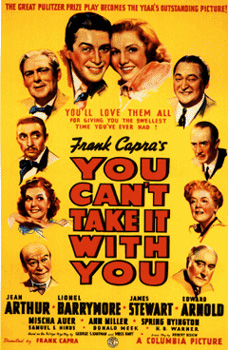
Capra, You Can't Take It With You
Cast:
Jean Arthur, James Stewart, Lionel Barrymore, Edward Arnold, Mischa Auer,
Ann Miller, Spring Byington, Samuel S. Hinds
Storyline:
A
screwball comedy, from the master director, Frank
Capra, about young
couple in love who must face their families. His family is a
conservative, upper crust blueblood, while hers is totally
off-the-wall.
Did it deserve to
win: Not necessarily!
Screwball comedies have never been made as well as they were in the
1930's, and Frank Capra was the master. This is not my favorite of
the genre, but it's certainly worthy of the Oscar, if it were another
year.
Robin
Hood was a popular action flick of the day, making Errol Flynn and Olivia
de Havilland stars. Boys Town was popular favorite as well,
featuring the very popular, Mickey Rooney, and Spencer Tracey. And
Jezebel was riding on the publicity mill of the upcoming, Gone With the
Wind, and featured the hugely popular, Bette
Davis.
Screwball
comedies were still hugely popular that year, and another of the best,
didn't receive any nominations. The Cary Grant-Katherine Hepburn
classics, Bringing Up
Baby and Holiday, are regarded as classics, and feature Hepburn
at her dizzying best!
Perhaps
the most deserving picture that year, and certainly the one that has aged
the best, wasn't even nominated. Snow White and the Seven Dwarfs,
Disney's animated masterpiece, was proof that animated films would have a
difficult time rising above the Best Song, and Best animated
categories. This film was given an honorary award, which featured
one Oscar surrounded by seven little ones. Shirley Temple handed it over
to Mr. Walt Disney.
Critique:
You Can't Take It With You
has all the elements of a good screwball comedy. The snobs are very
snobbish, and the free spirits are very free. There are two people,
from different backgrounds, who find love, and they are surrounded by a
host of colorful characters.
James
Stewart and Jean Arthur are stock characters for this sort of film, and
with Capra at the helm, this film can't go wrong.
You
Can't Take It With You is a great movie, with lots of laughs, and it takes
a jab at a serious subject, censorship and the entire Communist scare,
that would take center stage in just a few years.
Best Scene:But we thought it
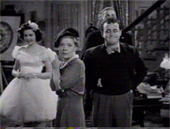
was tomorrow night! The unexpected meeting of the two families is
hysterical. When the Kirby's walk in on the dancing fools, things
get hysterical.
You just know that
dinner is going to be disastrous when Mrs. Sycamore can't think of what to
serve for the unexpected dinner, and finally suggests cooking up some
franks.
Behind the Scenes:
Frank Capra was so popular
by 1938 that the Director's Guild bestowed a special honor upon him, and
elected him the guild president. Among his big orders of business
prior to the Awards, was to fight for negotiating rights for the
directors. Refusal to budge by the studio bosses, nearly resulted in
a strike, and a boycott of that years Oscar ceremonies.
Snow
White was given the special Oscar, but it lost another key award, Best
Song. Someday My Prince Will Come was overlooked in favor of the
other big classic of the year, Thanks for the Memories. It would
become a Bob Hope signature song, which he used for his specials, and even
for some of the ceremonies that he hosted.
George
Bernard Shaw, the great playwright, won an Oscar for Best Adapted
Screenplay for Pygmalion. He was very critical of Hollywood at the
time, even insisting that a British cast and crew produce the movie.
Upon winning, he was quoted as saying, "It's an insult for them to
offer me any honor, as if they'd never heard of me before."
Despite his resistance, visitors to his home, including Mary Pickford and
Wendy Hiller, claimed that the statue was prominently displayed.
Bette
Davis was among those that did not get the role of Scarlett O'Hara,
from the
blockbuster that was in production in 1938. It was said that her
boss, Jack Warner, refused to let her out of her contract, after she'd
challenged the contract system by running off to England. As a
consolation, he gave her the lead in Jezebel, for which she won her second
Oscar.
Davis'
costar, Fay
Bainter, would become the first woman to be nominated in both
acting categories. She won Best Supporting Actress for Jezebel, and
was nominated for Best Actress for White Banners.
Spencer
Tracey's Oscar was mistakenly inscribed with the name Dick Tracey and he
sent it back to have it done over. A publicist announced that,
instead, they would be having it engraved to the real life Father Flanagan
- the man that Tracey portrayed in Boy's Town. Tracey balked at the
idea, claiming that he rightfully earned the award. In the end, the
publicist had two Oscar's made - one for Tracey, and one for film's
namesake.
Frank
Capra, the man of the decade, wins his second Best Picture Oscar, and
becomes the first director to have his name above the title.
Jimmy
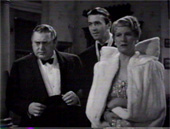
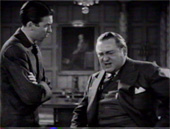
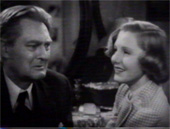
Stewart plays Tony Kirby, of the rich, banking family. He is
pictured here with his father, Anthony Kirby, played by Edward Arnold, who
is of course concerned with nothing but business.
Familiar
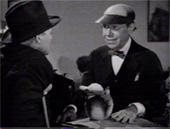
character actor, Paul Lane, is an uptight clerk who is propositioned by
Lionel Barrymore to life a life of Riley.
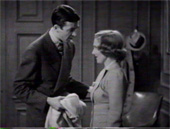
Despite
their very different backgrounds, Jimmy and Jean Arthur are very much in
love.
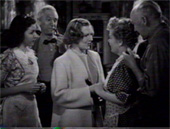
Arthur,
as Alice Sycamore, prepares her family to meet her new beau.
Lionel
Barrymore plays Grandpa Vanderhof, head of the quirky household.
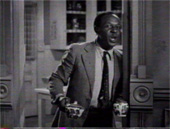
BEFORE
THEY PEAKED: Before he was Jack
Benny's happy-go-lucky butler, he was the butler in several movies,
including this one!
Oscar
nominee, Spring Byington, plays Alice's mother, Penny Sycamore.
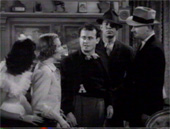
The
police barge in on dinner, with suspicion of Un-American activities.
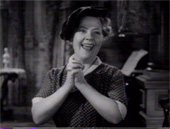
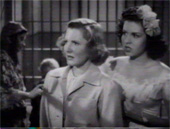
Jean in jail, flanked
by dancing sister, Essie, played by dancing sensation, Ann Miller.
Ann
Miller is pictured here with here with Dub Taylor, who plays her husband,
Ed. Taylor went on to play in several B-grade westerns, playing a
character called Cannonball.
Alice finally sees fit
to stand up for her family, who she had been quite ashamed of up until
this point.
All of these films are available on
DVD and/or VHS!
Also in 1938:
January 1:
The latest census shows over 8 million unemployed American's are barely
getting by.
July 15:
Howard Hughes sets a record, travelling by plane around the world in 3
days, 19 hours and 17 minutes.
October 30:
Orson Welles' War of the Worlds is broadcast, creating shockwaves across
America.
"Quite frankly,
I'd rather have my throat slit."
Jean Arthur, when approached to do an interview in her final
years.