
Tim Allison: A Virtual Portfolio
Defining the Nature of Science
Defining the nature of Science (NoS) is a challenging task. However, we must somehow impart to our students what the true nature of science and scientific knowledge is. Statements from various readings over the course of the year have given bits and pieces of the NoS, but compiling them became a difficult task, as Larry Bencze had us working on it. Considering our readings, we came up with the statement on the NoS which is located at the end of this reflection.
Scientific discoveries are largely the result of scientists' imaginations, as suggested by Gallas (p. 14), and by Khishfe and Abd-El-Khalick (p. 552); rather than being the result of strictly-followed rules which are universally applied, as students are often taught (Hodson, p. 199). Similarly, few students understand that science is "profoundly influenced by social, economic, and moral-ethical considerations, and so is, to a large extent, a product of its time and place." (Hodson, p. 203). Hodson (p. 192) also points out that science is not as decisive as we often pretend it to be. Many scientific theories and models have been shown to be incorrect; and this is likely to happen again and again in the future.
Taking these factors into account, we developed the statement seen below, with transliteration, as the writing may be difficult to see on the scanned copy, which demonstrates that science is not always as nicely organized as it often pretends to be.
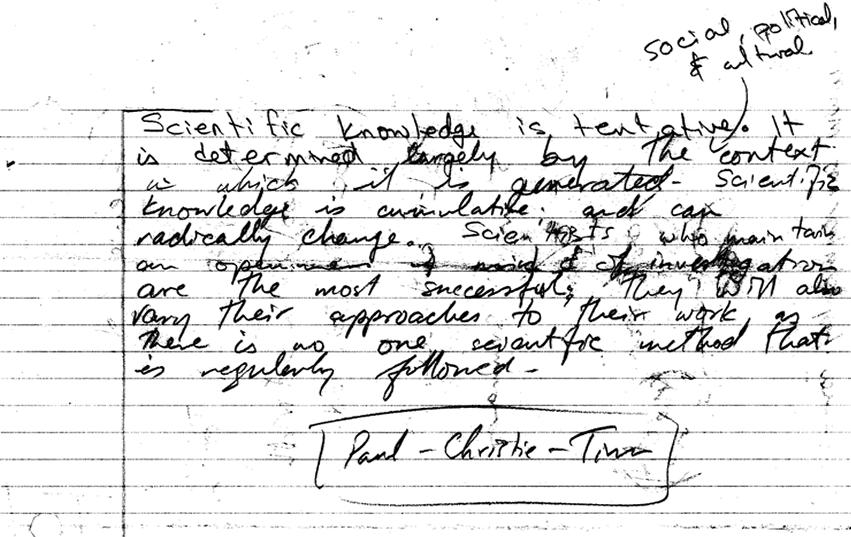
Transliteration (slightly altered from the original):
Scientific knowledge is tentative. It is determined largely by the social, political, and cultural context in which it is generated. Scientific knowledge is cumulative, and can radically change. Scientists who maintain an openness of mind and an openness of investigation are the most successful; successful scientists will also vary their approaches to their work, as there is no one scientific method that is regularly followed.
by: Paul (Burley), Christie
(Smith), and Tim (Allison);
demonstrating the cooperative nature of scientific investigations!
