

|
The following information is provided by the Ohio Department of Natural Resources Division of Wildlife. Wildlife Orphans?
Think Before You Act. 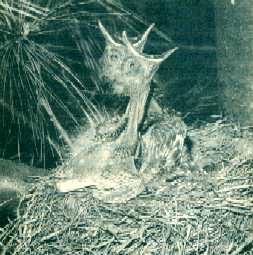 Is it Really an Orphan? In the spring and early summer, when wildlife reproduction is at its peak, you may have the good fortune to observe a nest of birds or a young mammal with no adult in sight. Enjoy the scene, but unless there appears to be something amiss (a nest out of a tree, broken legs or wings, or wounds and bleeding) LEAVE IT ALONE! Many species of animals are raised by one adult that is at the moment away from its offspring in search of the next meal. Wildlife parents are very devoted to the care of their young and rarely abandon them (abandonment usually occurs as a result of injury to or death of the parent). However, they cannot be in two places at once and it isn't unusual for the young to be alone at their nest site several times a day. Natural History Facts to Help You Better
Understand What You Are Observing
Songbirds & Birds of Prey Nestlings Nestling songbirds and birds of prey (hawks and owls) usually lack feathers or are covered with down. They are not yet able to perch. These young birds must be placed back into their nests or new nests must be constructed for them. Fledgling When songbirds and birds of prey leave the nest, they are "fledglings" and have feathers covering their bodies. They leave the nest for short periods of time to hop along the branches and often fall out of trees. If this happens keep your pets indoors and observe the fledgling. Watch from a distance to see if the bird can get out of harms way by itself and if the adult birds continue to care for the young bird. Ducks and Geese Young mallard ducks and Canada geese are commonly separated from the rest of their brood as they follow their parents to food or water. If left alone, the parents will most likely return for the stragglers. Mammals
Eastern Cottontail Rabbit Eastern cottontails feed their young only at night. You will not find any female at her nest during the day. Rabbits leave the nest when they are just three weeks old. A small rabbit with its eyes open and ears standing up is self sufficient and does not need your assistance. Squirrels Squirrels will retrieve their offspring when they fall or venture from the nest. They also have alternative sites if one nest is destroyed. Give the mother squirrel plenty of time to find and rescue her young. White-tailed Deer A small fawn alone in a meadow is not necessarily an orphan! The female deer will protect her young from preditors by leaving it alone in a secluded spot. Do not attempt to rescue a fawn until you have discussed the situation with your district wildlife officer. Opossums Opossums are marsupials. The young stay in a pouch on the female's belly for several months. After emerging from the pouch, the family unit stays together for another six weeks. Fox and Coyotes Foxes and coyotes make a den in hollow logs or trees, under a rock pile, or occasionally in ground burrows. Pups are born from February to May. Pups may be left unattended when the adult animals go off to hunt for food. Raccoons Large hollow trees in woods are preferred den sites, but nests may be in ground burrows, rock or brush piles or old buildings in proximity to people. The female cares for the young which are born between February and June. Raccoons feed primarily at night. The young scavenge with the female at two months of age and set off on their own in the fall. Rabies . . . What is it? Rabies is a virus that attacks nerves and brain tissue of most animals. When an animal is sick with rabies, the virus is shed in the saliva. It is then spread to other animals or people when the virus-laden saliva gets into a wound or mucous membrane. This is usually through a bite. Most rabies is found in wildlife such as skunks and raccoons. Pets get rabies from wildlife. Dogs and cats pose the greatest risk in spreading the disease from wildlife to people. Birds and reptiles do not carry rabies. Wildlife with rabies lose their fear of people. If rabid, raccoons and other nocturnal animals may be out roaming during the day. What Should I Do if I Have to Rescue an Orphan? After consulting your district office or wildlife rehabilitator, keep the animals in a warm dark area until they are placed with a permitted wildlife rehabilitator. Avoid handling the animals - this is for your benifit as well as theirs. The animal may carry parasites or diseases that could harm you. Handling by humans stresses the animal which may cause it to act defensively resulting in a kick, bite or scratch for you. It may also cause a mental and physical overload for the animal contributing in its death. May I Raise a Wild Animal Myself? Native wildlife are legally protected. It is illegal for anyone to possess a native wild animal unless permitted by the Ohio Division of Wildlife. Wildlife rehabilitators have a permit to provide care to orphaned or injured wildlife. Wildlife rehabilitators are not employed by the state. The wildlife district office can refer you to a local rehabilitator. Act on Positive Information. If you have found an obviously injured wild animal or know for a fact that a brood has lost its parent(s), intervention is an acceptable course of action. But don't plan on raising the babies on your own. Young wild life require special care and feeding that is beyond what the average household is prepared and capable to manage. Contact your district wildlife office for assistance in finding a local wildlife rehabilitator in your area with which to place the young or injured wildlife. Humans are always a young wild animal's LAST hope for survival, NEVER its best hope. A young animal should only be removed from the wild after all avenues to reunite it with an adult animal have been explored. What Can I Do to Prevent Wildlife Orphans? Check for nests before cutting down a tree or clearing brush. It is best to cut and clear brush in the autumn when nesting season is over. Place caps on all chimneys, vents and window wells to prevent animals from nesting there. Keep your pets under control so that they do not injure wild animals. Educate children to respect wild animals and their habitat, and not to try and catch or harass them. Exercise caution when driving and watch roadsides for wild animals, especially at dawn and dusk. Conserve habitat for wildlife. Send mail to Home Office Services, Inc. with questions
or comments about this web site. |
