MUSIC
IN THE MIDDLE AGES
One way we learn about music in the Middle
Ages is by examining Medieval art. There are instruments in the borders
of many manuscripts. Angels play everything from organs, vielles and
harps to trumpets and shawms in the paintings of the period. By the
12th century music grew from one melodic line (monophony) to two or
more (polyphony). One of the earliest major centers of polyphonic
music was at Notre Dame in Paris. Another important aspect of medieval
music is that, for the first time, we have written-down notation and
composer attributions. Bands played for special religious feast days,
such as Christmas, Easter, and Corpus Christi, at trade fairs, civic
ceremonies, royal occasions, banquets, affairs of state, and university
functions. Minstrels, minnesingers, troubadours, and trouveres told
stories about life and death through the songs they carried from village
to village. They wrote the poetry and set them to music and travelled
with their jongleurs who accompanied them on a variety of instruments,
mostly strings. When the dull nights of winter arrived, and during
periods of time when the nobles were isolated from the poor during
the plague, people sang songs and told stories, many about love and
romance, some of them humorous, heroic, and sometimes bawdy, to pass
the time. Many of the songs were written in praise of the idealized
woman.
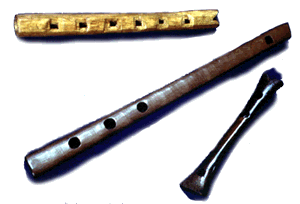 Music was very important during the Middle Ages. People considered
music as an art. They also used instruments to help them create
music. Their musical instruments were very special, and they
were very different from musical instruments today.
Music was very important during the Middle Ages. People considered
music as an art. They also used instruments to help them create
music. Their musical instruments were very special, and they
were very different from musical instruments today.
GAMES
During the Middle Ages the Nobles
played games like chess, checkers, backgammon and dice. All of them
were made to be played indoors. Nobles did not play many outdoor games.
(They did play chess outdoors sometimes.)The serfs (peasants) played
many of the games that the Upper Class people didn't play. The lower
class played Hockey, or Stickball (Similar to baseball or softball).
They also played soccer and golf. The only game that included both
Upper & Lower class was Ice Skating (they went when the lakes
or water sources froze over).
SPORTS
Folk football was a wild and rough
sport. The game was so violent, that Renaissance humanists,
such as Sir Thomas Elyot, thought that it as more likely to maim than
to benefit the participants. Folk football survived in Britain
and in France until the late 19th century.
During the Middle Ages,
hunting was very popular for both knights and common peasants. Participants
would bring 30 falconers and 60 pairs of hunting dogs. Forests were
used as the hunting grounds. Knights usually hunted foxes, deer, otters,
badgers, rabbits, wolves, and boars. Many peasant women
even hunted and kept falcons.
Jousting was probably the most
famous sport and the most exciting game to the nobles and lords during
the Middle Ages. The game was for two knights, both of them wore a
suit of heavy armor and sat on a horse holding a long weapon.
The point of jousting was to stab the each other.. To practice
their jousting skills, people often used a quintain. A quintain
was a dummy jousting target.
Archery matches, were usually
arranged months in advance. Town versed town in archery matches.
The spectators usually became very excited over the matches and it
was common for contests in running, jumping, cudgeling, and wrestling
to be offered to the lower classmen who attended the match.. Feasts
were common while watching the matches, and drunkenness commonly added
to the craziness of the spectators.



 THE
MIDDLE AGES
THE
MIDDLE AGES 


