GNUSTREAM: A P2P MEDIA STREAMING SYSTEM PROTOTYPE
Xuxian Jiang
Yu Dong Dongyan
Xu Bharat Bhargava
Department
of Computer Sciences
E-mail: {jiangx,dong,dxu,bb}@cs.purdue.edu
ABSTRACT
receiver-driven media streaming system.
top of Gnutella
integrates
*dynamic peer location and
*streaming capacity aggregation
*GnuStream
streaming session is controlled
by the
receiver peer
*dynamic set of peer senders
instead of one fixed sender
1. INTRODUCTION
[1] .On Peer-to-Peer Media
Streaming.
open-after-downloading.v .play-while-downloading.
peer
*online or offline
sender set members may change dynamically,
*sender: not be able to contribute full streaming bandwidth
set of peer senders
architectures for synchronous broadcast
Narada [3] and PeerCast [4]
þdynamic construction of a multicast
tree
ýnot consider the limited
contribution of bandwidth
CoopNet [5] builds
*multiple distribution
trees
*spanning a source and all peer receivers
*each tree transmitting a separate description of the media signal.
ý consults the source node for its upstream
peer senders
ZIGZAG [6]
*peer receivers hierarchy
of bounded-degree clusters
*multicast tree based on the hierarchy.
ýassumes that each peer only receives from one upstream peer sender.
GnuStream,
receiver-driven
media streaming system
top of Gnutella,
- underlying P2P network
dynamics
- heterogeneity.
Features:
- multi-sender bandwidth aggregation,
- adaptive buffer control,
- peer failure or degradation detection and
- streaming quality maintenance
2. SYSTEM OVERVIEW
2.1. System Environment

P1:
- call Gnutella lookup
service
- locates four
candidate senders P2-P5.
- aggregated bandwidth sufficient full
quality?
- P5 standby sender
2.2. System Features
(1) Integration with P2P
lookup substrate
readily deployable in the current Gnutella P2P network environment.
(2) Multi-sender aggregation
load allocation policies
- Even allocation
*Suitable for a well-provisioned and homogeneous
environment
- Proportional
allocation:
*proportion to the current capability of peer senders
*flexible and adaptive
*dynamic and heterogeneous environment
(3) Receiver data collection
receiver
*coordinates the arrival of different media
data segments,
*reconstructs media data in their original
and continuous order before *feeding them to the media player.
(4) Detection of peer
status change
periodic probing and soft states
detect any changes in the status of peer senders,
- peer disconnection,
- failure, and
- bandwidth degradation
(5) Recovery from failure or
degradation:
*migrate all or part of its streaming load to another peer sender or a
standby peer sender
*active peer senders change dynamically
6) Buffer control:
accommodate
*dynamic set of peer senders
*end-to-end network congestion,
buffer control mechanisms
*more concurrency and scheduling complexity
3. DESIGN AND
IMPLEMENTATION
3.1. Three-layer
Architecture
- Network Abstraction Layer,
- Streaming Control Layer and
- Media Playback Layer

(1) Network Abstraction Layer (NAL)
- masks underlying P2P network
- uniform interface of P2P
lookup substrate.
- peer and content
discovery
- deployable in Gnutella,
- portable to other P2P networks
(2) Streaming Control Layer (SCL)
- heterogeneity of
P2P networks.
- bandwidth aggregation,
- data collection, and
- status change detection and
recovery.
- sender set
- maintain the maximum
streaming quality èBuffer management
(3) Media Playback Layer (MPL):
- adaptable to the aggregated
streaming bandwidth
- media quality adaptation
based on the media data collected by SCL
double buffering between media decoder and player
·
efficiency
·
low switching overhead.
·
.plug-n-play.
3.2. GnuStream
Implementation
*Microsoft Visual C++ 6.0
*Gnutella client, namely Gnucleus.
buffer management.
- control buffer
core of buffer control
mechanisms
- Double display buffers >MPL
- decode buffer >MPL
*speed up display
*reduce the synchronization overhead
between MPL and SCL.
- Data collection buffer >SCL
*eliminate data overflow and
underflow
*smooth jitter in the presence of multiple senders.
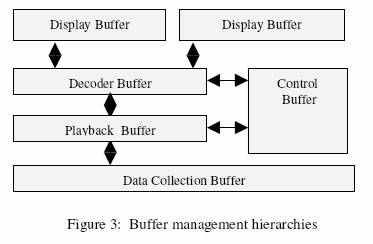
*Inside the control
buffer
*coordinate
the multiple peer senders
*delicate buffer
model is implemented to enforce the real-time property of media streaming.
Buffer Model
- manipulate the control
buffer using different
control pointers
*offset pointer: amount of data already consumed.
*End-of-data: trunk of continuous data available in buffer
*End-of-buffer indicates the end or maximum
size of buffer
- SCL
*adjusts the data
feeding rate to the decoder
*display frame rate
is tunable
(according to current aggregated streaming bandwidth)
*monitor the streaming progress
*compute system parameters
-next frame needed and
-expected bit-rate
from each peer sender.
4. EXPERIMENTS
multiple desktop PCs
- XEON CPU 2.00 GHz,
- 1.00G RAM
- 3COM 3C920 100Mbps Integrated
Fast Ethernet Controller.
*configured as peer senders/recv
*ý maximum
streaming bandwidth=60KB/s
(1) P2P streaming session
setup
*Before session
starts
- receiver
- compute the aggregated streaming bandwidth
- how
many peer senders are
needed.
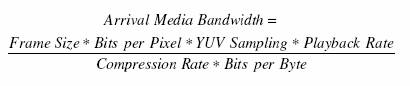
test media clip
- image size 352*240,
- frame rate 30frames/second
- YUV sampling 4:2:0
- bits per pixel, 8
- compression rate
26:1.
resultant streaming bandwidth approximately
143 KBps
receiver
*contacts three peer senders
*discovered by Gnutella
lookup service
*each streaming bandwidth of 60KBps.
*initiates the streaming session
(2) Buffering for continuous
media playback
*continuous
and jitter-free media playback
- receiver
- buffering
both before and during
- initial buffering
delay = …
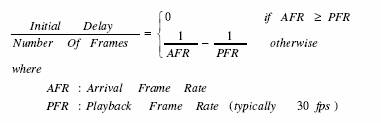
if playback > arrival = 1/A – 1/P
else = 0
test video clip
- 1680 frames.
- AFR is 25 fps
- initial buffering delay = 11.2 seconds.
during the initial buffering,
- senders transmit @ same
rate as contributed streaming bandwidth
- aggregated streaming bandwidth (3*60KBps) > playback rate (143.0KBps):
- exploit the residual bandwidth
to pretransmit media data which will be buffered
(3) Peer failure detection
and recovery
- turn off the Gnutella services on
one of the peer senders
- test the responsiveness
of GnuStream.s peer failure recovery
- 1 second to detect and recovery from the failure,
*replaced standby sender
*detection and recovery latency
*tradeoff
system reactivity v peer probing overhead
*no interruption to media playback
(buffer control)
5. CONCLUSIONS
- readily
deployable in Gnutella
network.
- dynamics and heterogeneity of P2P
- aggregated streaming capacity = full streaming quality
- self monitoring and adjustment (peer failure and bandwidth degradation)
- open source software
system,
http://www.cs.purdue.edu/homes/jiangx/GnuStream/
6. REFERENCES
[1] D. Xu,
M. Hefeeda, S. Hambrusch
and B. Bhargava, .On
Peer-to-Peer Media Streaming., IEEE ICDCS
2002, July
2002.
[2] T. Nguyen and A. Zakhor, .Distributed Video Streaming
Over Internet.,
SPIE/ACM MMCN 2002, Jan. 2002.
[3] Y. Chu,
S. Rao and H. Zhang, .A Case for End System
Multicast., ACM SIGMETRICS, June 2000.
[4] H. Deshpande,
M. Bawa and H. Garcia-Molina,
.Streaming Live Media over
a Peer-to-Peer Network.,
Stanford Database Group
Technical Report (2001-20),
Aug.
2001.
[5] V. N. Padmanabhan, H. J. Wang, P.A. Chou
and K.
Sripanijkulchai, .Distributing Streaming Media Content Using
Cooperative Networking., ACM NOSSDAV, May 2002.
[6] D. A. Tran, K. A. Hua and T. T Do .ZIGZAG: An
Efficient Peer-to-peer
Scheme for Media Streaming., IEEE
INFOCOM2003, April 2003.