The 1920s brought prosperity back to Germany. It was reached at Versailles, that for the world's economies to recover, Germany a key european country should be granted investment in order to recover as well. Germany was viewed as a strong economic ally for the west. It was also seen that Germany would be the first line of defense against the expansionist Soviet Union. As a result, German recieved large amounts of investment to revitalise her industry, much of this economic assistance came from America.
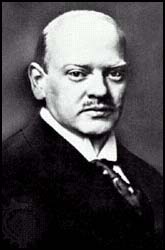 However despite this, Stresemann, like his predecessors, were still bound by Versailles. A strong nationalist, Dr Stresemann, desired to erode the shameful treaty, or Schmachfrieden. The tactic, he would adopt was Peaceful Co-Existance. In this Germany would co-operate with the allies over Versailles, to the extent that the harshness of the treaty would become evident and because of the pacific relations - concessions would soon follow. The 1925 Locarno Treaty is seen by historians as being co-operative in calming European tensions.
|
The introduction of the Locarno Treaty by Stresemann was a diplomatic success. The allies keen to improve relations, accepted Germany's entry into the League of Nations and by 1926, also presented her with a permenant seat on the League's Supreme Council. Germany had now been accepted again by the allies and she could begin to push for concessions. Stresemann at this time continued to maintain links with the Soviet Union and this was evident in the two counties signing the Treaty of Berlin in 1926. Germany was commiting to both ends of the political spectrum and this achieved economic and political advantages. The allies feared that should they not make concessions, then a Communist Germany was a possibility. Stresemann, a commited nationalist however could be pragmatic and achieve as many concessions as possible.
The new relations inside Europe was deemed the Locarno Honeymoon. If the Versailles Treaty had ended the World War, it was Locarno that had brought stability back to the continent.
German History [Continue]
|