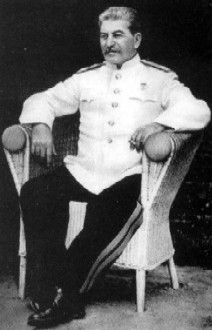
Josef Stalin emerged in 1929 as the sole leader of the Soviet Union. His rise through the party was meteroic despite having only a minimal role in the 1917 Revolution. His acceptance of many admininistrative jobs leading up to 1924 and Lenin's death ensured that he had a firm knowledge of politics and his party. Stalin was underestimated from the start by other senior members. He lacked the charisma of Lenin or oraty skills of Trotsky and was dubbed, the "Grey Blur" because of his apparent dullness.
On his succession, Stalin set out on the goals similiar of previous Russian leaders; strengthen the country, industrialise to the levels of the western democracies and secure her from foreign attack. Following the failed attempt at world revolution in 1920, Stalin like Lenin saw that global revolution was only possible if Russia was strong. This idea of postponed revolution was known as Socialism in one country. Committed Marxists condemned the policy as they saw it as an abandonment of true Communism. Of these critics, Leon Trotsky was the most out-spoken
Russian History [Back]
Russian History [Continue]
|
 Trotsky's condemnation of Stalin and his policies echoed those he made against Lenin almost a decade before. The Politburo, the cabinet of the Communist party, became divided on the idea of revolution. The Left and the right were in opposition and Stalin had the all important tie-breaking vote. Stalin would use this divide to infiltrate the Politburo with his own supporters. By 1940, none of original members other than Stalin remained in the Politburo, all having been killed during the Great Terror.
|

