
Warlord

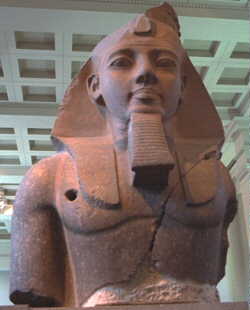
Ramesses II, son of Seti I and Queen Tuya was the third king of the 19th Dynasty. Called Ramesses the Great out of reputation alone. He was the greatest warlord any pharaoh could be. He is known from his many victories and magnificant building techniques. His greatest architectual achievemnt was the construction of Abu Simbel. He knew in order achieve immortality, its through stone.
Many have also come to know Ramesses II in ancient times through his victories in distant Syria and his fued with the Hittites. Ramesses was named co-ruler with his father, Seti I, early in his life. He accompanied his father on numerous campaigns in Libya and Nubia. At the age of 22 Ramesses went on a campaign in Nubia with two of his own sons. Seti I and Ramesses built a palace in Avaris where Ramesses I had started a new capital. When Seti I died in 1290 B.C., Ramesses assumed the throne and began a series of wars against the Syrians. The famous Battle of Kadesh is inscribed on the walls of Ramesses temple.
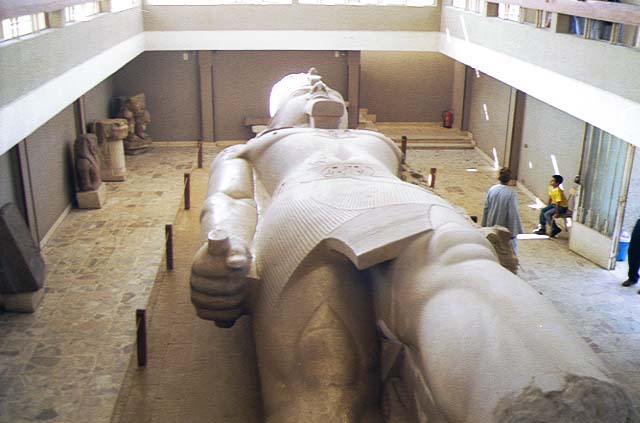
Ramesses' building accomplishments are two temples at Abu Simbel, the hypostyle hall at Karnak, a mortuary complex at Abydos, the Colossus of Ramesses at Memphis, a vast tomb at Thebes, additions at the Luxor Temple, and the famous Ramesseum. Among Ramesses' wives were Nefertari, Queen Istnofret, his two daughters, Binthanath and Merytamon, and the Hittite princess, Maathornefrure.
Ramesses was originally buried in the Valley of the Kings. Because of the widespread looting of tombs during the 21st Dynasty the priests removed Ramesses body and took it to a holding area where the valuable materials such, as gold-leaf and semi-precious inlays, were removed. The body was then rewrapped and taken to the tomb of an 18th Dynasty queen, Inhapi. The bodies of Ramesses I and Seti I were done in like fashion and all ended up at the same place. This systematic looting by the priests was done in the guise of protecting the bodies from the common thieves.
Copyright © 2002-2004 Tony E Productions. All Rights Reserved.
