|




|


WHEN IS IT NECESSARY
TO REPLACE A FLASH TUBE?
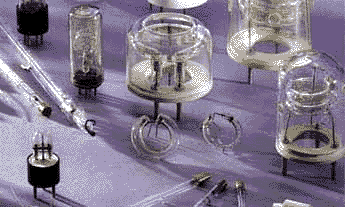
When flash tubes were made of Pyrex
glass, it became obvious when a flash tube needed replacement.
Miss-firing of the tube after 10-15 shots would be the warning
signal that the tube was getting old and ready to be replaced.
Today we are facing a much different
situation as most of professional flash tube manufacturers are
using Quartz glass and they operate for many years without a
miss-firing problem. But other characteristics of these Quartz
tubes change over its life span and cause problems that go
undetected for years. Most manufacturers warranty the operating
life of flash tubes for 10,000 flashes. An active professional
studio can reach this number of flashes in only a few weeks. We
all know that Quartz flash tubes last for years, they just keep
flashing. That's true but something does happen to a Quartz flash
tube over a period of time and manufacturer is aware of these
changes. Light output decreases by as much as 2 f-stops. Color
correction coatings darken and can change the color temperature
by as much as 800-1000 degrees Kelvin from its original color.
All this happens over a long period of time, but when the light
output decreases by 1 f-stop and the color changes 700-800
degrees Kelvin, it would be wise to replace the flash tube and
save a critical assignment. You can test the flash tubes in your
studio and keep records of each flash tubes light output and
color temperature; it will take only a few hours of your time but
save many hours of frustration in the future.
Testing for Light
Output & Color Temperature
Equipment Needed:
-
1- Flash Meter
-
1- Flash Color Temperature Meter
-
1- Light Stand
-
1-Tripod
-
1-Power Pack
-
All your Flash Heads.
-
Let's start.
-
1) Set the power pack to full power
position.
-
2) Place the first flash head to be
tested on to the light stand and plug it into the power pack.
-
3) Place the flash meter securely
on to the tripod camera platform pointing the dome directly at
the flash head. Note: Do not use any reflector or other light
modifiers as they can alter the readings. The distance is not
critical but 6 feet from the flash head is a good location for
the meter. If you get too close, the color temperature meter
will give incorrect readings or no readings, as the full power
output from the power pack will saturate the meter sensor.
-
4) Connect the cord from the flash
meter to the power pack sychro socket. (If you are working with
an assistant, cordless operation can be used.)
-
5) Set the flash meter for ASA 100
(or any ASA you desire), and the color temperature for 5500
degrees Kelvin.
-
6) Activate the flash meter by
pushing the button and observe the reading, take another full
power reading. Record the reading for flash head #A.
-
7) With the color temperature meter
in your hand and standing at the tripod position, take a color
temperature reading for flash head #A. Repeat the reading 2-3
times. Record the last reading.
-
8) Repeat this procedure for all
the flash heads making sure that the flash meter is at the same
distance and the power pack is at full power.
When testing is complete, you
will know the exact condition of all flash tubes and if repeated
every 2-3 months, you will be the one to make intelligent
decision to replace a worn out flash tube. Remember 2 f-stops
loss on a power pack brings the overall power to 300w.s. You paid
good hard-earned money to get 1200w.s. So let's keep it by doing
this simple test.
Courtesy of Larry Farrell,
Sun Star Strobo Flash
Lighting Systems
|
- We
Repair The
-
Following Equipment
-




 -

|

