Site hosted by Angelfire.com: Build your free website today!


SideRant2

Home - Back to Home Page
IntroRant - Introduction to SetiRant
SideRant1 - Verne, Sagan, Roddenberry
MainRant - Hypothesis et al
RantSum - The Rant Summed Up
RantLinx - Links to Other Web sites
RantDown - Get SetiRant.zip


Optical SETI


Optical SETI

In 1822, the German mathematician Karl F. Gauss suggested constructing an array of 100 small mirrors, each outfitted with a lantern, to draw the attention of our neighbours on the moon.

A simple signalling device might replace Gauss' lanterns with high-powered lasers, able to pump many thousands of joules of energy into extremely short bursts of light. In this way, the signal can briefly trump the light pollution caused by the aliens' home star.

We can look for such flashes with a fairly simple set-up. An ordinary mirror or lens telescope is used to gather light from the star system under investigation. Sensitive, high-speed detectors send data to electronic processors. A computer alerts astronomers to any interesting events.

Compared to modern radio SETI searches, which use mammoth antennas and digital receivers monitoring tens of millions of channels simultaneously, the "light bucket" method described above is both easy and inexpensive.

Optical SETI is a different way to hunt for extraterrestrials. Our ability to look for extremely short flashes of light has only recently become technically feasible. Even the simplest experimental set-up for Optical SETI is breaking new ground.

At Harvard University, a 60-inch telescope diverts one-fourth of the telescope's light to a detector, checking out about 2,500 stars. At Princeton University, a 35-inch telescope will observe the same objects as at Harvard, so that results can be compared.

The Harvard group gets a "hit" from their instrument about once a night. No one knows what is causing the "hits" - electronic interference, perhaps cosmic ray showers lighting up the atmosphere, possibly ETs.


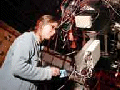
Shelley Wright, a physics student at UC Santa Cruz,
lines up the Lick Observatory's Nickel 40 inch reflector
to search for light pulses from extraterrestrial civilizations.


TOP