What is Post Impressionism?
This question has plagued students and scholars for years. To understand this movement, we must first explore the realm of Impressionism. Impressionism is defined as a light, impulsive way of painting. It began in France as a reaction against the formalism of the prevalent Academic style. Its naturalistic and down-to-earth treatment of its subjects has its roots in French Realism. Impressionism takes its name from a work by Claude Monet entitled “Impression: Sumrise.” In general, Impressionism’s main goal is to attempt to capture the subjective impression of light reflected upon a real-life scene.
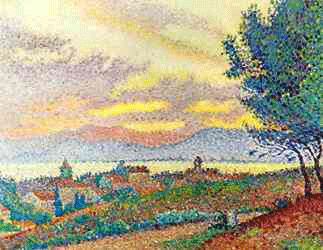
Paul Cignac
Post-Impressionism spawned when a variety of artists under the Impressionist influence decided to experiment with it, taking their pieces into different directions. In general, Post Impressionism is more emotionally charged, so to speak, than Impressionist artwork. Instead of focusing entirely on mirroring light’s reflections, Post Impressionists tried to convey their emotions through their works. The results of this movement include Van Gough’s “The Scream,” Gauguin’s “Self Portrait: Les Miserables, or Cezanne’s “The Murder”.
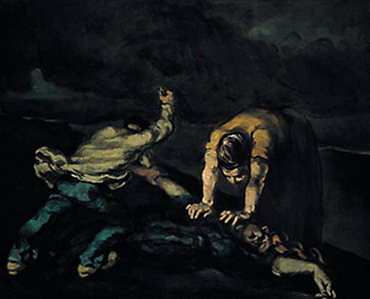
Paul Cezanne
One specific approach to Post Impressionism is Pointillism, practiced by Paul Signac and other artists. Pointillism is defined as an effect in which the colors in a painting were not blended together smoothly: little points in pure colors were grouped next to each other. With this method the colors were not blended in reality but were blended in vision. Work like this was theoretical very well grounded. Many drawings were made and it sometimes took the artist about a year to finish his painting. There is no question about impressionistic art anymore, because the artist did not paint the quick impression anymore. Pointillism did away with one of the basic aspects of the impressionistic movement.
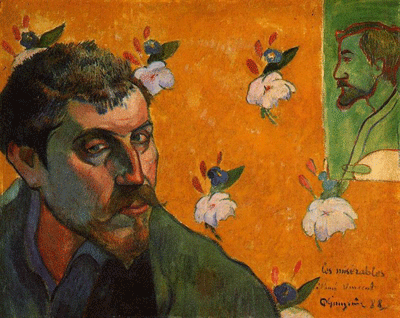
Paul Gauguin
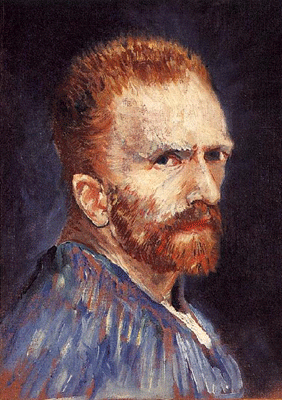
The most famous artist of the Post Impressionists is without doubt Vincent van Gogh. During his Dutch period van Gogh used dark colors, which was common in Holland (where he lived) at the time. While he visited his brother Theo, and art executive or agent of sorts, in Paris, he came into contact with the Impressionists. He was inspired by the methods of the Impressionist (especially the use of colors) and soon after he decided to move to the south of France, to Arles, where he roomed with Paul Gauguin. Gauguin influenced him to experiment with more vivid colors. Later on, possibly because of his wavering mental state, the stroke of his brush became more aggressive and the layers of paint became thicker. Because of the style of painting he used during the last period of his life and the energetically expression of his work, van Gogh is called the father of the Expressionism.
Return to Knowledge Main